| 1 | Selective Pallet Racking | Warehouses requiring direct access to many stock-keeping units (SKUs) | Low to medium | Very high; every pallet position is generally accessible | Approximately 500–5,000 lb (225–2,270 kg), depending on design | Flexible layout, easy inventory control, broad pallet compatibility | Uses more aisles and floor area than high-density systems |
| 2 | Drive-In Racking | Large quantities of the same product with low SKU variety | High | Low; pallets are stored in deep lanes | Approximately 1,500–4,000 lb (680–1,815 kg) | Strong floor-space utilization and efficient storage of uniform loads | Requires careful forklift operation; limited stock rotation and selectivity |
| 3 | Push-Back Racking | Multiple pallets per lane where higher density and faster access are both needed | Medium to high | Medium; normally operates on a last-in, first-out basis | Approximately 1,000–3,000 lb (455–1,360 kg) | Good density, fewer aisles, and faster loading than drive-in storage | Not ideal for strict first-in, first-out inventory rotation |
| 4 | Double-Deep Racking | Facilities seeking more density while retaining access to a reasonable range of SKUs | Medium to high | Medium; requires a reach truck or suitable double-deep equipment | Approximately 1,500–4,000 lb (680–1,815 kg) | Improves space utilization without fully sacrificing pallet access | May increase inventory handling and reduce selectivity for rear pallets |
| 5 | Pallet Flow Racking | Perishable goods or operations that require first-in, first-out rotation | High | High by lane; loading and picking occur from opposite sides | Approximately 1,000–3,000 lb (455–1,360 kg) | Supports FIFO rotation, organized replenishment, and reduced travel distance | Higher initial cost and greater maintenance requirements for rollers and brakes |
| 6 | Carton Flow Racking | Piece-picking operations with fast-moving cartons, totes, or cases | Medium to high | High; individual cartons are replenished from the rear | Approximately 100–750 lb (45–340 kg) per shelf or section | Improves picking speed, product presentation, and FIFO control | Needs correctly sized cartons and regular replenishment planning |
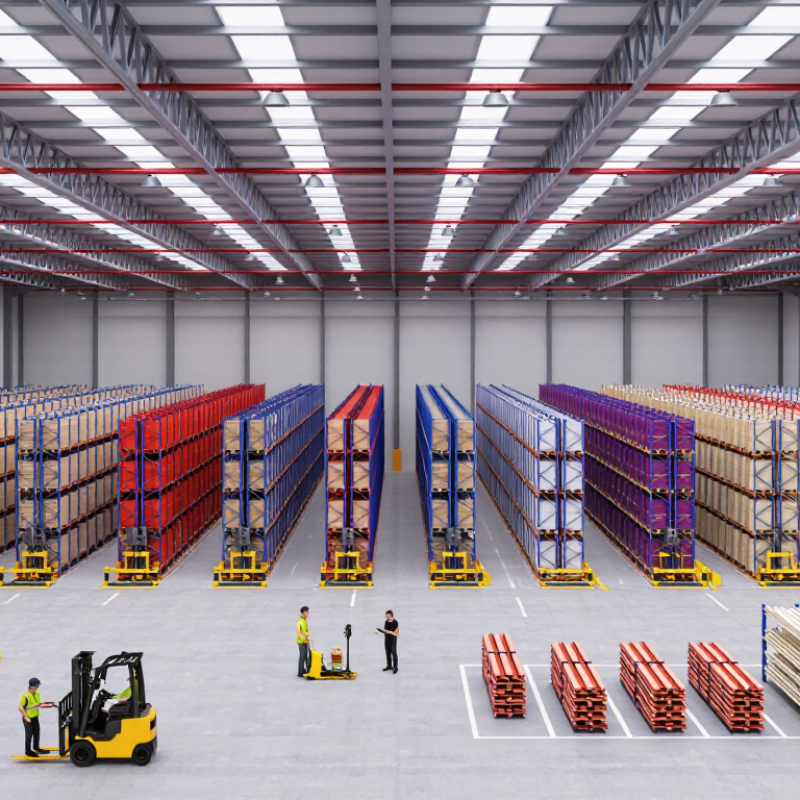
| 7 | Mobile Racking | Cold stores or space-constrained facilities where aisle space must be minimized | Very high | High, but usually only one or a small number of aisles are open at a time | Approximately 1,000–4,000 lb (455–1,815 kg) per pallet position | Can significantly reduce fixed aisle requirements and increase storage capacity | Higher installation cost, slower access, and need for floor and safety controls |
| 8 | Very Narrow Aisle (VNA) Racking | High-bay warehouses with large SKU ranges and high vertical space | High | Very high; most pallet positions remain directly accessible | Approximately 1,500–4,000 lb (680–1,815 kg) | Uses building height efficiently while maintaining strong pallet selectivity | Requires specialized trucks, precise floor tolerances, and operator training |
| 9 | Mezzanine or Multi-Tier Racking | Small-parts storage, order picking, and facilities with unused vertical clearance | High for small items | High for hand-picked inventory | Approximately 250–1,000 lb (115–455 kg) per shelf or bay, subject to engineering | Adds usable storage or work levels without expanding the building footprint | Requires structural review, access protection, stairs, and applicable permits |
| 10 | Cantilever Racking | Long, bulky, or irregular products such as timber, pipe, tubing, and panels | Medium for long products | High; open-front design provides direct access | Approximately 500–6,000 lb (225–2,720 kg) per arm, depending on configuration | Accommodates non-palletized loads and adjustable product lengths | Requires suitable load support, stability controls, and adequate handling clearance |