| Forehead Non-Contact Medical IR Thermometer | Detects infrared radiation from the forehead and estimates body temperature without skin contact. | Usually about 32–42.9 °C (89.6–109.2 °F) for body mode; device limits vary. | Forehead or temporal area. | Fast, hygienic, easy to use, and suitable for screening several people with minimal disturbance. | Readings can be affected by sweat, hair, headwear, cosmetics, direct sunlight, drafts, and acclimatization time. | Homes, schools, clinics, pharmacies, workplaces, travel settings, and markets requiring contact-free checks. | Medical-device registration, Celsius/Fahrenheit switching, adjustable emissivity or body-mode calibration, distance guidance, fever alarm, and multilingual instructions. |
| Tympanic Ear IR Thermometer | Measures infrared radiation from the tympanic membrane and surrounding ear canal. | Usually about 34–42.2 °C (93.2–108.0 °F) in body mode; device limits vary. | Ear canal, using the correct probe position. | Rapid response and generally good agreement with core temperature when correctly positioned. | Requires correct insertion and angle; earwax, small ear canals, ear coverings, and recent exposure to hot or cold conditions may affect results. | Hospitals, pediatric care, eldercare, and buyers prioritizing quick clinical measurements. | Disposable probe-cover availability, cleaning procedure, age-mode settings, fever thresholds, storage conditions, and local clinical compliance. |
| Temporal Artery Scanner | Scans infrared emissions over the temporal artery, commonly across the forehead toward the hairline. | Typically designed for approximately 34–42.2 °C (93.2–108.0 °F); model limits vary. | Temporal artery and forehead route. | Fast, low-contact operation and potentially more consistent than a single forehead spot when the scanning technique is correct. | Technique-sensitive; sweat, hair, head coverings, and incorrect scanning speed can reduce reliability. | Clinical facilities and professional caregivers needing efficient repeated measurements with limited cross-contact. | Clear scanning instructions, repeatability data, cleaning requirements, battery life, display readability, and training materials for different regions. |
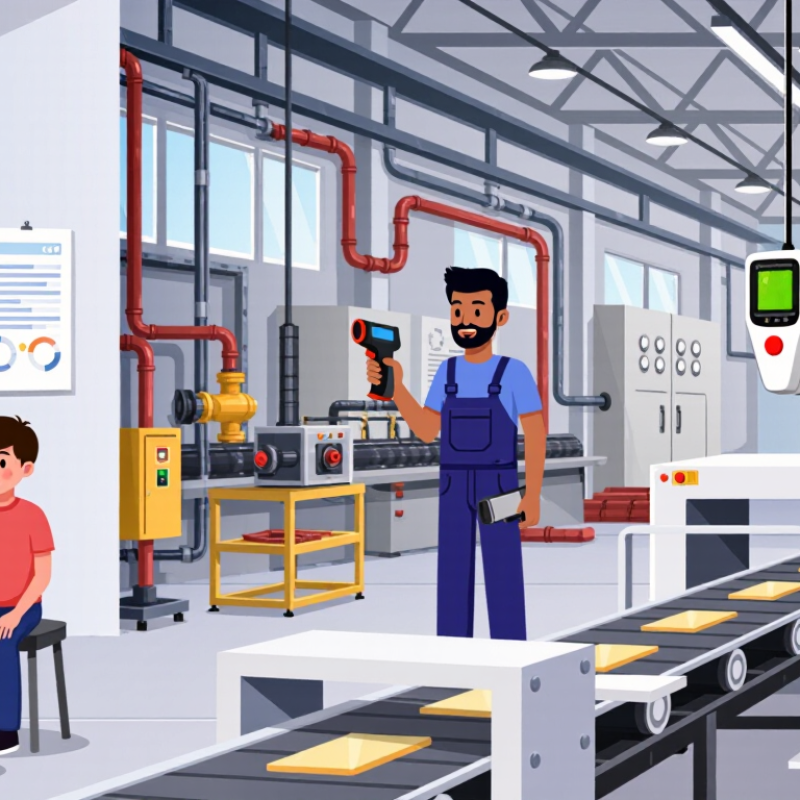
| Handheld Industrial IR Thermometer | Measures infrared radiation from a surface and converts it to an estimated surface temperature. | Common product ranges span approximately −50 to 550 °C (−58 to 1,022 °F); high-temperature models can extend higher. | Machinery, electrical panels, bearings, pipes, HVAC equipment, food surfaces, and other accessible targets. | Non-contact inspection, quick troubleshooting, broad temperature coverage, and portability. | Measures surface rather than internal temperature; reflective or shiny materials, steam, dust, distance, and incorrect emissivity settings can cause errors. | Maintenance teams, factories, building services, food operations, laboratories, and field technicians. | Distance-to-spot ratio, adjustable emissivity, response time, calibration certificate, environmental rating, laser safety class, and data logging. |
| Fixed-Mount Industrial IR Sensor | Continuously detects infrared radiation from a defined target area and outputs a temperature signal for monitoring or control. | Often selected from ranges such as −20 to 500 °C (−4 to 932 °F); specialized models cover wider ranges. | Moving production lines, ovens, kilns, conveyors, electrical assets, and process equipment. | Continuous measurement, automation compatibility, reduced manual inspection, and alarm or control integration. | Requires correct installation, stable alignment, suitable target visibility, power, and protection from the operating environment. | Manufacturers seeking process control, predictive maintenance, quality monitoring, and reduced production downtime. | Analog or digital output, industrial communication protocol, mounting accessories, ingress protection, calibration interval, response time, and integration support. |
| Infrared Thermal Imaging Camera | Uses an infrared detector array to create a thermal image and display temperature patterns across multiple points. | Many general-purpose units cover roughly −20 to 550 °C (−4 to 1,022 °F); specialized cameras may differ. | Large areas, electrical systems, buildings, mechanical assemblies, solar equipment, and concealed heat patterns. | Shows temperature distribution, identifies hotspots, supports documentation, and measures multiple areas at once. | Higher purchase cost, larger data volume, lower measurement certainty on reflective surfaces, and a learning curve for image interpretation. | Energy auditors, electrical inspectors, maintenance contractors, construction teams, and advanced industrial users. | Detector resolution, thermal sensitivity, visual camera, focus method, image storage, software compatibility, emissivity controls, and calibration traceability. |
| Food-Safety IR Thermometer | Measures infrared radiation from food or packaging surfaces without direct contact. | Commonly about −50 to 300 °C (−58 to 572 °F), depending on the product design. | Food surfaces, refrigerated displays, storage areas, cooking equipment, and receiving inspections. | Fast hygiene checks, useful for sealed packages and moving goods, and easy to clean when designed for food environments. | Surface readings do not confirm the internal temperature of food; packaging, condensation, steam, and reflective surfaces may affect results. | Restaurants, catering operations, supermarkets, cold-chain logistics, food processors, and hospitality businesses. | Food-contact material requirements, waterproof or washdown rating, HACCP-compatible procedures, calibration checks, probe compatibility, and temperature logging. |
| Medical IR Thermometer with Contact Probe Option | Combines infrared body-temperature measurement with a separate contact probe for oral, axillary, or other supported measurements. | Body-temperature mode is commonly around 32–42.9 °C (89.6–109.2 °F); contact-probe ranges vary by design. | Forehead or supported contact sites, depending on the selected mode. | Provides operational flexibility when non-contact readings need confirmation or when different patient groups require different methods. | More complex cleaning, training, storage, and workflow requirements than a single-mode thermometer. | Clinics, mobile medical teams, care facilities, pharmacies, and buyers serving mixed-use healthcare environments. | Mode-specific accuracy documentation, probe hygiene, disposable covers, alarm settings, battery replacement, regulatory approval, and recordkeeping functions. |