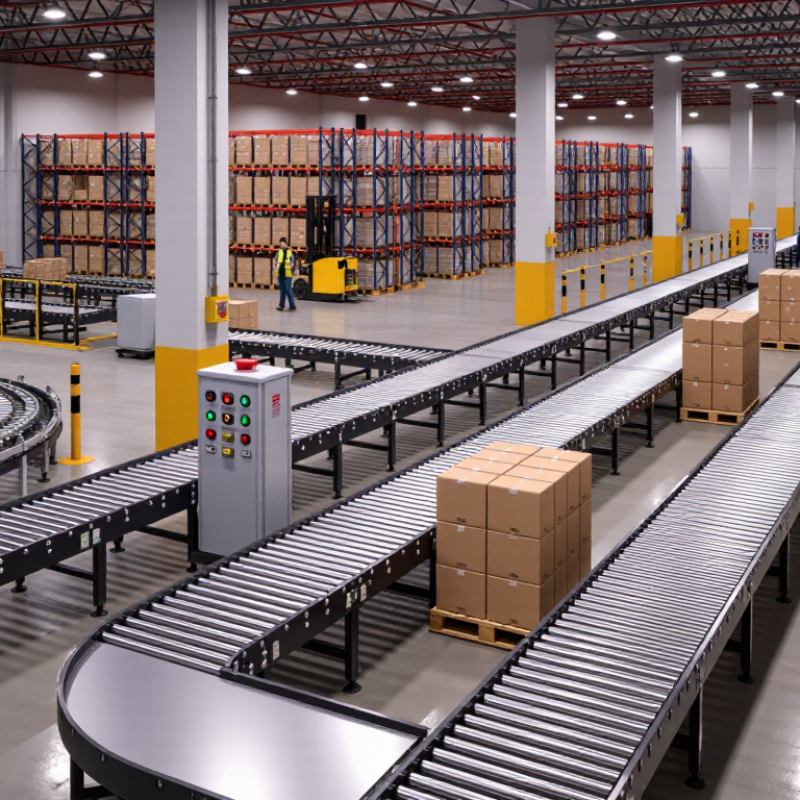
| Chain-Driven Roller Conveyor | Up to approximately 1,500 kg per pallet, depending on frame, roller, and drive selection. | Typically 6–18 m/min for controlled pallet handling. | Approximately 800–1,400 mm, with the conveyor sized to support the pallet over multiple rollers. | Rigid, flat-bottom pallets with reasonably consistent dimensions. | - Positive drive for heavy loads.
- Suitable for accumulation, transfers, and pallet flow lines.
- Handles moderate dirt and industrial operating conditions.
| - Specify roller pitch so the pallet is supported by at least three rollers.
- Check chain access, lubrication, guarding, and noise requirements.
- Use load-rated transfers where pallet direction changes.
|
| Gravity Roller Conveyor | Commonly 250–1,000 kg per pallet when the frame and rollers are correctly rated. | Non-powered; pallet movement depends on slope, load, and operator control. | Approximately 800–1,400 mm. | Stable, flat-bottom pallets used for short-distance staging or manual movement. | - Low purchase and operating cost.
- No motor, controls, or electrical power required.
- Simple construction with relatively easy maintenance.
| - Requires controlled gradients and mechanical end stops.
- Not ideal for automatic accumulation or long conveying distances.
- Verify pallet underside condition to prevent snagging.
|
| Belt-Driven Roller Conveyor | Typically 300–1,000 kg per pallet, subject to belt capacity and roller configuration. | Approximately 5–20 m/min. | Approximately 800–1,300 mm. | Flat-bottom pallets requiring smooth, relatively quiet conveying. | - Quiet operation compared with many chain-driven designs.
- Good for controlled starts, stops, and accumulation zones.
- Provides consistent roller rotation across the conveyor width.
| - Protect belts from oil, sharp debris, and excessive heat.
- Confirm belt tensioning and replacement access.
- Check whether the required load creates belt slip during acceleration.
|
| Motorized Roller Conveyor | Commonly 300–1,500 kg per pallet, depending on the number and rating of powered rollers. | Approximately 5–30 m/min, with variable-speed control available. | Approximately 800–1,400 mm. | Standardized pallets in automated warehouses, production, and distribution systems. | - Flexible zoning and precise pallet positioning.
- Efficient for accumulation because only occupied zones may run.
- Supports sensors, programmable controls, and system integration.
| - Evaluate motor protection, control architecture, and spare parts.
- Confirm stopping accuracy for robots, lifts, and palletizers.
- Provide safe access for sensors, drives, and electrical panels.
|
| Double- or Triple-Strand Chain Conveyor | Often selected for approximately 500–2,000 kg per pallet when the load is supported by suitable runners. | Typically 4–15 m/min. | Approximately 900–1,400 mm overall, depending on strand spacing. | Stringer pallets, block pallets with compatible support surfaces, and rigid industrial pallets. | - Good traction and strong positive movement.
- Works well for pallet transfer, indexing, and heavy-duty lines.
- Less sensitive to some pallet underside gaps than roller systems.
| - Match strand spacing to pallet runners and load distribution.
- Inspect chain wear, sprockets, lubrication, and guarding.
- Confirm pallet stability during stopping and transverse transfer.
|
| Turntable or Transfer Car | Commonly 500–2,000 kg per pallet, based on platform structure and drive capacity. | Transfer travel commonly 5–20 m/min; rotation is usually controlled at a slower rate. | Platform dimensions are commonly around 1,000–1,500 mm square. | Rigid pallets that need a 90-degree, 180-degree, or multi-directional route change. | - Reduces the need for long conveyor bends.
- Enables compact layouts and multiple line connections.
- Can combine roller or chain transport with positioning functions.
| - Check floor flatness, rail alignment, stopping accuracy, and safety zones.
- Allow sufficient clearance for pallet overhang and load movement.
- Integrate interlocks to prevent movement when personnel are present.
|
| Lift Table or Vertical Pallet Conveyor | Typically 500–2,000 kg per pallet, depending on lift height and duty cycle. | Usually 3–10 m/min vertical travel for controlled pallet movement. | Platform widths commonly range from 1,000–1,500 mm. | Rigid pallets in multi-level warehouses, production areas, and mezzanine systems. | - Moves pallets between floors without using a long ramp.
- Can connect multiple conveyor elevations.
- Suitable for repeated, programmed vertical transfers.
| - Verify lift height, cycle rate, platform capacity, and load center.
- Require gates, guarding, anti-drop protection, and emergency stops.
- Coordinate upper- and lower-level conveyor controls carefully.
|
| Pallet Accumulation Conveyor | Commonly 500–1,500 kg per pallet, with capacity calculated for the entire accumulation zone. | Typically 5–20 m/min, with zero-pressure or minimum-pressure control available. | Approximately 900–1,400 mm. | Standardized pallets requiring temporary buffering between process steps. | - Buffers production or shipping variability.
- Can reduce product contact when zero-pressure accumulation is used.
- Supports sensors, zone controls, and automated release logic.
| - Define accumulation length, pallet spacing, and release sequence.
- Confirm that controls prevent pallet collisions and back pressure.
- Account for pallet quality, load stability, and sensor contamination.
|
| Washdown or Corrosion-Resistant Conveyor | Often 300–1,500 kg per pallet, depending on construction and operating environment. | Approximately 3–15 m/min for controlled handling in wet or hygienic areas. | Approximately 800–1,400 mm. | Plastic pallets, stainless-compatible pallets, and loads used in wet-processing areas. | - Designed for frequent cleaning and exposure to moisture.
- Can use sealed components and corrosion-resistant structural materials.
- Helps support hygiene and contamination-control procedures.
| - Specify material compatibility with cleaning chemicals and temperatures.
- Check drainage, weld quality, seals, and ingress protection ratings.
- Do not assume a corrosion-resistant frame makes every component washdown-rated.
|
| Modular Pallet Conveyor Line | Commonly engineered for 500–1,500 kg per pallet, with each module individually load-rated. | Typically 5–25 m/min, depending on process requirements. | Approximately 800–1,400 mm, with custom widths available for special pallets. | Mixed pallet sizes when the system includes adjustable guides and suitable transfers. | - Combines straight conveyors, curves, transfers, lifts, and accumulation.
- Allows staged installation and future expansion.
- Supports integrated sensors, controls, and warehouse software.
| - Define the complete pallet envelope, including load overhang.
- Review interfaces between modules, controls, and safety circuits.
- Request documented throughput, duty cycle, and maintenance requirements.
|