| Core construction | Rigid mineral-filled polymer core, commonly combined with a decorative film, transparent wear layer, and balancing or attached underlayment layer. | Provides a firm, dimensionally stable alternative to many flexible vinyl products while retaining a relatively thin floor profile. | The subfloor still needs to be sound, clean, dry, and sufficiently level; a rigid core does not eliminate subfloor preparation. |
| Common total thickness | Approximately 4–8 mm, including the core, surface layers, and any attached pad. | Useful for renovations where door clearance and transitions are limited. | Confirm the complete installed height rather than judging only the nominal core thickness. |
| Wear-layer options | Common commercial options include 0.30 mm, 0.50 mm, and 0.70 mm transparent wear layers. | A thicker wear layer generally offers more reserve against abrasion, but it does not by itself determine the full product quality. | Select around 0.30 mm for lighter residential use, around 0.50 mm for heavier residential use, and around 0.70 mm where higher traffic is expected, subject to the product rating. |
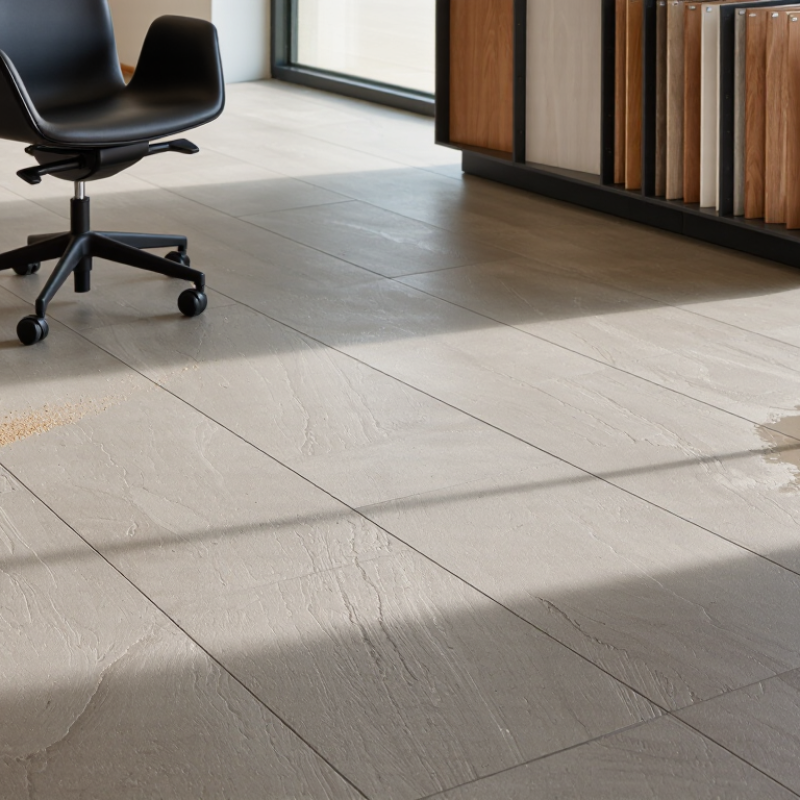
| Surface finish | Printed stone or wood appearance with a polyurethane or comparable protective finish; embossed textures may be available. | Texture can improve visual realism and reduce the appearance of minor marks, while smoother surfaces are usually easier to clean. | Use non-abrasive cleaners and avoid abrasive powders, steel wool, and harsh solvents. |
| Water resistance | The plank or tile body is generally highly resistant to water because the core is polymer-based and non-absorbent compared with wood-based flooring. | Suitable for kitchens, entrance areas, and many bathrooms when the complete floor system is approved for those locations. | Water can still damage the subfloor or enter through perimeter gaps and joints. Do not treat click flooring as a waterproofing membrane. |
| Installation method | Floating click-lock installation is common; glue-down formats are also available for selected applications. | Floating installation can shorten project time and simplify future plank replacement. | Follow the product’s locking direction, stagger requirements, cutting method, and expansion-gap instructions. Do not fasten a floating floor to the subfloor. |
| Subfloor flatness | The permitted variation is product-specific; many installation instructions use a limit of about 5 mm over 3 m as a reference. | A flat base reduces joint stress, hollow sounds, movement, and premature click-system failure. | Measure with a straightedge and repair high or low areas before installation. Always use the stricter requirement in the project documentation. |
| Acclimation before installation | Many products require storage and acclimation in the installation area for about 24–48 hours, but requirements vary. | Allows the flooring and room conditions to approach the intended installation environment. | Keep cartons flat, protected from moisture, and away from direct sunlight. Use the supplied installation guide for the exact period and temperature. |
| Expansion allowance | A perimeter gap is normally required for floating floors; a commonly specified range is approximately 6–10 mm, depending on product and room size. | Allows movement caused by temperature changes and helps prevent buckling or locked joints. | Maintain gaps at walls, columns, thresholds, and fixed cabinets where instructed. Use transition profiles for large or irregular areas when required. |
| Hot-climate compatibility | Generally suitable for conditioned indoor spaces, but direct solar heating can raise the floor surface far above room temperature. | Important for tropical, desert, and high-sunlight regions where heat concentration can stress joints and finishes. | Use curtains or solar control near large windows, avoid unapproved outdoor or unconditioned installations, and verify the product’s maximum surface-temperature limit. |
| Cold-climate compatibility | Suitable for many heated interiors; unheated rooms and rapid temperature swings require additional care. | Useful for homes, offices, and retail areas in temperate or cold regions when indoor conditions remain within the product range. | Do not install over a cold, damp slab without moisture assessment. Keep the building weather-tight and follow radiant-heating limitations. |
| Radiant floor heating | Some SPC products are compatible with hydronic or electric radiant systems; compatibility is not universal. | Can improve comfort in cold climates without radiators occupying wall space. | Confirm approval before purchase. Many systems limit floor surface temperature to approximately 27°C; never exceed the stated limit. |
| Humidity and moisture | The composite core has low moisture absorption, but the building envelope and subfloor remain critical. | Well suited to humid regions when condensation, slab moisture, and drainage are controlled. | Test concrete moisture according to local standards, correct leaks and condensation, and leave the required perimeter clearance. |
| Routine maintenance | Regular dry removal of dust and grit followed by damp cleaning with a neutral floor cleaner. | Grit is a major source of surface scratching and premature wear in high-traffic areas. | Use a soft broom, vacuum suitable for hard floors, or microfiber mop. Remove spills promptly and avoid flooding the floor. |
| Furniture and traffic protection | Resilient surface, but concentrated loads, sharp casters, and dragging can cause dents or scratches. | Relevant for offices, hospitality spaces, kitchens, and homes with heavy furniture. | Use felt pads, wide load-distribution cups, and hard-floor chair casters. Lift furniture instead of dragging it. |
| Best application profile | Indoor residential and many light-to-heavy commercial applications, subject to the product’s use classification and fire requirements. | Balances water resistance, installation speed, appearance, and relatively low routine maintenance. | For healthcare, hospitality, public buildings, or escape routes, verify local fire, slip-resistance, acoustic, and accessibility requirements. |
| Global purchasing checklist | Request technical data for thickness, wear layer, dimensions, locking system, underlayment, fire classification, slip resistance, emissions, and packaging. | Comparable documentation is more reliable than appearance or marketing terms alone. | Check local building codes, climate conditions, warranty exclusions, replacement availability, installation instructions, and the required spare quantity before ordering. |