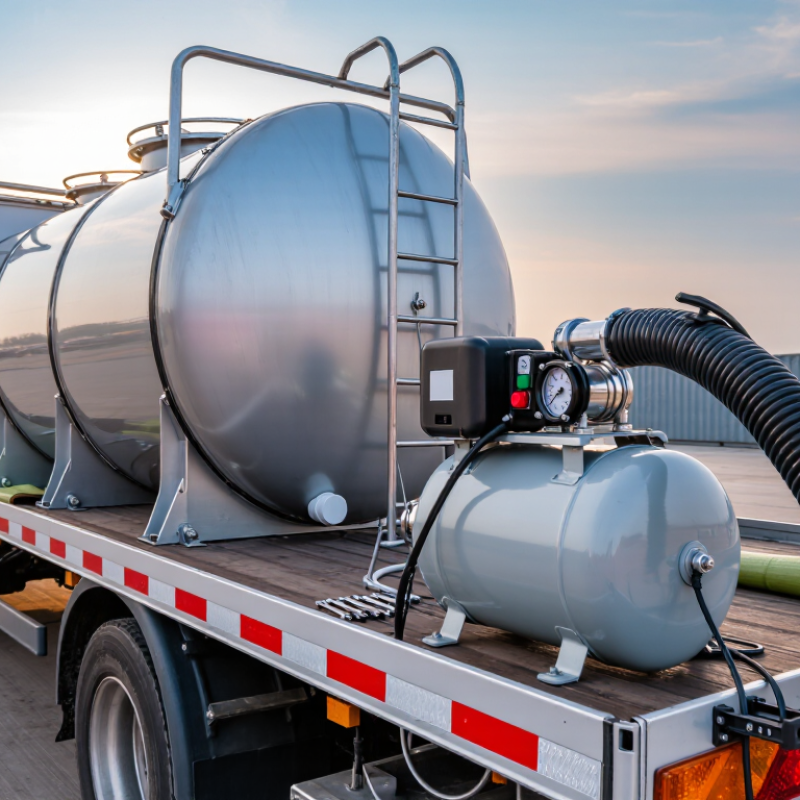
| Transfer Tank | Primary purpose | Temporary or mobile storage and controlled fluid transfer | Fuel handling, water supply, lubricants, agricultural liquids, and industrial fluids | Choose a tank according to the fluid, required storage volume, transportation method, local regulations, and available installation space. |
| Tank Type | Portable auxiliary tank | Approximately 75–500 gallons | Service vehicles, mobile generators, construction equipment, and field maintenance | Suitable when additional fuel or fluid capacity is needed without installing a permanent storage system. Confirm vehicle payload and mounting requirements. |
| Tank Type | Intermediate bulk container | Commonly about 275–330 gallons | Water, non-hazardous chemicals, detergents, and bulk liquid distribution | Select a compatible cage, pallet base, valve arrangement, and material rating. Verify that the container is approved for the intended liquid. |
| Tank Type | Stationary day tank | Approximately 50–1,000 gallons | Backup generators, boiler systems, heating equipment, and process systems | Use when equipment needs a nearby supply reservoir. Include level monitoring, overfill protection, ventilation, secondary containment, and emergency shutoff provisions. |
| Tank Type | Double-wall tank | Inner tank plus secondary containment chamber | Fuel, oils, and regulated liquids where spill control is important | A double-wall design can reduce spill risk, but it does not replace required inspection, leak detection, grounding, or regulatory compliance measures. |
| Tank Material | Carbon steel | Common for diesel, fuel oil, and many industrial liquids | Heavy-duty mobile tanks, generator fuel systems, and industrial storage | Provides good mechanical strength. Use suitable coatings or corrosion protection when exposed to moisture, chemicals, or outdoor conditions. |
| Tank Material | High-density polyethylene | Lightweight, corrosion-resistant construction | Water, fertilizers, cleaning solutions, and selected non-corrosive or corrosive liquids | Confirm chemical compatibility, ultraviolet resistance, temperature limits, and structural support before use. |
| Tank Material | Stainless steel | Common grades include 304 and 316, depending on fluid compatibility | Food-related liquids, chemicals, washdown environments, and corrosive service | Select the stainless-steel grade, weld finish, gasket material, and fittings based on the fluid and required sanitation or corrosion resistance. |
| Tank Design | Capacity | Approximately 25–1,000+ gallons for common transfer systems | Small equipment refueling through industrial liquid distribution | Size the tank for the required operating time while allowing free space for thermal expansion and avoiding unnecessary transport weight. |
| Tank Design | Baffles | Internal partitions that reduce liquid movement | Vehicle-mounted and trailer-mounted tanks | Baffles improve stability by limiting surge during acceleration, braking, and turning. They are especially important for partially filled mobile tanks. |
| Tank Design | Connections | Fill port, vent, outlet, drain, gauge, and pump connection | All transfer tank configurations | Check thread type, connection size, hose routing, access clearance, and whether the fittings are compatible with the fluid and pump. |
| Pump Type | Diaphragm pump | Typical flow: about 5–30 gallons per minute | Water, chemicals, agricultural liquids, and fluids containing small particles | Useful for self-priming and intermittent service. Select diaphragm, valve, and seal materials for the specific chemical and temperature range. |
| Pump Type | Centrifugal pump | Typical flow: about 10–100+ gallons per minute | Water transfer, irrigation, cooling water, and low-viscosity liquids | Best for relatively clean, low-viscosity fluids and continuous flow. Confirm that the pump has adequate suction conditions and is suitable for the required lift. |
| Pump Type | Positive-displacement pump | Typical flow: about 1–60 gallons per minute | Diesel, lubricants, viscous liquids, and applications requiring metered delivery | Provides consistent volume per cycle but may require a relief valve. Check viscosity, maximum pressure, pulsation, and operating speed. |
| Pump Type | Vane pump | Typical flow: about 10–30 gallons per minute | Diesel and other relatively clean petroleum-based fluids | Choose a vane material and pump rating suitable for the fluid. Use filtration to reduce wear caused by dirt or water contamination. |
| Pump Drive | 12-volt or 24-volt electric pump | Common for mobile systems; often about 10–30 gallons per minute | Service trucks, agricultural equipment, generators, and emergency transfer systems | Match voltage, current draw, fuse size, cable length, battery capacity, duty cycle, and ignition-protection requirements where applicable. |
| Pump Drive | AC electric pump | Common motor supplies include 120 V or 230 V AC | Workshops, fixed tanks, industrial facilities, and maintenance areas | Confirm power availability, motor enclosure, hazardous-location requirements, duty cycle, and the need for a local disconnect or emergency stop. |
| Pump Drive | Manual hand pump | Typically about 0.1–10 gallons per minute, depending on design and operator effort | Small tanks, remote locations, low-frequency dispensing, and backup operation | A practical option where electricity is unavailable. Consider operator effort, delivery height, fluid viscosity, and required transfer time. |
| Pump Performance | Flow rate | Common transfer range: approximately 5–60 gallons per minute | Refueling, process supply, irrigation, and equipment filling | Choose flow based on acceptable filling time and receiving equipment limits. A higher flow rate is not always better if it causes splashing, foaming, or overfill risk. |
| Pump Performance | Pressure or head | Often about 10–60 psi for general transfer service | Long hoses, elevated outlets, spray systems, and pressurized delivery | Calculate static lift, hose friction, fittings, filters, and outlet pressure together. Select a pump that meets the required duty point rather than relying only on maximum pressure. |
| Fluid Compatibility | Fuel and petroleum liquids | Requires fuel-compatible tank, hose, seals, filter, and pump materials | Diesel, kerosene, fuel oil, and selected gasoline applications | Verify flammability classification, grounding and bonding, ventilation, anti-static precautions, spill containment, and applicable storage regulations. |
| Fluid Compatibility | Water and water-based liquids | Material selection depends on potable, clean, wastewater, or chemical content | Drinking water, irrigation, dust suppression, washdown, and process water | For potable water, use components certified for drinking-water contact. For wastewater or abrasive fluids, consider solids handling, corrosion resistance, and cleanout access. |
| Safety Feature | Overfill protection | Level gauge, automatic shutoff, high-level alarm, or fill limiter | Fuel storage, chemical handling, and unattended filling | Use a control method appropriate to the tank and fluid. Do not depend on a visual gauge alone when overfilling could create a safety or environmental hazard. |
| Safety Feature | Filtration | Coarse strainer or fine filter selected by fluid and equipment requirements | Fuel transfer, hydraulic oil, lubrication, and process liquid systems | Install filtration where contamination can damage the receiving equipment. Check micron rating, pressure drop, water separation, and replacement access. |
| Safety Feature | Secondary containment | Integral double wall or external containment system | Outdoor storage, regulated liquids, and spill-sensitive locations | Determine the required containment volume from local regulations and site risk. Inspect containment areas for leaks, rainwater accumulation, and damage. |
| Installation | Mounting and load capacity | Must support the tank, fluid weight, vibration, and dynamic loads | Truck beds, trailers, skids, platforms, and fixed foundations | Estimate full operating weight, verify the supporting structure, use suitable restraints, and account for braking and cornering forces on mobile installations. |
| Maintenance | Inspection schedule | Inspect before use; perform periodic checks based on service conditions | All tanks and pumps, especially mobile or outdoor equipment | Check tank seams, fittings, hoses, grounding, vents, filters, pump seals, wiring, gauges, leaks, corrosion, and signs of mechanical damage. |