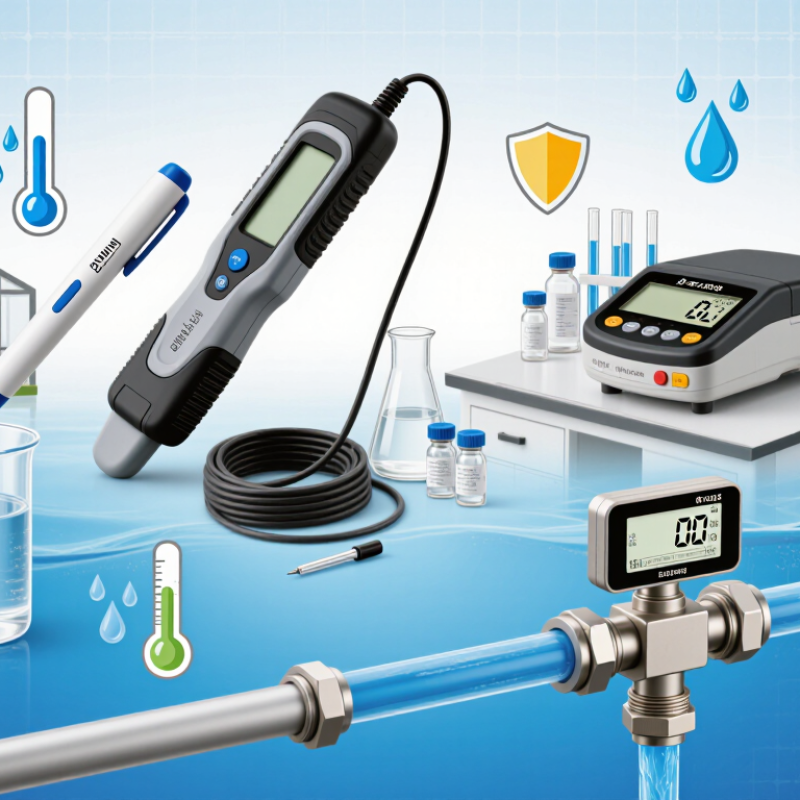
| Pocket Pen EC Meter | 0–20 mS/cm | Typically ±2% of full scale | Hydroponic nutrient solution, irrigation water, aquarium and general water checks | Direct immersion in a clean liquid sample; allow the reading to stabilize | Low cost, portable, quick to use and convenient for routine checks | Small electrode area can be affected by bubbles, contamination and highly concentrated solutions; usually less suitable for very low-conductivity water | Use an appropriate conductivity standard, commonly 1.413 mS/cm; rinse with clean water after use and keep the probe hydrated when required by the electrode design |
| Portable Handheld EC Meter | 0–200 mS/cm | Typically ±1% of reading or ±1 digit | Greenhouse nutrient tanks, irrigation systems, wastewater screening and field water testing | Immersion probe or flow-through cup; suitable for repeated field measurements | Wider range, stronger temperature compensation options and better readability than basic pens | More expensive than pen meters; accuracy depends on probe condition, sample temperature and correct calibration | Perform one- or two-point calibration according to the working range; inspect the cable and probe regularly and avoid storing the sensor dry if it uses a conductivity cell that requires hydration |
| Inline or In-Tank EC Controller | 0–20 or 0–200 mS/cm | Typically ±1–2% of full scale | Continuous monitoring of hydroponic reservoirs, fertigation lines, recirculating water and process tanks | Installed in a continuously mixed tank, bypass loop or flow cell | Real-time monitoring, alarm functions and potential integration with dosing or irrigation controls | Requires correct installation, stable flow or mixing and protection from solids, scale and air bubbles; more complex to commission | Calibrate after installation and whenever the probe is cleaned or replaced; clean deposits from the cell and verify the temperature sensor |
| Soil EC Probe | Approximately 0–20 dS/m | Often ±2–5% of reading, depending on soil texture and method | Field soil salinity mapping, greenhouse media, root-zone monitoring and crop management | Inserted at a consistent depth into moist soil or used with a prepared soil-water extract | Measures salinity near the root zone and supports spatial field comparisons | Results vary with moisture, bulk density, temperature, soil texture and probe contact; direct soil readings are method-dependent | Follow the manufacturer’s soil-specific procedure, maintain consistent moisture and depth, and compare results using the same extraction or in-situ method |
| Benchtop EC Meter | 0–200 mS/cm | Typically ±0.5–1% of reading | Laboratories, nutrient formulation, water-quality testing and quality-control work | Beaker or sample vessel with a dedicated conductivity cell; controlled sample temperature is preferred | High repeatability, stable display, advanced temperature compensation and data-recording options | Not designed for routine field use; requires a clean workspace, suitable sample vessels and careful electrode handling | Use traceable conductivity standards covering the expected range; rinse between samples, prevent cross-contamination and periodically verify calibration |
| Low-Conductivity Water Meter | Approximately 0–2,000 µS/cm | Typically ±1% of reading or better with a suitable cell | Drinking water screening, filtered water, condensate, rainwater and low-mineral process water | Use a clean vessel and a probe designed for low-conductivity measurements; avoid contact with conductive surfaces | More sensitive for low-ionic-strength water than general-purpose high-range meters | Readings can drift because of carbon dioxide absorption, contamination, unstable temperature and poor sample handling | Use a low-range standard, clean the cell carefully and allow the sample temperature to equilibrate before measurement |
| High-Range Industrial EC Meter | 0–1,000 mS/cm | Typically ±1–2% of full scale | Brine, seawater, concentrated process liquids, cooling systems and industrial wastewater | Use a compatible high-range cell in a sample vessel or engineered flow-through installation | Handles concentrated solutions that exceed the range of common hydroponic meters | Not optimized for ultrapure or very low-conductivity water; electrode fouling and temperature effects may be significant | Select the correct cell constant, calibrate with a suitable high-conductivity standard and clean the sensor to prevent scale or chemical buildup |