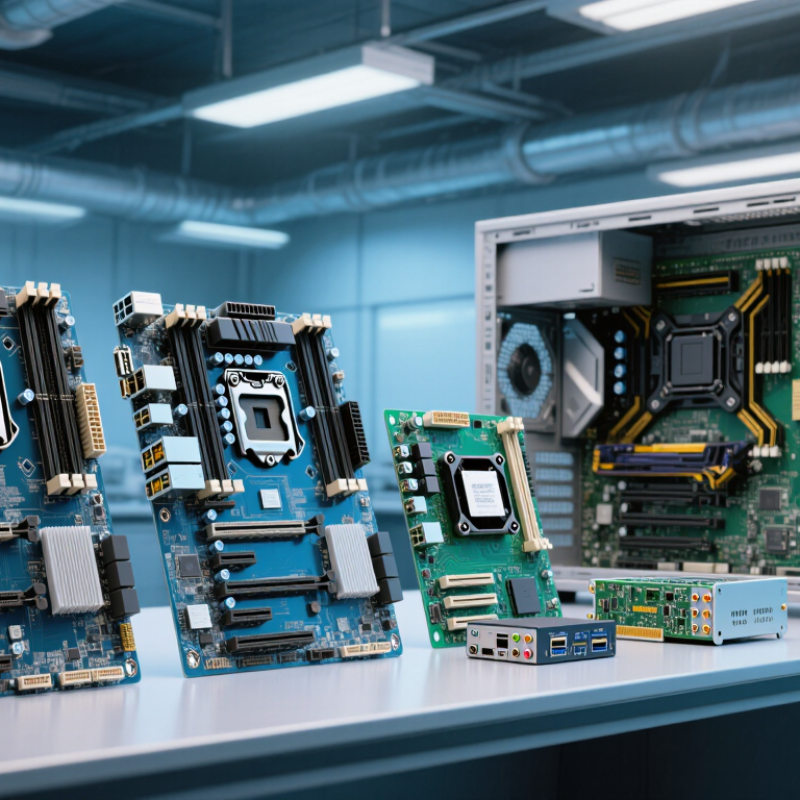
| ATX Industrial Motherboard | 305 × 244 mm | Up to seven expansion-slot positions in the ATX layout; commonly supports PCI Express, multiple SATA interfaces, USB, Ethernet, and industrial I/O options depending on the design. | Industrial automation, machine vision, factory control cabinets, digital signage, network appliances, and general-purpose industrial computers. | Large PCB area, broad expansion capability, easy component access, and wide availability of standard chassis and power supplies. | Larger enclosure requirement and usually higher power and cooling requirements than compact form factors. | Confirm exact slot arrangement, PCIe lane allocation, operating-temperature rating, 24-pin power compatibility, mounting-hole pattern, and chassis clearance. |
| MicroATX Industrial Motherboard | 244 × 244 mm | Up to four expansion-slot positions in the standard layout; normally provides PCI Express, SATA, USB, Ethernet, and display interfaces according to the model. | Compact automation controllers, industrial PCs, transportation systems, inspection equipment, and embedded server applications. | Balances expansion capability and enclosure size while retaining compatibility with many ATX-based system components. | Fewer expansion positions than ATX; slot spacing can be restrictive when using large add-in cards. | Check whether the selected chassis supports the board mounting points, whether adjacent slots remain usable, and whether the power supply provides sufficient continuous output. |
| Mini-ITX Industrial Motherboard | 170 × 170 mm | One standard expansion-slot position; frequently integrates dual Ethernet, serial ports, USB, display outputs, GPIO, storage interfaces, and optional wireless or cellular connectivity. | Edge computing, kiosks, compact controllers, robotics, in-vehicle systems, portable test equipment, and space-constrained automation devices. | Very small footprint, low power consumption potential, and straightforward integration into compact enclosures. | Limited expansion, reduced heat-spreader area, and less room for connectors or removable storage. | Verify processor thermal design power, heat-sink height, connector orientation, memory type, DC-input range, vibration resistance, and long-term availability. |
| 3.5-Inch Single-Board Computer | Approximately 146 × 102 mm | Usually relies on integrated I/O, board-to-board connectors, mini PCI Express, M.2, or other compact expansion interfaces rather than full-size PCIe slots. | Industrial gateways, HMI terminals, medical instruments, smart retail equipment, factory data collection, and embedded control systems. | Compact design, low power demand, integrated peripheral interfaces, and flexible mounting options. | Limited full-size expansion and often lower maximum memory or storage capacity than larger boards. | Check the exact board outline, mounting-hole coordinates, connector access, BIOS or firmware support, watchdog features, and availability of Linux or Windows drivers. |
| COM Express Computer-on-Module | Compact: 95 × 95 mm
Basic: 125 × 95 mm | Processor, chipset, memory, and high-speed interfaces are placed on a removable module; a separate carrier board provides application-specific I/O. | Modular industrial computers, medical devices, robotics, transportation electronics, machine vision, and products requiring processor scalability. | Enables processor upgrades without redesigning the complete carrier board and supports customized system I/O. | Requires a compatible carrier board, connector design, thermal solution, and careful high-speed signal layout. | Confirm COM Express pinout type, module revision, carrier-board compatibility, connector stack height, thermal design, BIOS support, and migration options for future processors. |
| PICMG 1.3 System Host Board | Approximately 338.58 × 126.39 mm | Designed for a passive backplane system; provides a host processor interface to PCI Express, PCI, and other backplane resources according to the implementation. | Industrial rack systems, factory automation, legacy PCI-based equipment, data acquisition, and multi-slot control systems. | Centralized backplane architecture, serviceable slot-based expansion, and suitability for systems requiring several plug-in modules. | Depends heavily on backplane design and may be less suitable for very compact or low-power products. | Validate the exact PICMG 1.3 backplane pinout, supported PCIe generation, slot bifurcation, processor cooling, rear I/O arrangement, and legacy-card compatibility. |
| 3U VPX Embedded Computing Board | 100 × 160 mm | Uses a rugged backplane architecture with high-speed serial fabric connections; commonly configured with PCI Express, Ethernet, or other application-specific fabrics. | Defense and aerospace systems, rugged transportation, radar processing, high-performance image processing, and mission-critical edge computing. | High mechanical ruggedness, strong signal integrity, high-speed backplane connectivity, and support for harsh environments. | Higher system cost, specialized chassis and backplane requirements, and greater integration complexity. | Check VPX profile and slot compatibility, backplane fabric topology, conduction- or air-cooling method, shock and vibration ratings, environmental qualification, and power budget. |
| 6U VPX Embedded Computing Board | 233.35 × 160 mm | Provides more board area and connector capacity than 3U VPX; supports complex processing, storage, I/O, and high-speed backplane configurations. | High-performance defense electronics, avionics, radar, electronic warfare, industrial simulation, and large-scale rugged computing platforms. | Greater processing, I/O, and power capacity for demanding embedded applications. | Large and costly system architecture with higher enclosure, power, and thermal-management requirements. | Confirm slot pitch, power-interface specification, cooling method, backplane topology, environmental compliance, system weight, and maintenance access. |
| Industrial SBC with Custom Backplane | Application-specific; commonly based on a defined Eurocard or custom PCB outline | Uses a dedicated backplane or carrier to expose selected PCIe, Ethernet, serial, digital I/O, storage, and synchronization interfaces. | Specialized inspection systems, telecommunications, transportation control, laboratory instruments, and long-life OEM equipment. | Highly optimized electrical, mechanical, and I/O design for a specific system architecture. | Higher non-recurring engineering cost and reduced interchangeability with off-the-shelf platforms. | Review mechanical drawings, connector mating cycles, signal-integrity requirements, firmware ownership, minimum order quantities, redesign charges, and spare-part policy. |