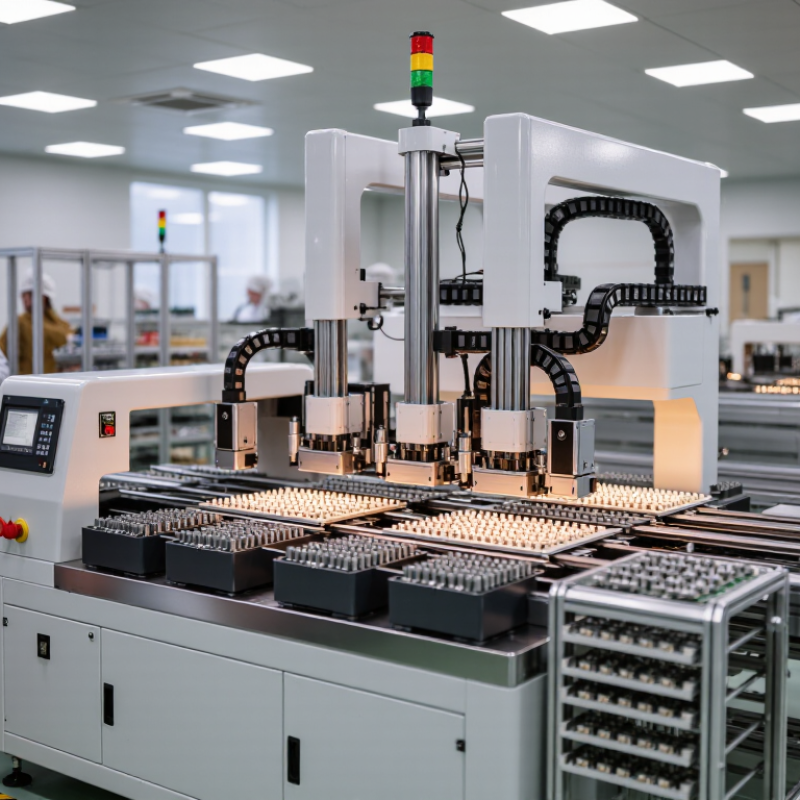
| SMT component placement machine | Vision-guided heads pick electronic components from feeders, correct their position and orientation, and place them onto solder-pasted printed circuit boards. | Programmable placement heads, component feeders, board handling, and camera-based alignment; some production lines use separate machines for different component ranges. | Printed circuit board assembly, including consumer electronics, automotive electronics, and industrial control boards. | Designed for repeatable placement of many small components and integration into automated electronics lines. | Check supported component sizes and package types, feeder capacity, board dimensions, changeover needs, and how published placement-rate figures are measured. |
| Cartesian or gantry pick-and-place system | One or more linear axes move a pickup tool along straight, orthogonal paths, commonly across a work surface or production line. | Typically uses X-Y motion, with an optional Z axis and rotary tool axis; the frame and travel can be configured for the work area. | Machine tending, packaging, palletizing, loading and unloading, and moving parts between fixed stations. | Straightforward motion planning and a work envelope that can be adapted to the application. | Confirm travel, payload at the required reach, frame rigidity, guarding, and whether the layout needs overhead access. |
| SCARA robot | A horizontal articulated arm moves in the X-Y plane, while a vertical axis performs pick-and-place motion; a rotary axis can orient the part. | Commonly uses two horizontal rotary joints, a vertical slide, and a wrist rotation axis. | Assembly, small-part handling, packaging, and loading or unloading machines where fast planar movement is useful. | Compact footprint and efficient movement between points within its working area. | Evaluate the reachable area, vertical stroke, payload, mounting position, and whether the required paths are mainly planar. |
| Delta parallel robot | Multiple lightweight arms connect to a moving platform and coordinate to move the end effector, often from an overhead-mounted base. | Parallel-link design with a compact moving platform; vision systems and conveyor tracking may be added for sorting tasks. | High-cycle sorting, food handling, pharmaceutical packaging, and picking lightweight products from conveyors. | Low moving mass supports rapid repetitive motion in suitable applications. | Check payload, pick area, product presentation, sanitation requirements, and the need for conveyor tracking or vision guidance. |
| Six-axis articulated robot | Six coordinated rotary joints position and orient a tool in three-dimensional space, allowing the robot to approach parts from multiple directions. | Floor-, wall-, or ceiling-mounted arm with a gripper, vacuum tool, or application-specific end effector. | Machine tending, case packing, assembly, handling irregular parts, and tasks requiring varied approach angles. | Flexible reach and tool orientation for complex paths and changing work-cell layouts. | Assess payload throughout the reach, cycle time for the actual path, work-cell access, safety measures, and programming requirements. |
| Collaborative robot pick-and-place cell | A force- and safety-monitored robot arm performs programmed handling tasks and may operate near people when the complete application is risk-assessed and appropriately safeguarded. | Robot arm with a gripper or vacuum tool, often mounted on a bench, stand, or mobile base; cameras and conveyors can be integrated. | Small-batch assembly, packaging, inspection handoff, and repetitive workstation tasks. | Can suit flexible production areas and frequent task changes, depending on the application and risk assessment. | Collaborative designation alone does not make a cell safe; assess the robot, tool, workpiece, speed, layout, and applicable safety requirements together. |
| Pneumatic pick-and-place unit | Air-powered cylinders extend, retract, or rotate a pickup tool between defined positions; gripping is commonly provided by a pneumatic gripper or vacuum circuit. | Fixed-stroke linear or rotary modules, often arranged as a simple two- or three-axis transfer unit. | Dedicated assembly fixtures, repetitive transfers, and simple loading or unloading stations. | Simple point-to-point motion can be suitable for a stable task with a limited number of positions. | Check compressed-air availability, stroke adjustment, end-position control, noise, and suitability for product or recipe changes. |