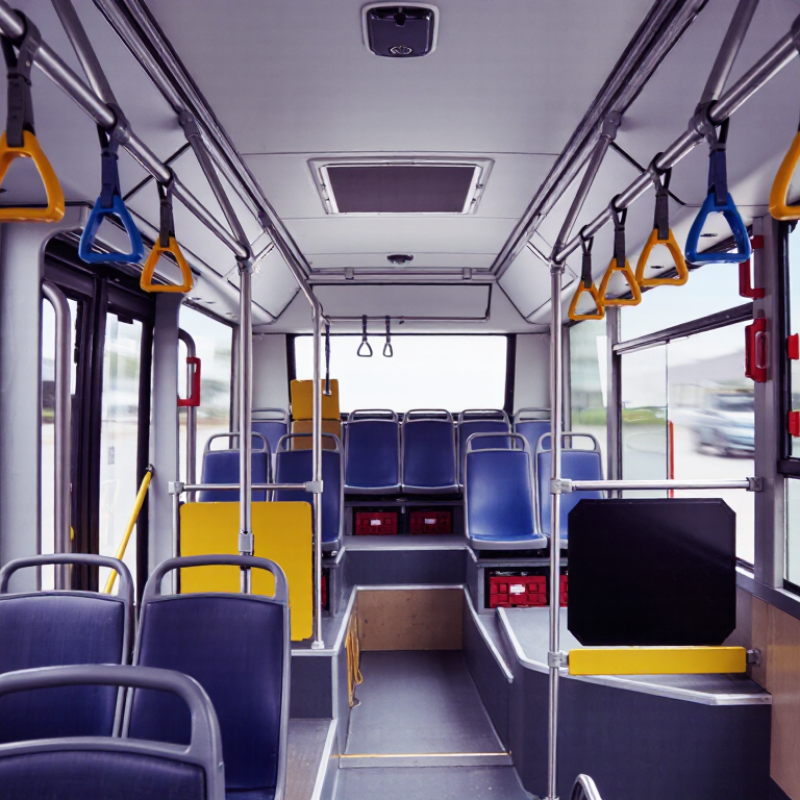
| Vertical Stanchion | From the vehicle floor to the ceiling or roof structure, especially near doors and standing areas. | Stainless steel Aluminum Powder-coated steel | Common tube outside diameter: approximately 25–38 mm.
Height is customized to the vehicle interior and mounting structure. | Provides stable support during acceleration, braking, and turning; supports high passenger loads; suitable for dense standing areas. | Must be firmly connected to reinforced floor and ceiling points. Avoid obstructing passenger circulation, emergency exits, or driver visibility. | City buses, articulated buses, airport shuttle buses, and high-capacity transit vehicles. |
| Horizontal Grab Rail | Along the ceiling, side wall, seat rows, and standing zones. | Stainless steel Aluminum Steel | Common tube outside diameter: approximately 25–38 mm.
Length and bend radius depend on the interior layout. | Offers continuous support for multiple passengers and can improve movement through the aisle. | Brackets must resist vibration and repeated loading. The rail should have a smooth, easy-to-clean surface without sharp edges. | Urban transit buses, commuter buses, school buses, and long-distance coaches. |
| Overhead Passenger Rail | Suspended from the ceiling above the aisle or standing passenger area. | Aluminum Stainless steel Composite components | Usually paired with hanging straps or loops.
Rail height is selected according to interior clearance and passenger reach. | Maximizes floor space, supports many passengers, and keeps the aisle relatively open. | Ceiling attachments must be structurally reinforced. The design should maintain adequate head clearance and allow simple inspection of straps and fittings. | High-floor city buses, articulated buses, rapid transit buses, and vehicles with large standing capacities. |
| Hanging Strap or Loop | Attached to an overhead rail for passengers who cannot comfortably reach a fixed rail. | Thermoplastic elastomer Polyester webbing Polyurethane Metal fitting | Loop size and hanging length vary by interior height and accessibility requirements. | Flexible, lightweight, and accessible to passengers of different heights; can reduce standing instability. | Materials should tolerate repeated pulling, cleaning chemicals, humidity, and temperature changes. Fasteners require regular inspection. | City buses, articulated buses, school transportation, and other vehicles with significant standing capacity. |
| Entrance and Exit Handrail | Beside stairways, door openings, and step wells. | Stainless steel Powder-coated steel Aluminum | Common tube outside diameter: approximately 25–38 mm.
Curved or angled sections are often used to follow the step geometry. | Helps passengers maintain balance while boarding or leaving and can improve safety in wet or crowded conditions. | Must provide continuous, unobstructed gripping areas and sufficient clearance from doors, steps, and adjacent panels. | City buses, coaches, school buses, low-floor buses, and accessible transit vehicles. |
| Priority Area Handrail | Near wheelchair spaces, mobility aid areas, priority seats, and accessible boarding zones. | Stainless steel Aluminum High-strength polymer fittings | Dimensions are coordinated with wheelchair clearances, seat geometry, and the vehicle accessibility layout. | Supports passengers with reduced mobility and helps improve stability during boarding, stopping, and turning. | Must not reduce wheelchair maneuvering space or interfere with restraint systems, ramps, lifts, or priority seating. | Low-floor city buses, paratransit vehicles, accessible coaches, and public transport vehicles designed for inclusive mobility. |
| Seat-Adjacent Handhold | Mounted to seat frames, seat partitions, or side panels near passenger seating. | Aluminum Stainless steel Glass-fiber-reinforced polymer | Compact grip sections are shaped around seat pitch, aisle width, and passenger clearance requirements. | Provides a convenient grip when standing up, sitting down, or moving beside a seat. | The grip should not create a snagging hazard or reduce legroom. Seat-frame connections need to withstand repeated passenger loading. | Coaches, commuter buses, school buses, and urban buses with mixed seating and standing areas. |
| Partition-Mounted Handrail | Installed on glass, composite, or metal partitions near doors, stairs, and seat groups. | Stainless steel Aluminum Reinforced polymer | Straight, curved, or offset profiles are selected to match partition thickness and passenger clearance. | Uses existing interior partitions and can combine passenger guidance with interior space management. | Mounting points must be reinforced. Transparent partitions require careful load distribution to prevent cracking or excessive flexing. | Transit buses, airport buses, premium coaches, and vehicles with separated entrance or seating zones. |
| Fold-Down or Swing-Away Rail | Near priority seats, wheelchair spaces, or areas requiring occasional access clearance. | Stainless steel Aluminum Engineering polymer joints | Geometry is customized to provide a usable grip while maintaining the required clear passage when folded or moved. | Balances passenger support with flexible space management in multifunctional interior zones. | Hinges, locks, and stops must be durable and easy to operate. The rail must not swing unexpectedly during vehicle movement. | Accessible buses, demand-responsive vehicles, shuttle buses, and vehicles with convertible interior layouts. |
| Anti-Microbial or Soft-Touch Handrail | Frequently touched areas such as entrance rails, vertical poles, and priority zones. | Textured polymer Elastomer sleeve Coated metal | Core dimensions generally follow the supporting rail; surface thickness and texture depend on the grip system. | Can improve tactile comfort, grip confidence, and perceived cleanliness when paired with a validated surface treatment. | Antimicrobial claims should be supported by appropriate test evidence. The surface must remain resistant to abrasion, cleaning agents, and color fading. | Urban buses, healthcare shuttle buses, school transportation, and high-frequency public transit fleets. |