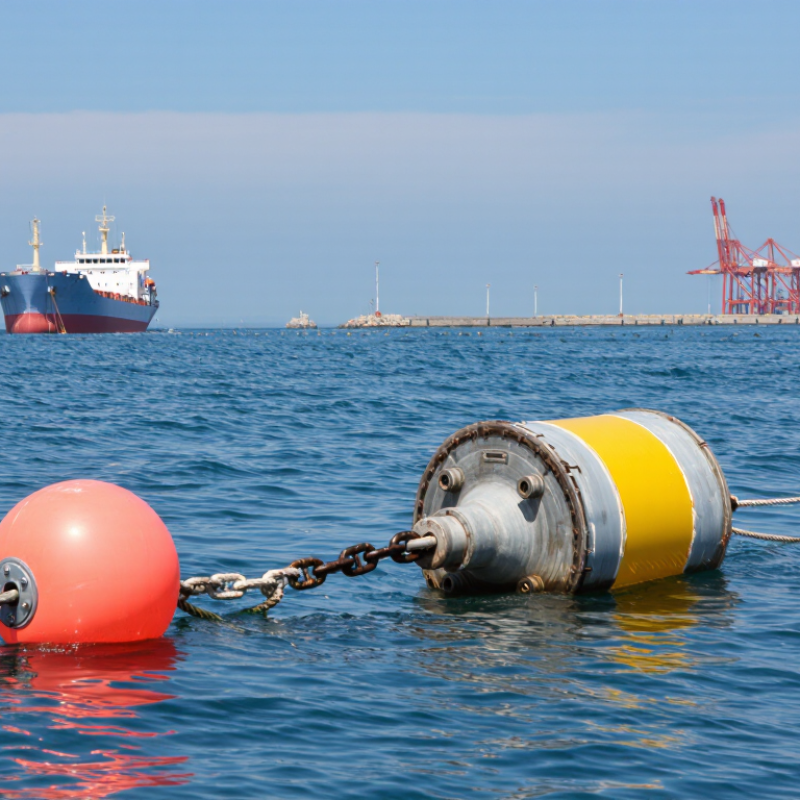
| Common foam-filled buoy configurations |
| Cylindrical mooring buoy | Upright or near-upright body, commonly with a central or through-body attachment arrangement. Dimensions and reserve buoyancy vary by design. | General-purpose moorings where a visible, accessible buoy body is needed. | Body diameter and height, attachment layout, freeboard under load, and whether the buoy can accommodate the specified mooring hardware. |
| Spherical or elliptical buoy | Rounded body profile with a broad range of sizes and attachment configurations. Rounded shapes can present less exposed flat surface than box-like forms. | General mooring applications where a compact rounded profile is appropriate. | Actual net buoyancy, loaded freeboard, eye or chain-attachment strength, and clearance from vessels and nearby structures. |
| High-freeboard buoy | Designed with greater visible height above the water for its intended loading condition; the shape and dimensions are product-specific. | Sites where visibility or access to the buoy is a priority. | Freeboard at the expected working load—not just unloaded height—along with wind exposure, stability, and the buoy’s rated attachment capacity. |
| Low-profile or compact buoy | Smaller or lower-exposed form intended for locations with limited clearance. Available buoyancy and load capacity are limited by its size and design. | Space-constrained moorings or installations where a lower profile is preferred. | Required net buoyancy, minimum loaded freeboard, clearance, visibility needs, and compatibility with the mooring line or chain. |
| Large-volume or heavy-duty buoy | Higher-volume designs may provide greater buoyancy, but capacity depends on the buoy’s actual displacement, materials, and rated hardware. | Applications with higher calculated buoyancy requirements or heavier mooring arrangements. | Manufacturer-rated working load limits, net buoyancy, lifting-point and attachment ratings, and engineering suitability for site loads. |
| Pickup or pick-up buoy | A smaller float used to keep a mooring line or pickup line accessible at the surface; it is not necessarily intended to support the main mooring load. | Retrieving or identifying a mooring line where the main mooring buoy is not required at the surface. | Confirm its intended function, line attachment, visibility, and buoyancy. Do not treat it as a load-bearing mooring buoy unless specifically rated for that use. |
| Key specifications and purchasing checks |
| Dimensions and displacement | Compare overall diameter, height or length, and displacement in water. These values are model-specific and are not standardized across buoy shapes. | Every installation. | Request a dimensioned drawing and displacement data for the exact configuration. Check clearance and installation access at the site. |
| Net buoyancy and loaded freeboard | Net buoyancy is the buoyancy available after accounting for the buoy’s own weight. Freeboard depends on the buoy, attached hardware, and applied load. | Every load-bearing mooring application. | Size from the project’s calculated load and required reserve, not from appearance alone. Confirm expected freeboard at the stated working load. |
| Foam core and outer skin | Foam-filled designs commonly use a buoyant foam core with a protective outer skin or shell. Materials and construction vary by product. | Sites where maintaining buoyancy after surface damage is a design consideration. | Ask for core and skin material details, construction method, repair guidance, and information on resistance to the site’s abrasion, impact, and exposure conditions. |
| Attachment points and hardware | Options may include lifting eyes, mooring eyes, through-body fittings, or chain and line connections, depending on the design. | All installations; particularly important for load-bearing use. | Verify the rated capacity of each attachment and its connection to the buoy body. Check compatibility with chain, rope, shackles, and installation equipment. |
| Environmental suitability | Performance depends on the materials, hardware, water conditions, temperature, UV exposure, and contact with marine growth or debris. | Coastal, offshore, inland-water, and industrial sites. | Provide the supplier with site conditions, including salinity, exposure, abrasion risks, and expected temperature range; confirm suitability for the actual environment. |
| Inspection and service life | Inspection needs depend on the buoy, mooring system, and operating environment. There is no single service-life figure that applies to all designs. | Every long-term installation. | Request inspection and repair instructions. Include the outer surface, attachment points, connections, and signs of deformation or damage in the maintenance plan. |
| Engineering and documentation | Rated capacities and design documentation should correspond to the exact buoy model and hardware configuration being supplied. | Projects with defined design, operational, or regulatory requirements. | Check drawings, material details, buoyancy data, rated loads, and any project-required test or compliance documents. Have the mooring system sized for site-specific loads. |