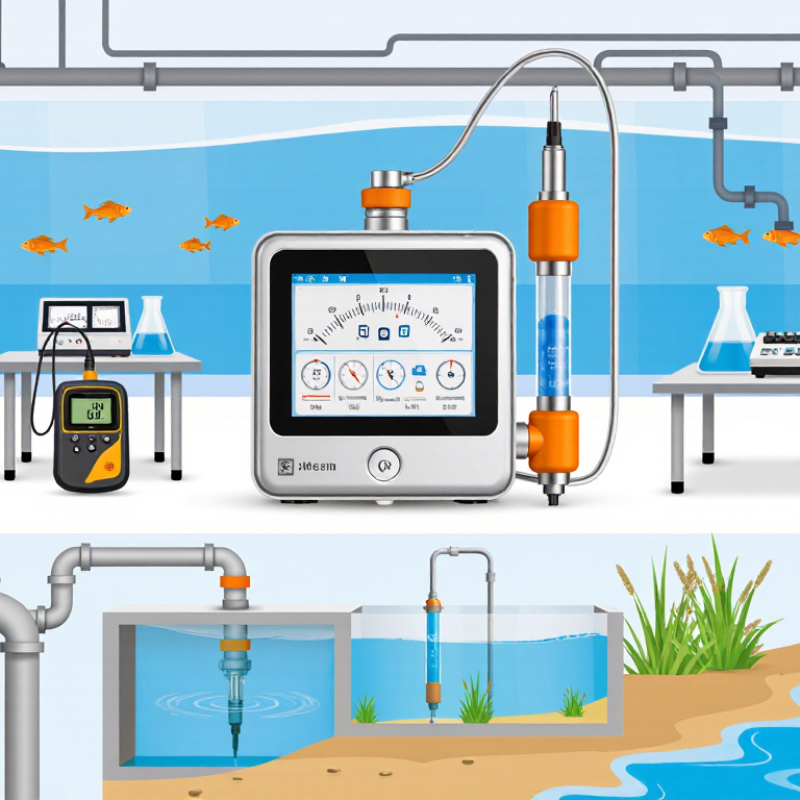
| Optical Luminescent DO Meter | Measures the change in luminescence lifetime or intensity of a light-sensitive optical sensor when exposed to oxygen. | 0–20 mg/L
0–200% saturation | Typically ±0.1–0.2 mg/L or ±1–2% of reading, depending on the model and operating range. | Usually 5–60 seconds | Drinking-water monitoring, rivers, lakes, aquaculture, wastewater treatment, field surveys and laboratories. | No electrolyte refill; low maintenance; good stability; limited sensitivity to flow; no oxygen consumption during measurement. | Optical caps require periodic replacement; sensor performance can be affected by coating, fouling, temperature and incorrect calibration. | Check optical-cap service life, temperature compensation, salinity compensation, pressure correction, data logging and IP protection. |
| Polarographic Membrane DO Meter | A polarized cathode reduces oxygen that diffuses through a membrane, generating a current proportional to oxygen concentration. | 0–20 mg/L
0–200% saturation | Typically ±0.1–0.3 mg/L or ±1–2% of reading after proper calibration. | Typically 30–90 seconds | Wastewater process checks, environmental monitoring, aquaculture and general laboratory testing. | Proven technology; widely understood; suitable for routine dissolved oxygen testing; replacement membranes are commonly available. | Requires polarization before use; consumes oxygen; needs sufficient water movement; membrane and electrolyte maintenance are necessary. | Verify warm-up time, membrane availability, electrolyte type, probe construction, stirring requirements and calibration workflow. |
| Galvanic Membrane DO Meter | Anodes and cathodes generate a current through an electrochemical reaction without requiring external polarization. | 0–20 mg/L
0–200% saturation | Typically ±0.2–0.5 mg/L or ±2–3% of reading. | Typically 30–120 seconds | Portable field testing, aquaculture ponds, surface water and basic wastewater inspections. | Ready for use with little or no warm-up; simple operating procedure; generally economical for routine measurements. | Consumes oxygen; sensor output may drift; membrane and electrolyte replacement are required; accuracy depends strongly on flow and maintenance. | Consider sensor replacement cost, membrane durability, calibration stability, spare-part supply and performance in low-flow water. |
| Portable Multiparameter DO Meter | Combines a dissolved oxygen probe with measurement channels for parameters such as temperature, pH, conductivity, salinity or turbidity. | Commonly 0–20 mg/L
Up to 200% saturation | Depends on the installed probe; commonly ±0.1–0.3 mg/L for DO. | Approximately 5–120 seconds, depending on the sensor type. | Environmental inspections, aquaculture management, water-resource surveys, compliance sampling and field laboratories. | Reduces the number of instruments; supports compensation for temperature, salinity and pressure; enables synchronized field records. | Higher purchase cost; more complex calibration; probe maintenance differs by parameter; larger data-management requirements. | Check the number of channels, probe interchangeability, GPS, wireless transfer, battery life, memory capacity and software compatibility. |
| Benchtop Laboratory DO Meter | Uses an optical, polarographic or galvanic probe connected to a stable laboratory display and measurement platform. | Commonly 0–20 mg/L
0–200% saturation | Often ±0.1 mg/L or better under controlled laboratory conditions, subject to the probe and calibration method. | Typically 10–90 seconds | Water-quality laboratories, wastewater testing, research, quality control and standard-method analysis. | Large display; stable operation; advanced calibration records; improved sample handling; often supports GLP-style data management. | Not designed for remote fieldwork; requires a controlled workspace; sample stirring and temperature equilibrium may affect results. | Review data export, audit-trail functions, calibration reminders, stirrer compatibility, sample-volume requirements and laboratory temperature control. |
| Inline Process DO Transmitter | A permanently installed optical or electrochemical sensor continuously measures dissolved oxygen in a pipe, channel or treatment basin. | Commonly 0–20 mg/L
Some systems support extended ranges | Typically ±0.1–0.2 mg/L or ±1–2% of reading, depending on process conditions and sensor design. | Usually 5–120 seconds | Activated-sludge aeration control, industrial wastewater, water-treatment plants, fermentation and process-water systems. | Continuous monitoring; supports alarms and control loops; reduces manual sampling; can improve aeration-management efficiency. | Installation quality is critical; fouling, bubbles, vibration and changing flow conditions can affect readings; scheduled cleaning is required. | Check mounting options, cleaning system, output signals, communication protocols, pressure rating, chemical compatibility and controller integration. |
| Submersible or Data-Logging DO Probe | A sealed probe records dissolved oxygen and temperature at programmed intervals while deployed in a water body or monitoring station. | Commonly 0–20 mg/L
0–200% saturation | Typically ±0.1–0.3 mg/L, depending on sensor technology, fouling protection and deployment conditions. | Typically 5–120 seconds | Long-term lake, river, reservoir, groundwater and aquaculture monitoring. | Supports unattended monitoring; records trends over time; useful for identifying stratification, hypoxia and daily oxygen cycles. | Biofouling and sediment accumulation can distort readings; battery capacity and memory limit deployment duration; retrieval may be required. | Evaluate deployment depth, battery life, memory, anti-fouling protection, vented pressure compensation, retrieval accessories and data export. |
| Flow-Through DO Analyzer | Measures dissolved oxygen in a continuously pumped sample stream passing through a controlled flow cell. | Commonly 0–20 mg/L
Specialized ranges may be available | Typically ±0.1–0.2 mg/L when flow, temperature and pressure are controlled. | Typically 10–90 seconds | Laboratory water systems, boiler-feed and high-purity water checks, industrial process sampling and pilot plants. | Provides consistent sample contact; suitable for continuous or semi-continuous sampling; easier to isolate from difficult process locations. | Requires pumps, tubing and flow control; leaks or air ingress can cause errors; installation is more complex than handheld testing. | Confirm wetted-material compatibility, flow requirements, pressure limits, sample conditioning, alarm outputs and maintenance access. |
| Portable Optical Spot DO Sensor | Uses a compact optical sensing element for quick measurements at selected sampling points without continuous deployment. | Commonly 0–20 mg/L
0–200% saturation | Typically ±0.2 mg/L or ±2% of reading. | Usually 5–45 seconds | Field screening, hatchery tanks, aquaculture sampling, educational laboratories and routine spot checks. | Compact; simple operation; low oxygen consumption; convenient for repeated measurements at multiple locations. | Less suitable for permanent process control; optical sensing elements need periodic verification and replacement. | Prioritize portability, one-handed operation, waterproof construction, automatic stabilization, calibration prompts and replacement-sensor cost. |
| Winkler Titration Reference Method | A chemically fixed water sample is titrated to determine dissolved oxygen concentration; it is a reference laboratory method rather than an electronic meter. | Commonly suitable for approximately 0–20 mg/L | Can provide high accuracy when sampling, fixation and titration are carefully controlled. | Several minutes to hours, depending on sample handling and laboratory procedure. | Method verification, instrument validation, research and situations where electronic sensors require an independent reference. | No electronic sensor drift; useful for checking instrument performance; established analytical basis. | Time-consuming; requires reagents and laboratory skill; sample must be fixed correctly; not suitable for real-time monitoring. | Use only where trained personnel, appropriate reagents, safe chemical handling and controlled sampling procedures are available. |