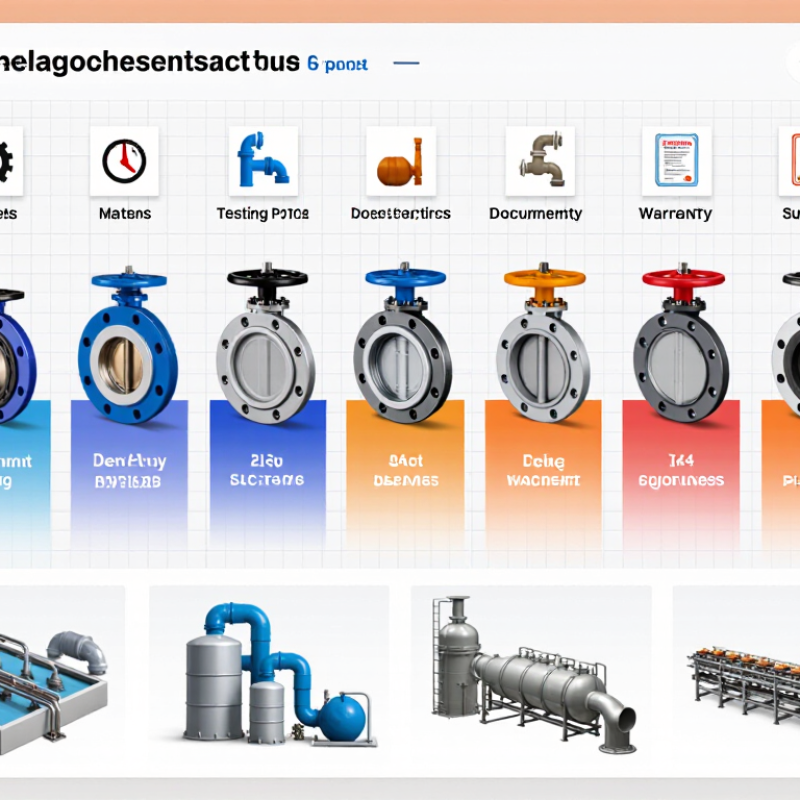
| 1 | Wafer Body Design | Short face-to-face length Bolt-through installation | Clamps between two pipe flanges and provides compact shutoff or flow-control service. | Ductile iron, carbon steel, stainless steel, or aluminum bronze, depending on service requirements. | Water, air, HVAC fluids, and selected industrial liquids. | Water distribution, cooling systems, HVAC networks, and general process piping. | Check flange compatibility, available installation space, pipe alignment, and required pressure rating. |
| 2 | Disc and Shaft Assembly | Concentric Eccentric options | Rotates approximately 90 degrees to open, throttle, or isolate the pipeline. | Stainless steel, ductile iron, nickel-plated ductile iron, or corrosion-resistant alloys. | Clean water, treated water, air, gases, and compatible chemicals. | Isolation lines, pump systems, water treatment, compressed-air systems, and process plants. | Disc material, shaft design, operating torque, corrosion resistance, and allowable pressure drop should match the medium. |
| 3 | Resilient-Seated Type | Soft liner Bubble-tight shutoff | Uses an elastomer seat to create a tight seal around the disc during closure. | EPDM, NBR, FKM, or other elastomers selected for temperature and chemical compatibility. | Water, wastewater, air, and selected low-temperature process fluids. | Potable-water systems, sewage treatment, fire-protection piping, and HVAC service. | Verify seat compatibility with temperature, pressure, disinfectants, oils, hydrocarbons, and process chemicals. |
| 4 | High-Performance Type | Offset shaft Metal-supported seat | Reduces rubbing between the disc and seat and supports more demanding pressure or temperature service. | Carbon steel or stainless-steel body, stainless-steel disc, and metal or reinforced sealing components. | Hot water, steam-related services, hydrocarbons, gases, and industrial process fluids when properly specified. | Refining, chemical processing, power generation, industrial utilities, and thermal systems. | Review temperature limits, seat construction, emissions requirements, pressure class, and fire-safe requirements where applicable. |
| 5 | Actuation Options | Lever Gear operator Pneumatic Electric | Controls valve position manually or through an automated control system. | Valve materials vary by service; actuators commonly use aluminum, cast iron, steel, and engineered polymer components. | Water, air, gas, and process fluids compatible with the selected valve and seat. | Manual isolation, remote control, automatic sequencing, flow regulation, and emergency shutdown systems. | Consider torque, cycle frequency, fail position, power supply, control signal, environmental protection, and actuator duty rating. |
| 6 | Pressure and Size Range | Commonly DN50–DN1200 Class-dependent ratings | Provides scalable pipeline isolation and control across small, medium, and large pipe diameters. | Material selection depends on pressure, temperature, corrosion exposure, and mechanical loading. | Municipal water, wastewater, cooling water, air, gases, and industrial liquids. | Waterworks, district energy, building services, irrigation, and large industrial pipelines. | Confirm nominal diameter, pressure class, operating temperature, flange standard, flow velocity, and required shutoff direction. |
| 7 | Standards and Testing | API 609 EN 593 ISO 5211 EN 12266-1 | Defines dimensional, performance, actuator-interface, and pressure-test requirements for applicable valve designs. | Test and material requirements depend on the governing standard, service category, and project specification. | Industrial fluids, water, air, gases, and other media approved by the valve specification. | Infrastructure projects, industrial plants, utilities, building services, and packaged equipment. | Request certificates, pressure-test records, material documentation, coating details, and applicable compliance declarations. |