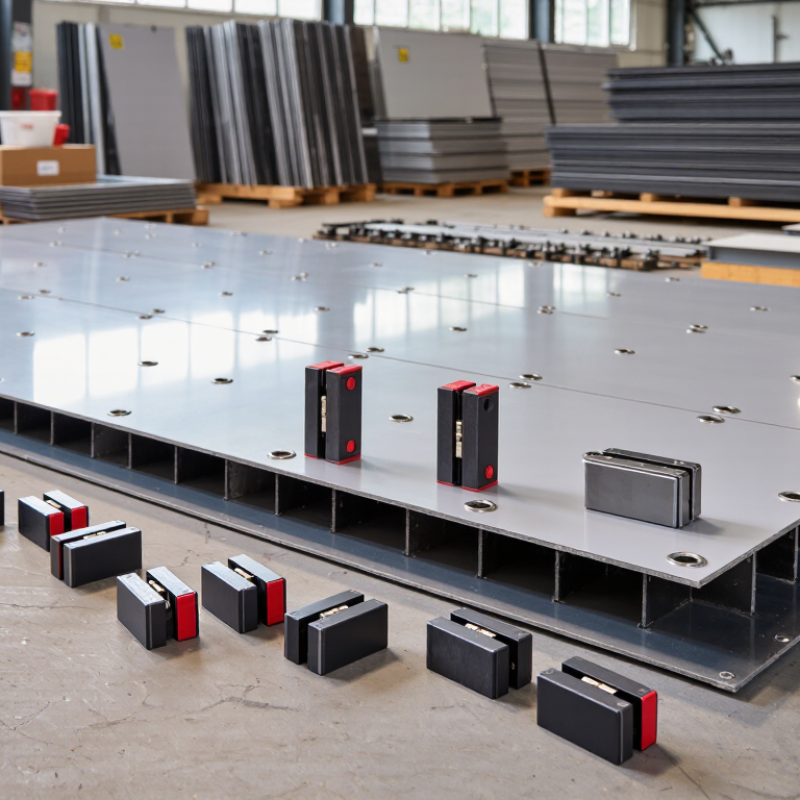
| 1 | Steel formwork with repeated panel layouts | Standard push-button shuttering magnet | The integrated button engages the magnetic unit and is designed for quick positioning and release on compatible steel beds or forms. | Check the steel contact surface, available installation space, button access, and the supplier’s stated holding-force test conditions. |
| 2 | Layouts where the magnet must be positioned or released from the side | Side-release or side-operation magnet | A side-access mechanism can be more practical when vertical clearance above the magnet is limited. | Confirm the operating direction, tool clearance, magnet orientation, and whether workers can safely reach the release mechanism. |
| 3 | Timber or plywood formwork used with a steel casting bed | Magnet box or magnet with a formwork adapter | The magnet anchors to the steel bed while an adapter or box provides a mounting interface for the formwork profile. | Match the adapter dimensions to the profile and verify that the assembly transfers the expected load without rocking or slipping. |
| 4 | Aluminum or other non-ferromagnetic formwork | Magnet assembly used with a compatible steel plate or adapter | A magnet cannot directly hold to non-ferromagnetic aluminum. A suitable ferromagnetic component may provide the required magnetic contact. | Check the complete load path, attachment method, steel plate thickness, and whether the adapter is approved for the formwork system. |
| 5 | Edge and corner sections requiring a specific profile position | Corner magnet or shaped adapter assembly | A purpose-shaped contact or adapter can help locate edge forms where a standard flat assembly may not fit well. | Compare the actual corner geometry, clearances, and contact area; do not assume a standard magnet fits every corner profile. |
| 6 | Heavy-duty or custom formwork profiles | Custom magnet box or multi-magnet assembly | A configured assembly can accommodate non-standard profile dimensions or mounting arrangements when a standard unit is unsuitable. | Provide drawings and design loads. Have the assembly checked for contact, load direction, stability, and release access before production. |
| 7 | Any application where formwork may shift, vibrate, or carry substantial loads | Magnet type selected by verified load requirements, with mechanical restraint where required | Magnetic holding performance depends on the contact conditions and load direction; a rated pull force alone does not establish safe resistance to sliding or overturning. | Account for steel thickness, surface flatness, coatings, debris, air gaps, vibration, and safety factors. Follow the formwork design and manufacturer’s instructions. |