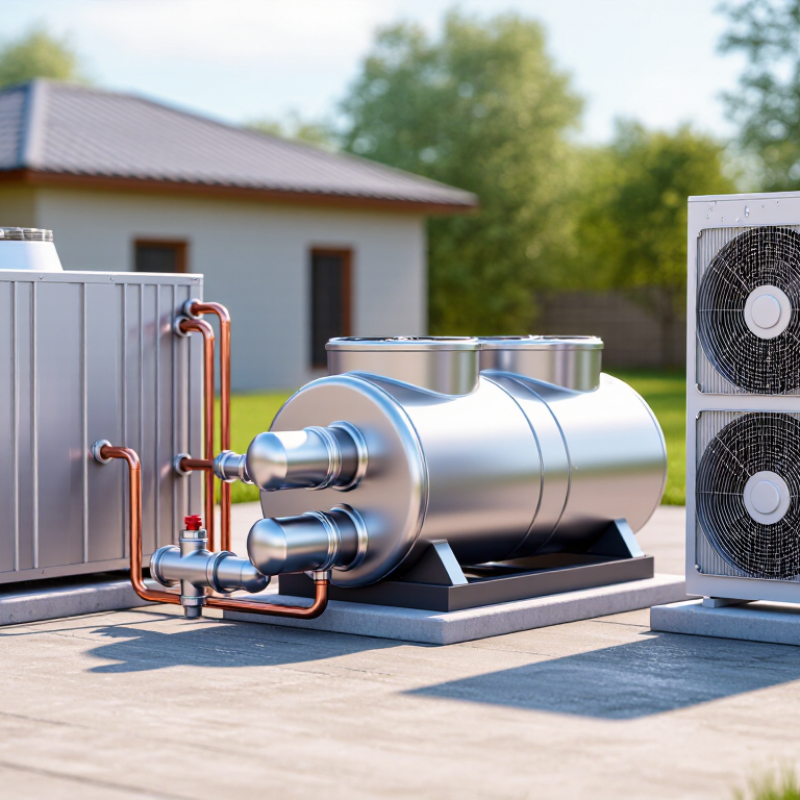
| How It Rejects Heat | Releases refrigerant heat directly to outdoor air through finned coils and fans. | Transfers refrigerant heat to condenser water, which usually rejects the heat through a cooling tower or dry cooler. | Depends on site conditions |
| Typical System Capacity | Commonly used from small packaged systems up to approximately 500 refrigeration tons (1,760 kW of cooling), with larger applications possible. | Commonly selected for medium and large chilled-water plants, often from approximately 20 to more than 1,000 refrigeration tons (70 to 3,517 kW). | Water-cooled for large plants |
| Typical Full-Load COP | Approximately 2.5–3.5 for many conventional air-cooled chillers under standard rating conditions. | Approximately 4.0–6.0 for many conventional water-cooled chillers under standard rating conditions. | Water-cooled |
| Part-Load Efficiency | Can be efficient at moderate loads with variable-speed fans, but performance is strongly affected by outdoor temperature. | Often provides strong part-load efficiency because entering condenser-water temperature can be lower than outdoor air temperature. | Usually water-cooled |
| Effect of Outdoor Temperature | High outdoor temperatures raise condensing pressure and can reduce capacity and COP. Output may drop during heat waves. | Less directly affected by outdoor dry-bulb temperature, but performance depends on outdoor wet-bulb temperature and cooling-tower approach. | Water-cooled in hot climates |
| Water Consumption | No continuous condenser-water consumption. Small amounts may be needed for coil cleaning or maintenance. | Cooling-tower systems typically consume water through evaporation and blowdown. A practical planning range is approximately 0.5–2.0 gallons per ton-hour (0.06–0.25 L/kWh of cooling), depending on climate, cycles of concentration, and tower operation. | Air-cooled where water is scarce |
| Installation Requirements | Requires outdoor clearance, adequate airflow, structural support, electrical service, and access for coil cleaning. | Requires condenser-water pumps, piping, water treatment, a cooling tower or heat-rejection device, and additional mechanical-room space. | Air-cooled for simpler projects |
| Initial Cost | Generally lower because there is no cooling tower, condenser-water loop, water treatment system, or condenser-water pump. | Generally higher because of the tower, pumps, piping, controls, water treatment, and additional installation work. | Air-cooled |
| Operating Cost | Usually has lower water and maintenance costs, but electrical consumption may be higher at high ambient temperatures. | Often has lower compressor energy use at larger scale, but adds pumping, fan, water, treatment, and maintenance costs. | Water-cooled for high annual runtime |
| Maintenance Needs | Clean coils, inspect fans and motors, check refrigerant circuits, and maintain adequate airflow. | Maintain tubes, pumps, tower fill, drift eliminators, water chemistry, filtration, and biological-control programs. | Air-cooled for lower maintenance complexity |
| Noise and Visual Impact | Fans can produce noticeable outdoor noise, and large coil banks may require significant roof or yard space. | Cooling-tower fans and pumps create noise, but the chiller itself can be located indoors; tower placement remains important. | Project-specific |
| Water Quality Risk | No condenser-water scaling, corrosion, or biological-growth risk. | Requires treatment and monitoring to control scale, corrosion, fouling, and microbial growth, including Legionella-related risks. | Air-cooled |
| Expected Service Life | Often approximately 15–20 years when properly maintained, depending on corrosion, operating hours, and component quality. | Chiller equipment can often operate for approximately 20–25 years, but towers, tubes, pumps, and water-treatment components may require earlier refurbishment or replacement. | Water-cooled for long-term plants |
| Carbon and Resource Trade-Off | Avoids operational water use but may require more electricity, especially during hot weather. | Can reduce electricity consumption but uses water and treatment chemicals, creating a site-specific environmental trade-off. | Depends on local utility mix and water availability |
| Recommended Application | Small to medium buildings, water-stressed locations, projects with limited maintenance staff, and installations where simple construction is a priority. | Large commercial or industrial facilities with high cooling loads, long operating hours, reliable water supplies, and access to qualified maintenance personnel. | Choose by lifecycle cost |