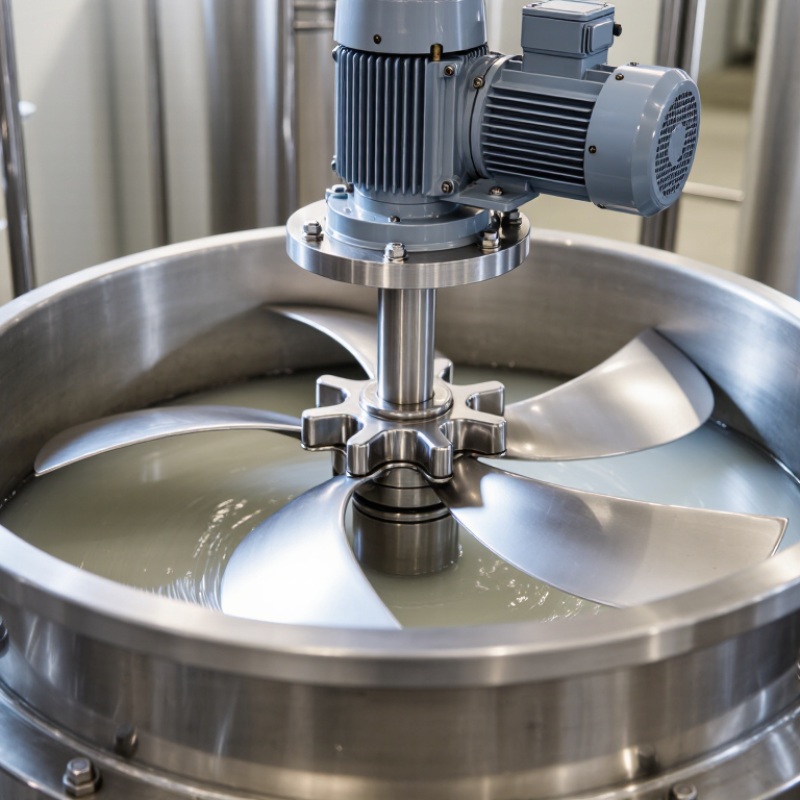
| Axial-Flow Impeller | Moves liquid primarily parallel to the shaft, creating strong top-to-bottom circulation throughout the vessel. | Vertical circulation
Bulk turnover | Blending low- to medium-viscosity liquids, suspending solids, and maintaining uniform temperature or concentration. | Low to medium viscosity liquids; suitable for many water-based process fluids. | Blade angle, impeller diameter, liquid depth, and baffle arrangement strongly affect pumping capacity and mixing time. |
| Radial-Flow Impeller | Discharges fluid outward from the shaft toward the vessel wall, producing a strong radial flow and higher local turbulence. | Side-to-side circulation
High turbulence | Gas dispersion, liquid blending, and processes that need relatively high shear near the impeller. | Low to medium viscosity liquids, especially when gas-liquid contact is important. | Power demand, gas flooding, impeller submergence, and excessive shear should be evaluated during scale-up. |
| Marine-Style Propeller | Uses angled blades to generate efficient axial pumping with comparatively low resistance and moderate shear. | Axial flow
Rapid circulation | Simple blending, dilution, heat-transfer support, and keeping light solids or crystals in suspension. | Low-viscosity liquids and applications requiring economical circulation. | Effective at relatively high rotational speed; poor vessel geometry or inadequate baffling can cause vortexing. |
| Pitched-Blade Turbine | Angled blades combine axial and radial flow, providing a balance between circulation and shear. | Mixed flow
Moderate turbulence | Blending, solids suspension, crystallization, heat transfer, and general-purpose batch processing. | Low to medium viscosity liquids and liquid-solid mixtures. | Blade pitch, clearance from the tank bottom, and solid settling velocity influence suspension quality. |
| Hydrofoil Impeller | Uses streamlined blades to pump a large volume of liquid with lower drag than many conventional turbines. | Strong axial flow
Low shear | Large-volume blending, solids suspension, wastewater treatment, and temperature equalization. | Low to medium viscosity fluids where energy efficiency is important. | Often provides good circulation per unit of power, but performance depends on proper installation and tank geometry. |
| Anchor Agitator | Rotates close to the vessel wall and sweeps material around the tank, reducing stagnant regions near the surface. | Wall-following flow
Low circulation | Viscous product blending, heat-transfer processes, and wall-scraping service when fitted with suitable wiping elements. | Medium to high viscosity materials, pastes, creams, and shear-sensitive products. | Usually operates at low speed; torque, wall clearance, heat-transfer area, and motor sizing are critical. |
| Helical-Ribbon Agitator | Helical blades move material both around the vessel and along the shaft, producing strong circulation in viscous fluids. | Combined axial flow
Intensive bulk movement | Blending polymers, adhesives, resins, pastes, and other high-viscosity formulations. | High-viscosity liquids and non-Newtonian materials. | Requires high starting torque; temperature-dependent viscosity and drive-train strength must be considered. |
| Gate or Paddle Agitator | Moves material across a broad blade area, generally with gentle sweeping action rather than intense turbulence. | Gentle radial flow
Near-wall movement | Slow blending, maintaining uniformity, and handling products that may be damaged by high shear. | Low to medium viscosity fluids and some delicate suspensions. | Offers gentle mixing but may require longer mixing times; dead zones should be checked during equipment design. |
| High-Shear Rotor-Stator | A rotating element passes close to a stationary stator, creating intense local velocity gradients and strong dispersion forces. | Localized high shear
Fine-scale turbulence | Emulsification, deagglomeration, wetting powders, and producing fine dispersions. | Low to medium viscosity liquids, emulsions, and formulations requiring particle-size reduction. | Can increase heat generation, air entrainment, and product damage; residence time and temperature control are important. |
| Magnetic or Sealed Agitator | Transfers rotational motion through a magnetic coupling or sealed drive arrangement, minimizing or eliminating a conventional shaft seal. | Depends on impeller
Closed-vessel operation | Contained processing, sterile service, hazardous fluids, and applications where leakage control is a priority. | Low to medium viscosity fluids; selection depends on pressure, temperature, and containment requirements. | Coupling torque, seal-free containment, cleanability, vessel pressure, and heat removal must be verified. |
| Gas-Dispersion Agitator | Breaks an introduced gas stream into bubbles and distributes those bubbles through the liquid for mass transfer or reaction. | Radial dispersion
Gas-liquid circulation | Fermentation, oxidation, hydrogenation, stripping, and other gas-liquid reactions. | Low to medium viscosity fluids with controlled gas flow. | Gas flow rate, bubble size, power input, flooding limit, pressure, and mass-transfer area determine performance. |
| Common Design Variable | The agitator transfers mechanical power to the process fluid through an impeller, shaft, drive, and supporting structure. | System-dependent
Geometry-sensitive | Applies to blending, suspension, dispersion, heat transfer, reaction, crystallization, and aeration. | Selection depends on viscosity, density, solids loading, gas rate, temperature, and chemical compatibility. | Key checks include mixing time, power per volume, torque, shear rate, vortex control, baffling, materials, and scale-up method. |