Why Do PP/TPO Automotive Interior Parts Show Visible Scratches?
PP and TPO are widely used in automotive interiors because they offer an attractive combination of low density, processability, stiffness, impact performance and cost efficiency.
Their surface appearance, however, can be sensitive to mechanical damage. When a molded surface is scratched, the damaged region reflects and scatters light differently from the surrounding area. Even when the physical groove is relatively shallow, the resulting optical contrast can make the scratch highly visible.
In automotive scratch evaluation, this change is often expressed through Delta L, or the change in lightness between the scratched and original surface under defined test conditions. A lower Delta L generally indicates lower visible scratch contrast.
However, Delta L should not be interpreted in isolation. Applied load, stylus geometry, surface texture, pigment, filler loading, conditioning and test method can all influence the result.
Why Is Talc-Filled PP/TPO More Difficult to Protect?
Talc is commonly incorporated into automotive PP/TPO compounds to improve stiffness, dimensional stability and thermal performance. At the same time, talc can make visible scratch whitening more difficult to control.
When scratching disrupts the polymer-rich surface, lighter filler-containing regions may become exposed or optically more noticeable. On dark-colored molded parts, this can appear as a white or light-gray scratch mark.
The same anti-scratch additive may therefore perform differently in neat PP, a lightly filled PP compound and a highly filled PP/TPO formulation.
For practical material development, talc loading should be treated as one of the first formulation variables to evaluate.
How Do Anti-Scratch Additives Improve PP/TPO Surface Performance?
One important approach is to reduce friction between the molded polymer surface and the object moving across it. Lower friction can reduce the severity and depth of scratching. A shallower and smoother damaged region may scatter less light, helping reduce visible scratch contrast.
Silicone-based technologies are widely used for this purpose because they can modify the surface behavior of PP/TPO compounds while being incorporated directly during compounding. High- and ultra-high-molecular-weight silicone masterbatches also provide a convenient pelletized form for handling and dosing.
Silicone concentration alone, however, does not determine the final result. The additive must also be sufficiently compatible with the polymer matrix.
For demanding automotive applications, anti-scratch performance is therefore best considered as a balance of surface modification + polymer compatibility + long-term stability.
Six Factors to Consider When Selecting an Anti-Scratch Additive
1. Polymer Matrix
Start with the actual resin system. PP homopolymer, PP copolymer, and PP/EPDM-based TPO may not respond to the same anti-scratch additive in the same way. Compatibility influences additive dispersion, phase stability and long-term surface behavior. A PP-Homo-rich formulation may therefore require a different additive approach from a PP copolymer-rich or TPO system.
2. Talc and Filler Loading
Talc loading can significantly influence scratch visibility and additive response. A grade and dosage that perform well in one PP/TPO compound may not provide the same result when filler loading changes. Whenever possible, the anti-scratch additive should therefore be evaluated in the actual filled formulation rather than only in neat resin.
3. Target Scratch Test and Delta L
A good selection process starts with the test requirement rather than the product. Automotive programs may use procedures such as PV3952, GMW14688 or customer-specific scratch methods. The final result can depend on applied load, stylus geometry, surface grain, conditioning, part color, and measurement method. For this reason, a reported Delta L value is most meaningful when the corresponding test conditions are also known. Instead of asking which additive gives the strongest anti-scratch effect, it is more useful to define the required test method and target Delta L.
4. Aging and Long-Term Surface Stability
A good initial scratch result does not automatically mean that a formulation is suitable for long-term automotive use. Heat aging, UV exposure and temperature cycling may reveal changes that are not visible immediately after molding. For automotive interior materials, scratch resistance should therefore be evaluated both before and after the relevant aging conditions.
5. VOC, Odor and Fogging
Automotive cabin materials are evaluated as complete formulations. An anti-scratch additive should therefore also be considered in relation to VOC, odor and fogging requirements. Final compliance should be confirmed using the complete compound, including resin, filler, pigment, stabilizer and other additives, according to the applicable OEM or project specification. The additive should support the formulation target rather than be treated as an independent guarantee of final compliance.
6. Gloss, Grain and Tactile Quality
Scratch resistance should not be improved at the expense of the intended surface design. A matte dashboard, fine-grain door trim or low-gloss center console has a specific visual and tactile target. The selected additive should therefore also be evaluated for its effect on gloss, grain definition, surface uniformity, color consistency and hand feel. For premium automotive interiors, the best result is not simply a lower Delta L. It is a surface that remains visually and tactilely consistent while becoming more resistant to scratch and mar damage.
Anti-Scratch Technologies Compared
| Technology | Main Benefit | Main Point to Evaluate |
| Fatty amide / conventional slip agent | Cost-effective lubrication | Migration and aging behavior |
| Wax/lubricant | Slip and processing improvement | Formulation dependency |
| Silicone oil | Strong lubrication | Migration and matrix compatibility |
| UHMW silicone masterbatch | Durable surface modification and convenient pellet form | Polymer compatibility and dosage |
| Organically modified siloxane | Long-term surface modification | Interaction with polymer and filler system |
| Surface coating | High level of surface protection | Additional process and cost |
There is no universally superior technology for every formulation. For molded-in-color PP/TPO automotive parts, masterbatch-based technologies can be particularly attractive because surface-performance modification can be incorporated directly during compounding and molding.
Why Initial Delta L Is Not Enough?
Two formulations may show similar initial scratch performance immediately after molding. After thermal or UV aging, however, one may retain a dry, uniform and stable surface while another may show changes in gloss, surface feel or scratch resistance.
From an automotive engineering perspective, these formulations are not equivalent.
A more meaningful evaluation should therefore extend beyond the initial scratch result and consider initial scratch resistance > aging > long-term surface stability > VOC/odor performance > aged scratch resistance.
The most suitable anti-scratch solution is not necessarily the one that produces the lowest initial Delta L. It is the one that maintains the required surface performance under the relevant application and aging conditions.
Performance Validation Beyond Initial Scratch Resistance
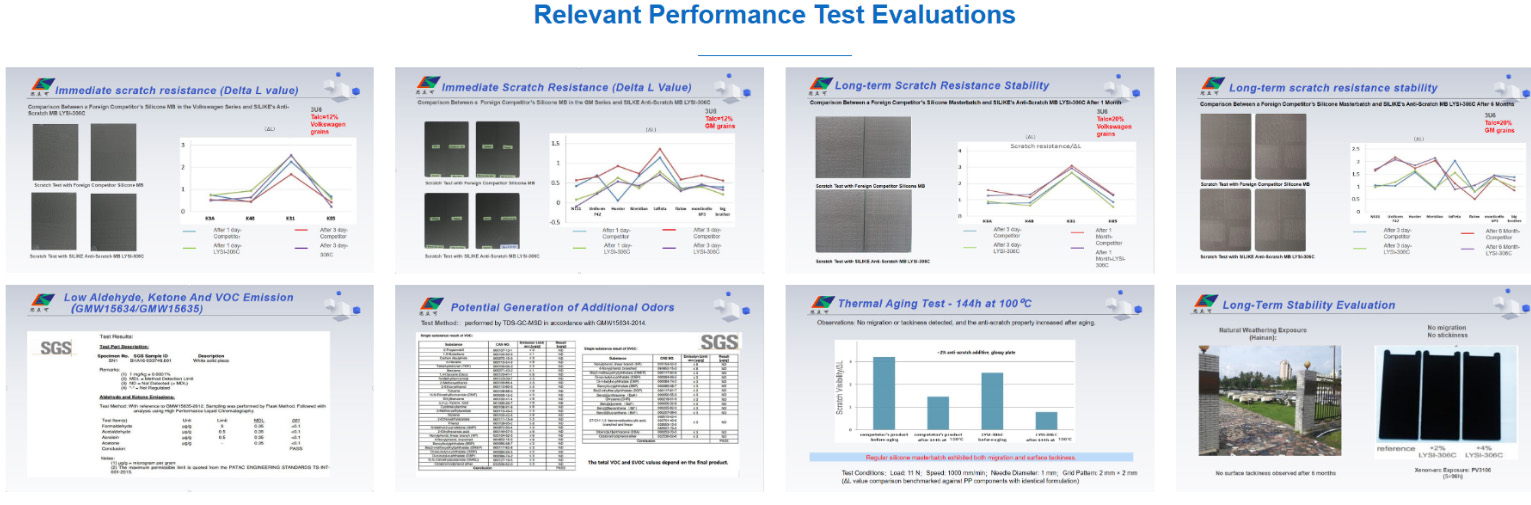
For automotive PP/TPO anti-scratch modification, performance evaluation should extend beyond a single initial scratch test. SILIKE has conducted relevant evaluations on selected anti-scratch formulations and application systems, covering immediate scratch resistance, long-term scratch-resistance stability, aldehyde/ketone and VOC-related testing, odor evaluation, thermal aging and long-term surface stability.