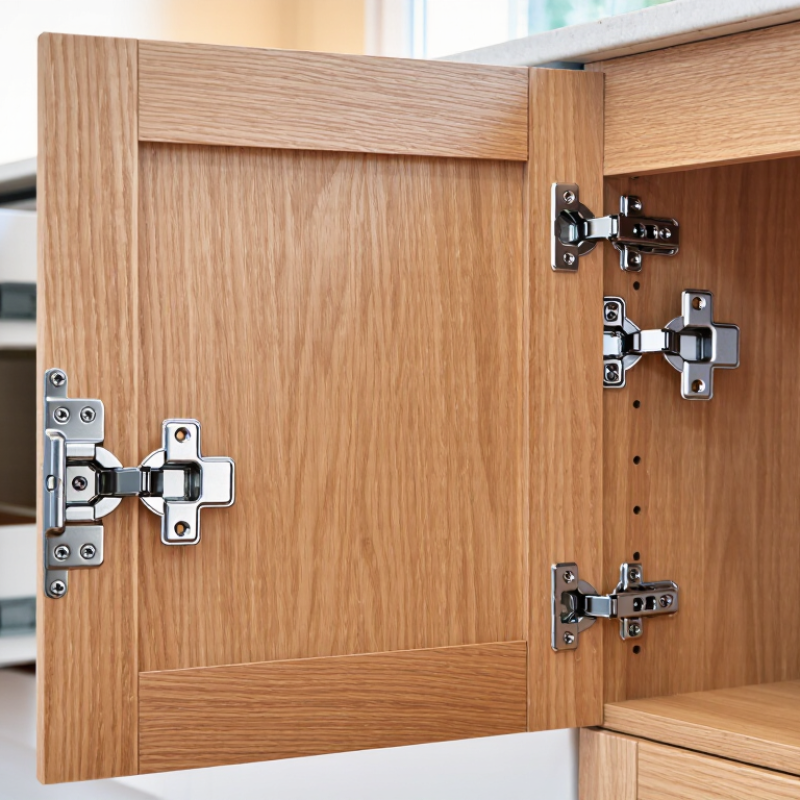
| Door position | The door covers most of the cabinet side or partition when closed. | Two doors share a cabinet partition; each covers part of the partition. | The door sits inside the cabinet opening, generally flush with the front edges. |
| Typical use | Cabinet ends or openings where a door should cover the cabinet side. | Paired doors mounted on opposite sides of a shared partition. | Cabinetry designed to show the face frame or cabinet carcass around the door. |
| Hinge geometry | Typically uses a relatively straight hinge arm; the required overlay depends on the door, mounting plate, and cabinet layout. | Typically uses a cranked arm to create partial overlay; the required offset depends on partition and door dimensions. | Typically uses a more deeply cranked arm to position the door inside the opening. |
| Typical closed-door relationship | Door front sits over the cabinet side. Overlay is set by the hinge and mounting plate combination. | Each door commonly covers roughly half of a shared partition, allowing for the specified gap. | Door edges remain within the opening, with clearance needed around the door for movement. |
| 35 mm cup bore | A 35 mm cup diameter is common. Cup depth and edge setback must match the selected hinge instructions. | A 35 mm cup diameter is common. Cup position must be checked against the shared partition layout. | A 35 mm cup diameter is common. Cup position must leave enough door material and avoid clashes inside the cabinet. |
| Common cup-bore planning range | Many hinges use a cup depth around 11–13 mm; edge setback varies by hinge and door design. | Many hinges use a cup depth around 11–13 mm; confirm the required setback and minimum door thickness. | Many hinges use a cup depth around 11–13 mm; confirm the required setback and inset clearance. |
| 180-degree opening | Possible only with a hinge specifically designed and rated for a wide opening; nearby walls or cabinet sides may limit travel. | Possible with a suitable wide-angle hinge, but paired doors and the partition can restrict the opening. | Possible with a suitable wide-angle hinge, subject to opening width, door thickness, and cabinet clearance. |
| Adjustment considerations | Check overlay, side clearance, and door alignment after fitting. Adjustment range varies by hinge and plate. | Set both doors evenly and verify the gap over the shared partition. | Check reveal gaps on all sides and confirm that the door does not bind against the opening. |
| Best fit when | You want broad coverage of the cabinet side and a conventional overlay layout. | You need two doors to share one partition without either door covering its full width. | You want the door face to sit within the cabinet opening rather than over the cabinet front. |
| Before ordering | Verify the specified opening angle, door thickness and weight limits, cup diameter and depth, cup setback, mounting-plate height, required overlay or reveal, and available clearance. “180 degree” describes a hinge’s rated or advertised opening capability; the actual opening depends on the cabinet installation. |