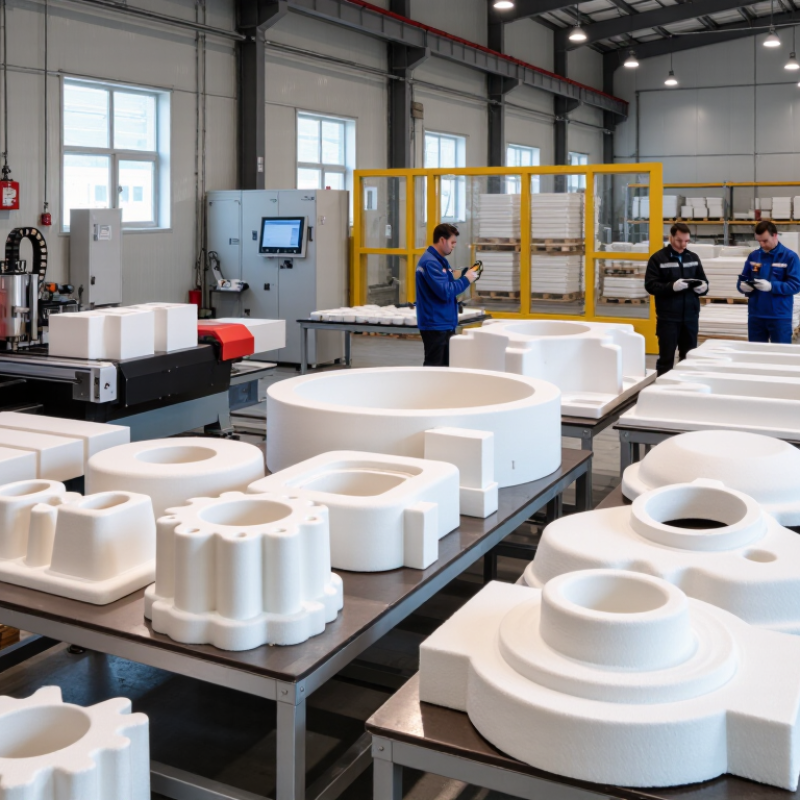
| Pattern Material | Expanded polystyrene (EPS) beads are commonly used; the pattern is consumed during metal pouring. | EPS enables complex one-piece patterns without permanent cores or conventional parting lines. | Material specification, bead grade, safety data, and sample pattern. |
| Pattern Density | Typical molded EPS pattern density is approximately 18–30 kg/m³, depending on the casting application. | Density affects dimensional stability, vapor generation, coating performance, and casting surface quality. | Measured density report from production samples and defined acceptance limits. |
| Mould Construction | Common mould materials include aluminum, aluminum alloys, and other rigid tooling materials suitable for steam molding. | Rigid, thermally stable tooling supports repeatable pattern dimensions and longer service life. | Mould material grade, wall-thickness design, surface finish, and tooling-life estimate. |
| Manufacturing Method | The mould is produced from approved 3D data using CNC machining, coordinated machining, or comparable precision processes. | Accurate tooling reduces pattern mismatch, flash, machining allowance variation, and casting defects. | CAD/CAM workflow, inspection records, machine capability, and first-article report. |
| Dimensional Accuracy | A practical target for many EPS tooling projects is approximately ±0.10–0.30 mm on controlled mould dimensions, subject to size and geometry. | Tooling accuracy directly influences pattern repeatability and final casting dimensional consistency. | CMM or equivalent inspection report with datum structure and tolerance results. |
| Steam Venting | Steam channels, vents, and vacuum or air evacuation paths should be designed according to pattern size and geometry. | Adequate venting promotes uniform bead expansion, complete filling, and fewer weld lines or density differences. | Venting layout, steam-pressure range, cycle data, and trial-pattern results. |
| Pattern Assembly | Complex patterns may be molded as multiple sections and bonded with compatible adhesive or thermal joining methods. | Accurate joints prevent visible seams, leakage of refractory coating, and local casting dimensional errors. | Assembly procedure, joint-tolerance criteria, adhesive specification, and sample inspection. |
| Refractory Coating Compatibility | Coatings are generally applied to create a permeable barrier between the EPS pattern and molten metal; coating thickness is application-specific. | The coating controls metal penetration, surface finish, gas flow, and pattern handling strength. | Coating compatibility test, drying procedure, permeability data, and surface-finish samples. |
| Casting Process | In lost foam casting, the coated EPS pattern is placed in unbonded sand; molten metal replaces and decomposes the pattern during pouring. | Correct mould design must support the complete pattern, gating, risers, coating, and sand-compaction process. | Process simulation, filling plan, trial-casting record, and defect-analysis report. |
| Surface Finish | A smooth mould surface generally supports better EPS pattern release and more consistent casting surface quality. | Surface defects on the mould can be transferred to the pattern and then to the casting. | Surface-finish measurement, visual standards, polished-area specification, and sample approval. |
| Cooling and Ejection | Cooling channels, ejector arrangements, and draft angles should be adapted to the mould geometry and EPS release requirements. | Proper cooling and ejection reduce sticking, warpage, cracking, and cycle-time variation. | Cycle-time data, ejection drawings, cooling layout, and release-test results. |
| Quality Control | Key controls include incoming material verification, in-process inspection, final dimensional inspection, and traceable corrective actions. | Documented quality control lowers the risk of repeated tooling defects and unstable production results. | Inspection plan, calibration records, nonconformance procedure, and batch traceability. |
| Prototype and Trial Support | A capable supplier should support prototype patterns, trial moulding, sample casting, dimensional feedback, and design revisions. | Early testing identifies shrinkage, filling, venting, coating, and assembly issues before volume production. | Trial schedule, revision-control process, sample approval procedure, and technical support response time. |
| Best-Supplier Selection Criteria | The strongest supplier combines accurate tooling, suitable EPS processing, reliable inspection, practical casting knowledge, clear documentation, and responsive engineering support. | Supplier capability should be judged by verified technical performance rather than price alone. | Compare quotations using the same drawings, tolerances, material requirements, inspection scope, delivery terms, and warranty conditions. |