| Humidity Measurement Principle | Capacitive polymer sensing element | The sensing element detects changes in capacitance caused by water vapor. Capacitive sensors are widely used because they offer low power consumption, repeatable readings, and continuous monitoring. |
| Relative Humidity Range | 0 to 100% RH, non-condensing | The sensor can measure the full practical relative-humidity scale, but prolonged condensation may affect accuracy, response time, or long-term stability. |
| Typical Humidity Accuracy | Approximately ±2 to ±3% RH at 25°C | Accuracy normally depends on temperature, humidity level, calibration method, and the specified measurement range. Buyers should request a test report or calibration certificate. |
| Temperature Measurement | Typically -40°C to +85°C | Temperature data supports humidity compensation and allows the device to calculate additional values such as dew point or absolute humidity. |
| Typical Temperature Accuracy | Approximately ±0.3 to ±0.5°C | Temperature accuracy should be evaluated together with the operating environment and the calibration points used by the manufacturer. |
| Response Time | About 5 to 15 seconds for a 63% response | Response time varies with airflow, protective filters, sensor housing, and environmental changes. A faster response is useful for HVAC, storage, and process monitoring. |
| Measurement Interval | Commonly 1 to 60 seconds; configurable | A shorter interval provides more detailed trend data, while a longer interval reduces network traffic and power consumption. |
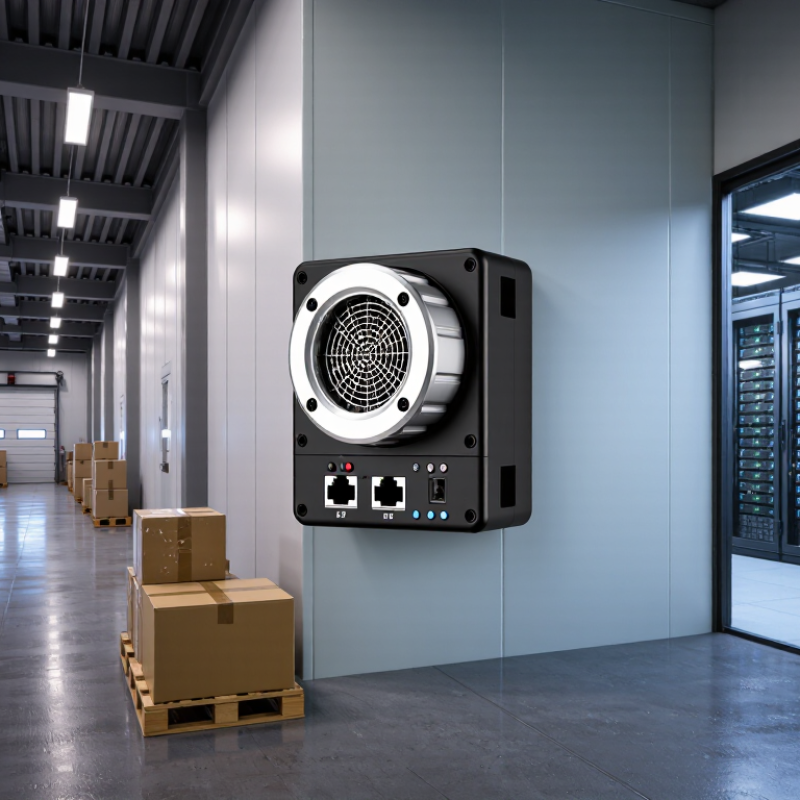
| Ethernet Interface | 10/100 Mbps Ethernet, RJ45 | A standard Ethernet interface supports connection to switches, gateways, industrial networks, and building-management infrastructure. |
| Communication Protocols | Modbus TCP; HTTP or MQTT may also be available | Modbus TCP is commonly used in industrial automation. MQTT is useful for cloud and IoT systems, while HTTP can support web-based integration and API access. |
| Data Transmission Method | Digital packets over an IP network | The sensor converts the measured signal into digital values and sends humidity, temperature, timestamp, status, and alarm data to a server, PLC, gateway, or monitoring platform. |
| Dew-Point Calculation | Usually available through firmware or software | Dew point is calculated from relative humidity and temperature. It helps identify condensation risks in cold rooms, data centers, warehouses, and HVAC ducts. |
| Power Supply | Typically 9 to 36 VDC; PoE may be supported | Buyers should confirm input-voltage tolerance, connector type, current consumption, and whether the device supports IEEE 802.3af or another PoE standard. |
| Network Configuration | DHCP and static IP addressing | Static IP is often preferred for industrial installations, while DHCP simplifies deployment on managed corporate or building networks. |
| Alarm Functions | High/low RH and temperature thresholds | Threshold alarms can be sent through relay output, email, SNMP, MQTT, HTTP, or a monitoring platform, depending on the device configuration. |
| Data Logging | Internal memory or external software storage | Data logging helps maintain a historical record for quality control, environmental compliance, equipment protection, and troubleshooting network interruptions. |
| Calibration Capability | One-point or two-point RH calibration | Two-point calibration generally provides better correction across the working range. Calibration intervals should be based on application risk and operating conditions. |
| Ingress Protection | Common enclosure ratings: IP30 to IP65 | IP rating selection depends on installation location. Dusty, humid, or washdown environments require a more suitable enclosure and correctly installed cable glands. |
| Operating Environment | Typically -20°C to +60°C for the electronics | The permissible environmental range of the electronics may differ from the sensing probe range. Buyers should verify storage temperature, condensation limits, and installation altitude. |
| Installation Options | Wall, duct, panel, or remote-probe mounting | Remote probes are useful where the electronics must remain outside a cold room, duct, clean area, or high-temperature zone. |
| Cybersecurity Considerations | Password control, network segmentation, and encrypted protocols where supported | For global deployments, confirm firmware-update procedures, user authentication, access permissions, TLS support, and compatibility with the buyer’s IT security policy. |
| Common Applications | HVAC, warehouses, cold rooms, server rooms, laboratories, and production areas | The best specification depends on the required accuracy, condensation exposure, response time, network architecture, enclosure protection, and compliance requirements. |