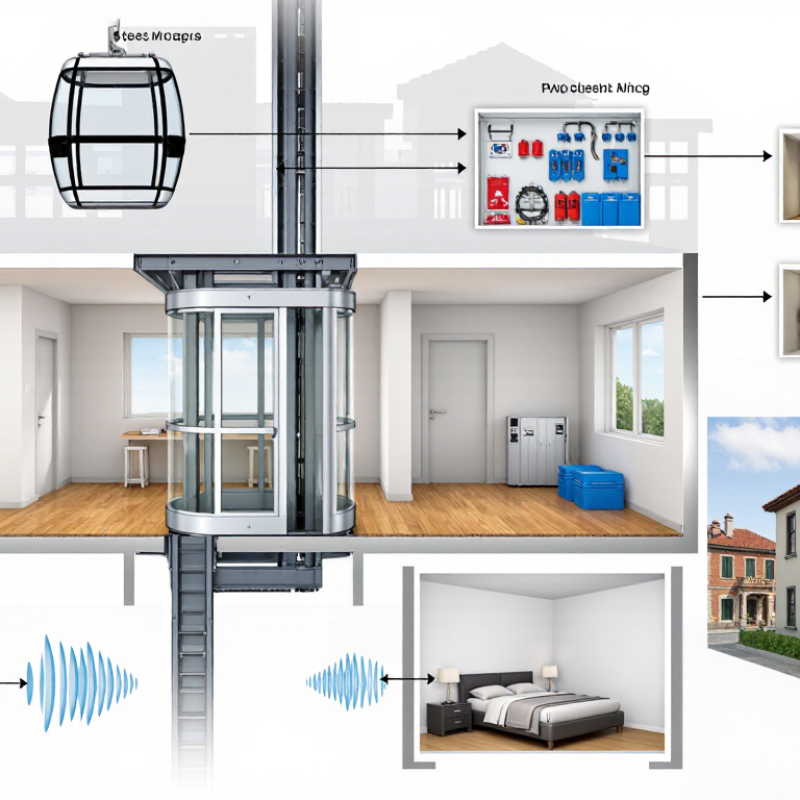
| Traction Elevator with Machine Room | 320–630 kg | 0.40–1.00 m/s | Up to approximately 15–25 m in many private homes | Electric traction system with counterweight; commonly available in single-phase or three-phase configurations depending on motor capacity. | High stability
Efficient for frequent use, smooth leveling, and suitable for multiple floors. A machine room can simplify access to major equipment during servicing. | Requires additional machine-room space and accurate structural planning. Verify overspeed protection, emergency braking, door interlocks, and emergency lowering provisions. | ★★★★★ |
| Machine-Room-Less Traction Elevator | 320–630 kg | 0.40–1.00 m/s | Up to approximately 15–25 m in many private homes | Gearless or geared traction equipment is installed within the shaft or adjacent equipment space, reducing building footprint. | Space efficient
Good ride quality, lower visual impact, and generally lower operating energy than hydraulic systems for comparable residential use. | Maintenance access must be carefully designed. Check heat dissipation, rescue access, controller location, battery backup, and compliance with applicable local elevator codes. | ★★★★★ |
| Hydraulic Home Elevator | 320–450 kg | 0.15–0.50 m/s | Commonly up to approximately 10–15 m | Hydraulic pump and cylinder provide lifting force. The system usually needs a dedicated cabinet or plant area and may require greater pit or structural coordination. | Strong low-rise option
Reliable for short travel, effective at handling heavier loads, and capable of providing smooth starts and stops when correctly tuned. | Higher energy use during upward travel, slower speed, possible hydraulic-oil temperature variation, and more stringent inspection of hoses, valves, seals, and leak protection. | ★★★★☆ |
| Screw-Drive Home Elevator | 250–400 kg | 0.10–0.20 m/s | Typically up to approximately 10–12 m | An electric motor rotates a screw or spindle mechanism. The design can avoid a conventional counterweight and may require limited pit depth. | Simple installation
Suitable for low-rise homes, often adaptable to existing buildings, and generally provides controlled movement with a compact shaft arrangement. | Slower travel, potential mechanical wear at the screw and nut assembly, and the need to verify lubrication, load limits, emergency descent, and long-term component availability. | ★★★☆☆ |
| Platform Lift | 225–400 kg | 0.10–0.15 m/s | Often suitable for 1–3 levels and approximately 4–10 m | May use screw, hydraulic, or chain-based lifting technology. The platform format can reduce enclosure requirements in some applications. | Accessibility focused
Useful for wheelchair access, lower-rise movement, and retrofit projects where a full enclosed elevator is not practical. | Usually slower and less enclosed than a conventional elevator. Confirm guarding, gate interlocks, anti-crush protection, weather resistance, and whether the installation meets elevator or platform-lift regulations. | ★★★★☆ |
| Panoramic Glass Home Elevator | 320–450 kg | 0.30–0.60 m/s | Commonly up to approximately 15–20 m | Usually based on traction or screw-drive technology, combined with laminated or tempered safety glazing and a customized enclosure. | Premium appearance
Provides visibility, natural light, and strong architectural integration while retaining the safety systems of the underlying elevator technology. | Glass adds weight and cost; inspect glazing certification, edge protection, thermal performance, cleaning access, cabin ventilation, and the structural fixing method. | ★★★★☆ |
| Vacuum Pneumatic Elevator | 150–250 kg | 0.15–0.30 m/s | Generally intended for low-rise travel of approximately 6–12 m | Air-pressure differential moves the cabin inside a sealed cylindrical tube. It normally requires limited excavation and no conventional shaft counterweight. | Low structural impact
Can be suitable for selected retrofit applications and may offer a distinctive compact design with limited building work. | Lower capacity, limited travel and cabin size, audible pump operation, and specialized maintenance requirements. Confirm emergency descent, sealing performance, power-failure operation, and local approval. | ★★★☆☆ |
| Compact Home Elevator with Shallow Pit | 250–400 kg | 0.15–0.40 m/s | Typically up to approximately 10–15 m | May use a compact traction, screw, or hydraulic system engineered for reduced pit depth and limited overhead space. | Renovation friendly
Helps adapt existing houses where excavation, headroom, or shaft dimensions are restricted. | Reduced pit and overhead dimensions can affect rescue access, cabin size, service clearance, and door arrangement. Verify all dimensions before construction and obtain approval from the responsible authority. | ★★★★☆ |