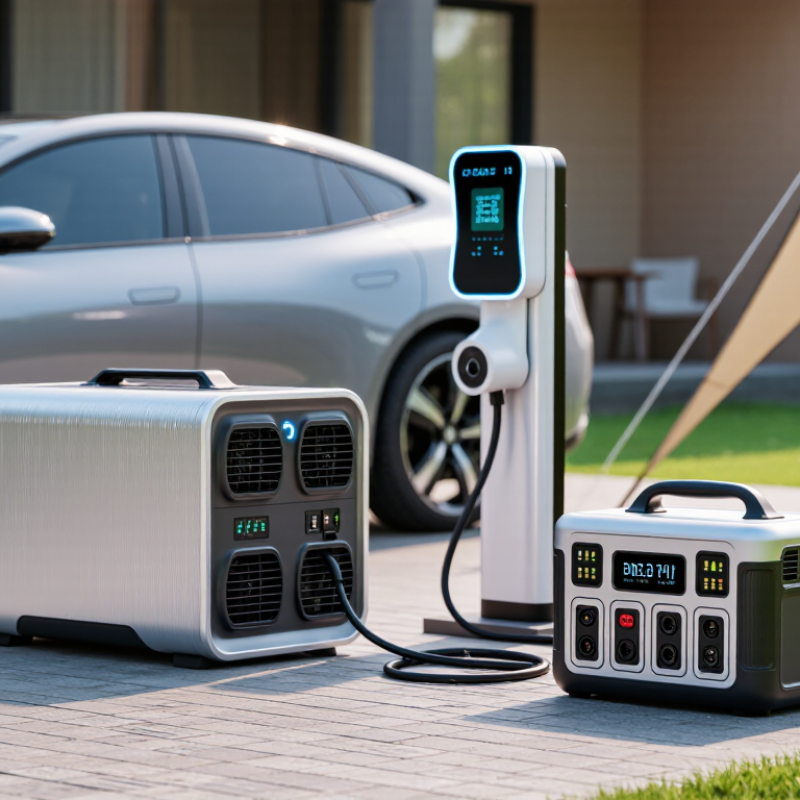
| Intended use | Decide whether the unit is for emergency backup, occasional roadside top-ups, or regular EV charging. | Most portable power stations are better suited to backup power or slow emergency charging than to routine vehicle charging. Match the unit to the actual use case. |
| Usable battery capacity | Compare usable energy in kilowatt-hours (kWh), not only the advertised battery capacity. Check the manufacturer’s stated output limits and reserve settings. | The usable energy determines how much power is available before recharging. The amount of driving range gained varies with the vehicle, driving conditions, charging losses, and battery temperature. |
| Continuous AC output | Confirm the continuous AC output in watts and amps, and compare it with the EVSE’s input requirements. Do not rely on a short-duration peak or surge rating. | An EVSE may not operate if the power station cannot supply its required current continuously. A higher wattage rating alone does not establish EV-charging compatibility. |
| Charging voltage | Check whether the station provides 120 V AC or 240 V AC, and confirm that the vehicle’s charging equipment accepts that supply. | A 120 V output generally supports only slow Level 1 charging when the EVSE and power station are compatible. Level 2 charging requires a suitable 240 V supply and compatible equipment. |
| EVSE compatibility | Check the vehicle and EVSE manuals for accepted voltage, current, plug type, and minimum operating requirements. Use an EVSE intended for the vehicle and region. | A standard household outlet or adapter does not guarantee that an EVSE will work. The EVSE may refuse to start if its electrical checks are not satisfied. |
| Grounding and neutral configuration | Verify in the power-station and EVSE manuals that their grounding and neutral arrangements are compatible. Use only manufacturer-approved operating modes. | Some EVSEs perform ground-fault and supply checks that can prevent charging from an incompatible power source. Never defeat a ground check or alter wiring to make charging work. |
| Electrical protection | Look for documented overcurrent, overload, short-circuit, overtemperature, and ground-fault protections. Follow the specified outlet and cable limits. | These protections help reduce the risk of equipment damage, electric shock, or overheating. They do not make an unsuitable outlet, cable, or charging setup safe. |
| Independent safety certification | Check for relevant, verifiable safety certifications for the power station and a separate certification or listing for the EVSE, as applicable in your region. | The power station and EVSE are separate products with separate safety requirements. A certification for one does not certify the other or prove that the pair is compatible. |
| Battery chemistry and service life | Review the battery chemistry, warranty, stated cycle-life conditions, and the capacity-retention point used in cycle-life claims. | Cycle-life figures depend on test conditions and do not guarantee a particular service life. A clear warranty and defined test conditions make product comparisons more meaningful. |
| Temperature limits | Check the specified operating and charging temperature ranges for both the power station and the vehicle’s EVSE. Keep the equipment out of conditions beyond those limits. | Battery charging and power output can be restricted by temperature. A cold or hot unit may reduce output, pause charging, or require time to reach an acceptable temperature. |
| Outdoor and moisture protection | Check the ingress-protection rating, if provided, for the power station, connectors, and EVSE. Use outdoor equipment only as its instructions permit. | A rating applies only to the product and conditions specified; it does not mean that equipment can be submerged or used in every kind of rain. Keep connections dry unless specifically rated for the exposure. |
| Recharging and input options | Compare AC recharge time, vehicle or solar input options, and the maximum supported input power. Confirm which accessories are required. | A large battery can take a long time to recharge from a low-power source. Input limits and accessory requirements affect how practical the station is for repeat use. |
| Portability and operating limits | Check the unit’s weight, handles or wheels, cable reach, ventilation clearances, and any restrictions on use inside a vehicle or enclosed space. | High-capacity units can be heavy and require clear airflow. Following placement and ventilation instructions helps prevent overheating and makes setup safer. |