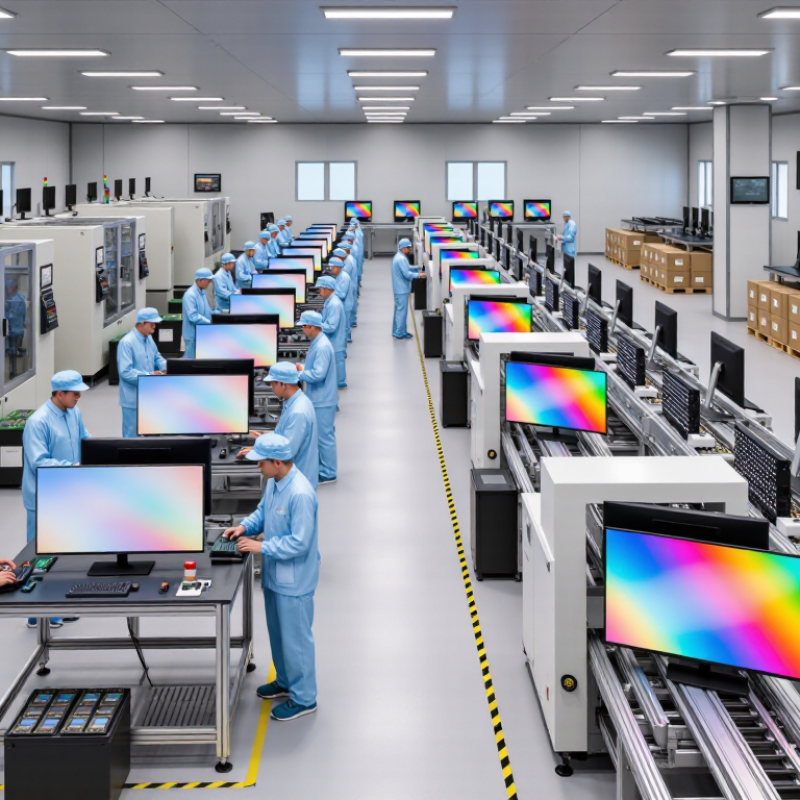
| Panel fabrication | Manufactures TFT-LCD panels on large glass substrates in display fabrication plants. | Panel sizes range from compact screens to large-format displays; capabilities depend on the production line and process generation. | IPS is a liquid-crystal alignment mode used in some TFT-LCD products. Not every LCD line or product is IPS. |
| Large-area LCD production | Supports high-volume production of panels for televisions, monitors, and other large screens. | Large glass substrates can be cut into multiple panels; the number and size of usable cuts vary by substrate and product design. | IPS-type panels are used in some large-screen applications where wide viewing angles are desirable. |
| Small- and medium-sized LCD production | Supplies displays for tablets, laptops, vehicle systems, and other electronic devices. | Products may differ in resolution, brightness, power use, touch integration, and operating-temperature requirements. | IPS is one option among several LCD modes; the chosen mode depends on viewing, cost, performance, and application needs. |
| Panel modules and integration | Combines the display cell with components needed for connection and use in a finished device. | Module work can include driver integration, backlighting, connectors, mechanical design, and touch-panel assembly. | A finished IPS module’s specifications depend on both the LCD cell and the module configuration. |
| Materials and components | Provides inputs used in panel and module production. | The supply chain includes glass, polarizers, color filters, liquid-crystal materials, driver ICs, backlight components, and process chemicals. | Material quality and availability influence yield, image performance, cost, and production continuity. |
| Equipment and process support | Enables fabrication, inspection, repair, and process control across the production line. | LCD manufacturing uses specialized deposition, lithography, cell-assembly, cutting, bonding, and inspection equipment. | Process precision and yield management are important to consistent panel quality, regardless of the LCD mode. |
| Device makers and OEM/ODM integrators | Specify displays and integrate panels or modules into finished products. | Selection criteria commonly include dimensions, resolution, interface, brightness, viewing angle, availability, and qualification requirements. | IPS may be selected for wide viewing angles, but product requirements and total system cost determine the final choice. |