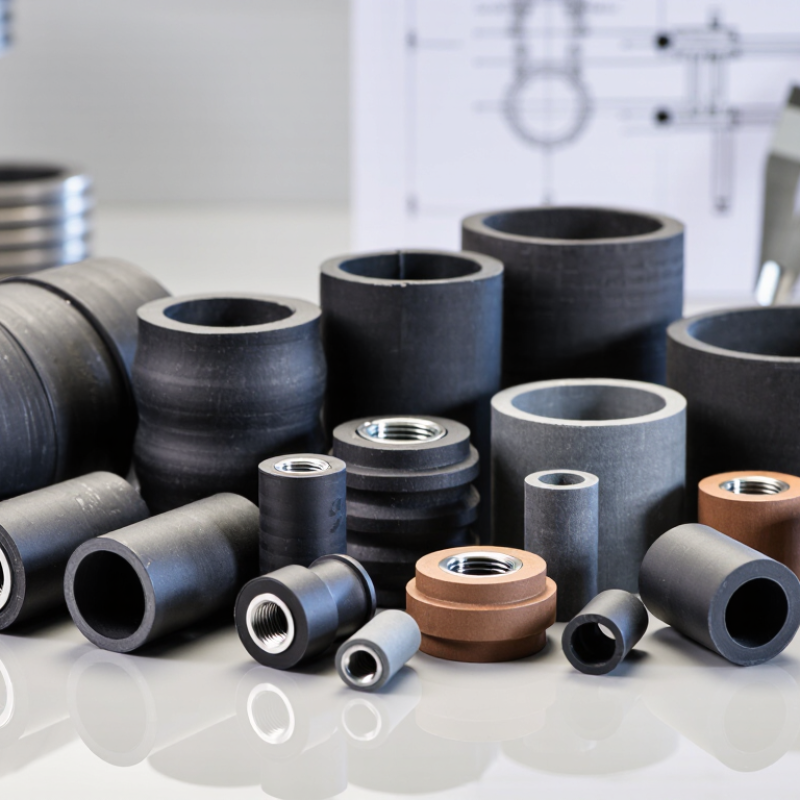
| Primary purpose | A rubber bush is an elastomeric isolation and locating component used between two mechanical parts. | Controls movement while reducing vibration, impact, and structure-borne noise. | The correct bush should balance isolation, steering or positioning accuracy, durability, and comfort. | Application review, dimensional inspection, and functional testing. |
| Typical applications | Suspension arms, stabilizer bars, engine mounts, cab mounts, exhaust hangers, industrial machinery, and pipe supports. | Automotive, commercial vehicles, agricultural equipment, construction machinery, and general industrial systems. | Operating load, temperature, chemicals, and required service life vary greatly by application. | Application specification and duty-cycle analysis. |
| Basic structure | Usually consists of an elastomer body, one or more metal sleeves, bonding layers, and sometimes voids or interlocking features. | Common forms include cylindrical, bonded, split, flanged, tapered, spherical, and voided designs. | Structure determines stiffness direction, installation method, load capacity, and movement control. | Cross-section review, material identification, and visual inspection. |
| Elastomer material | Natural rubber and synthetic elastomers such as EPDM, nitrile rubber, chloroprene, and silicone may be selected according to service conditions. | Hardness commonly falls within approximately 40–90 Shore A, depending on design requirements. | Material choice affects oil resistance, weathering, temperature capability, damping, and fatigue life. | Material certificate, hardness test, chemical-resistance test, and aging test. |
| Static stiffness | Resistance to slowly applied displacement under a defined load. | Reported in N/mm or kN/mm; the required value is application-specific and directional. | Too soft can cause excessive movement; too stiff can transmit vibration and increase noise. | Compression, radial, axial, or torsional load-deflection testing. |
| Dynamic stiffness | Frequency- and amplitude-dependent resistance during cyclic or oscillating loading. | Typically higher than static stiffness; values must be stated with frequency, temperature, and amplitude. | Important for vibration isolation, ride quality, acoustic performance, and resonance control. | Dynamic mechanical analysis or forced-oscillation testing. |
| Damping capacity | The ability of the elastomer to dissipate mechanical energy as heat. | Often expressed using loss factor, damping coefficient, or hysteresis characteristics. | Higher damping can reduce resonance and vibration, but may increase heat generation and stiffness variation. | Hysteresis loop analysis and dynamic mechanical testing. |
| Temperature capability | Usable temperature depends on elastomer formulation, loading, exposure time, and surrounding components. | Many general-purpose designs operate around −40°C to +100°C; specialized compounds may extend beyond this range. | Incorrect temperature selection can cause hardening, softening, cracking, compression set, or premature failure. | High- and low-temperature aging, compression-set, and functional tests. |
| Environmental resistance | Resistance to water, ozone, ultraviolet exposure, road salt, oils, fuels, hydraulic fluids, and cleaning chemicals varies by compound. | EPDM generally provides strong weathering performance, while oil resistance requires a compatible elastomer. | Global buyers should match the compound to the actual fluid and climate exposure rather than rely on appearance alone. | Immersion, ozone, UV, salt-spray, and chemical-compatibility testing. |
| Fatigue durability | Ability to withstand repeated deformation without cracking, debonding, tearing, or permanent loss of function. | Life depends on strain amplitude, frequency, preload, temperature, contamination, and alignment. | A bush that passes static load tests may still fail under long-term cyclic service. | Accelerated cyclic endurance and post-test visual and dimensional inspection. |
| Compression set | Permanent deformation remaining after prolonged compression and recovery. | Lower compression set generally indicates better retention of shape under sustained compression. | High compression set can reduce preload, cause looseness, and change alignment over time. | Standard compression-set testing at specified temperature and duration. |
| Tensile and tear strength | Resistance of the elastomer to stretching and propagation of cuts or tears. | Reported as tensile strength, elongation at break, and tear strength; values vary by compound and cure system. | Critical for designs exposed to high strain, sharp edges, misalignment, or repeated articulation. | Tensile, elongation, and trouser or angle-tear testing. |
| Bonding and sleeve integrity | Bonded bushes rely on adhesion between rubber and metal; non-bonded designs rely on controlled interference, geometry, or retention features. | Bond failure, sleeve movement, corrosion, and rubber separation are key failure risks. | Reliable bonding and corrosion protection help maintain alignment and prevent noise or looseness. | Pull-out, torsion, peel, shear, and visual bond inspection. |
| Dimensional accuracy | Includes inner diameter, outer diameter, length, flange dimensions, void orientation, and installation tolerances. | Tolerance should be defined on the engineering drawing and checked at controlled conditions. | Incorrect dimensions can create installation damage, excessive play, abnormal stiffness, or premature wear. | Calipers, gauges, coordinate measurement, and incoming inspection plans. |
| Installation requirements | Installation may require controlled press-fit force, lubrication restrictions, orientation marks, pre-compression, and specified tightening conditions. | Assembly conditions should follow the design drawing and service instructions. | Correct installation is essential because twisting, over-pressing, or incorrect preload can shorten service life. | Assembly audit, press-force monitoring, torque verification, and alignment inspection. |
| Quality and traceability | A robust supply specification covers material batch, cure conditions, dimensions, performance tests, packaging, and change control. | Use documented inspection records, lot identification, sampling plans, and nonconformance procedures. | Traceability reduces supply-chain risk and supports consistent performance across different production lots. | Quality documentation review, audit, first-article inspection, and periodic requalification. |