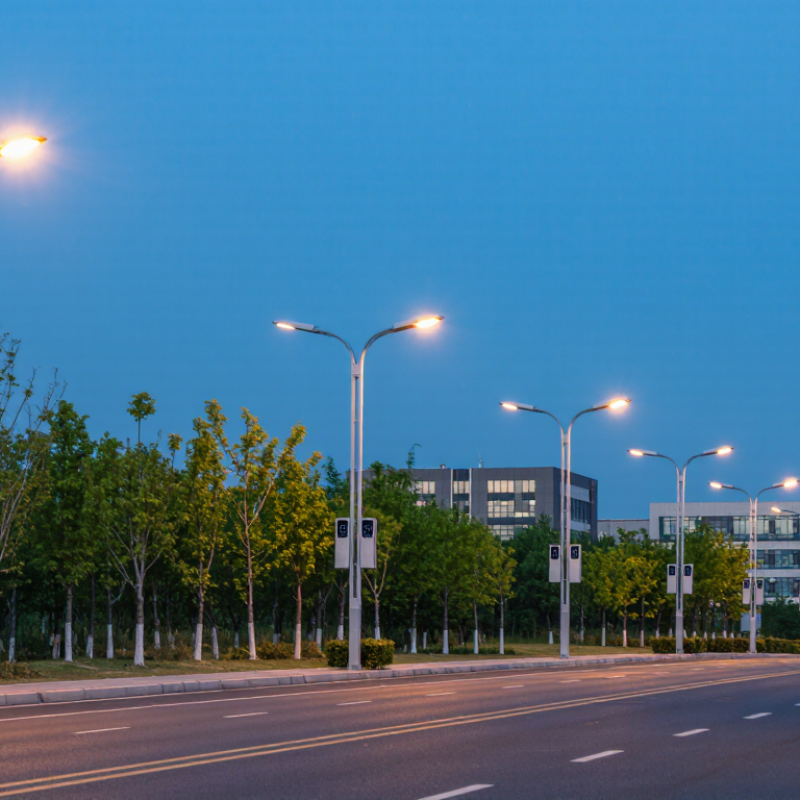
| Urban roads and arterial streets | LED luminaires selected to suit road layout, traffic conditions, mounting height, and applicable roadway-lighting requirements. | Remote on/off control, scheduled dimming, fault alerts, and energy-use monitoring. | Central management software; wireless or wired communications; utility power and existing poles where suitable. | Road-lighting compliance, glare control, uniformity, surge protection, maintainability, and compatibility with the control system. |
| Residential streets and local roads | LED lighting designed for lower-speed streets, pedestrian visibility, and nearby homes. | Time-based dimming and, where appropriate, occupancy-responsive brightness adjustments. | Lighting-control network connected to a municipal operations platform. | Light spill, visual comfort, dependable low-light operation, control flexibility, and resident-facing operating policies. |
| Intersections and pedestrian crossings | Lighting positioned to make road users, crossing areas, and potential conflicts more visible. | Monitoring of luminaire status; adaptive control may be coordinated with traffic or crossing systems where permitted. | Traffic signals, crossing controls, roadway sensors, and city monitoring systems, subject to integration requirements. | Visibility at conflict points, reliable operation, safe integration with traffic equipment, and clear fault reporting. |
| Parks, plazas, and public spaces | Area lighting planned for paths, entrances, gathering areas, and landscape context. | Schedules, zone-based dimming, remote monitoring, and optional environmental or people-counting sensors. | Park-management systems, public Wi-Fi, security systems, or other services when supported by the pole and network design. | Appropriate light distribution, glare and spill control, weather resistance, accessibility, and privacy-aware sensor use. |
| Highways, tunnels, and transport corridors | Lighting specified for the operating conditions and safety requirements of each corridor or enclosed section. | Central status monitoring, scheduled control, alarms, and maintenance diagnostics. | Transport control centers, roadway communications, emergency systems, and backup-power arrangements where required. | Applicable transport standards, environmental durability, communication resilience, emergency procedures, and service access. |
| Industrial sites, ports, and logistics areas | High-mast or area lighting selected for large work zones, access roads, and operational yards. | Zone controls, operating schedules, remote fault detection, and optional integration with site sensors. | Industrial networks, site-management platforms, access-control systems, and operational communications. | Ingress and corrosion protection, vibration and temperature limits, maintainability, coverage, and network security. |
| Smart-city service poles | Street lighting combined with purpose-designed pole hardware and separately specified digital equipment. | May support cameras, environmental sensors, public Wi-Fi, traffic sensors, or EV-charging equipment, depending on design. | Power distribution, communications backhaul, mounting provisions, data platforms, and relevant city services. | Structural capacity, electrical loading, equipment interoperability, cybersecurity, data governance, and lifecycle support. |
| Municipal retrofit projects | Existing luminaires or poles are assessed for LED and control upgrades; replacement scope depends on condition and compatibility. | Remote dimming and monitoring can be introduced in stages, subject to the selected control architecture. | Existing power circuits, pole assets, municipal control platforms, and available communications coverage. | Survey accuracy, installation disruption, compatibility testing, warranty terms, spare parts, and measurable energy reporting. |
| Selection note: There is no single best solution for every city. Compare suppliers using documented photometric designs, applicable certifications, tested environmental and electrical performance, interoperability details, cybersecurity practices, warranty coverage, and local maintenance capability. Energy savings depend on the baseline system, operating hours, dimming strategy, and site conditions. |