| 1. Photocell and scheduled dimming | Local dusk-to-dawn switching with preset dimming schedules; no remote network required. | Photocontrol receptacle and a compatible dimming driver; verify the control method used by the luminaire. | Small deployments, rural roads, and projects where remote monitoring is not required. | Simple architecture, limited communications infrastructure, and straightforward operation. | Does not normally provide centralized fault alerts, live status, or remote schedule changes. | Confirm photocell compatibility, dimming behavior, surge protection, and local switching requirements. |
| 2. Central management with cellular nodes | Individual luminaires communicate with a management platform over a cellular network. | A compatible luminaire controller; some installations use a seven-pin control receptacle conforming to ANSI C136.41. | Projects needing remote monitoring without installing a private radio network. | Can support remote scheduling, status reporting, and fault notifications where cellular service is available. | Coverage, subscription terms, roaming, and device support vary by country and operator. | Check coverage at pole locations, supported cellular bands, SIM management, data costs, and platform export options. |
| 3. Zhaga-D4i-ready control system | Interoperable luminaire and controller components designed for connected lighting applications. | Zhaga Book 18 interface with applicable D4i requirements; confirm the specific luminaire and node certifications. | New installations prioritizing replaceable controllers and standardized luminaire interfaces. | A standardized interface can simplify component replacement and multi-vendor procurement. | An interface alone does not guarantee end-to-end compatibility with every control platform or feature. | Verify the exact Zhaga and D4i conformity, supported sensors, dimming functions, and controller-to-platform compatibility. |
| 4. LoRaWAN gateway-based network | Low-power radio nodes send data to one or more gateways, which connect to the network server. | LoRaWAN; gateway placement and radio settings must suit local spectrum rules and site conditions. | Municipal or campus projects with planned gateway locations and modest device data needs. | Designed for low-power, low-bandwidth communications and can use a privately managed network. | Coverage depends on buildings, terrain, antenna placement, interference, and regional radio regulations. | Request a radio survey, confirm gateway backhaul and redundancy, and check regional frequency-plan compliance. |
| 5. NB-IoT-connected lighting | Low-power cellular IoT connectivity through a participating mobile network operator. | NB-IoT modem and an operator-supported SIM or embedded SIM; availability is market-dependent. | Distributed installations where NB-IoT service is available and device data requirements are modest. | Uses cellular IoT infrastructure and avoids the need for a project-owned radio gateway network. | Operator availability, network coverage, roaming, service terms, and latency can differ between markets. | Confirm local NB-IoT service, device certification, indoor or pole-level coverage, and long-term operator support. |
| 6. LTE-M-connected lighting | Cellular IoT communication with support determined by the modem, operator, and network deployment. | LTE-M-capable controller and an operator-supported SIM or embedded SIM. | Projects that need cellular connectivity and may require more responsive communication than a low-data-only design. | Can provide direct cellular communication without a local gateway, subject to network availability. | LTE-M support and coverage are not uniform across countries or operators; service plans may be required. | Check LTE-M band support, operator certification, roaming policy, data plan, and replacement options for the modem. |
| 7. Power-line communication (PLC) | Control and status data travel over electrical conductors, with system components dependent on the chosen PLC design. | Compatible PLC controllers, concentrators, and management software; interoperability is implementation-specific. | Projects where power-line infrastructure and electrical distribution topology are suitable for PLC. | May reduce the need for a separate wireless radio link at each luminaire. | Signal performance can be affected by wiring layout, electrical noise, transformers, and network segmentation. | Require an on-site communications assessment and verify compatibility with the project’s electrical network. |
| 8. Wi-Fi mesh lighting network | Nodes communicate over a Wi-Fi-based network, with gateways or access points providing backhaul. | Wi-Fi hardware and networking configuration selected for the deployment; check supported frequency bands. | Dense campuses, industrial sites, or districts with existing managed Wi-Fi infrastructure. | Can make use of existing network resources when coverage and security policies allow. | Coverage, interference, cybersecurity management, and backhaul capacity need careful planning. | Assess pole-level signal strength, network ownership, device onboarding, security updates, and access-point capacity. |
| 9. Mesh network with cellular backhaul | Nearby luminaires exchange data over a local mesh; selected gateways connect the mesh to a remote platform over cellular service. | Mesh nodes and gateways using a compatible radio protocol; cellular connectivity at gateway locations. | Areas where local nodes are close enough for mesh communication but wired backhaul is limited. | Can reduce the number of cellular connections required compared with direct cellular connectivity at every pole. | Mesh performance depends on node spacing, obstacles, gateway placement, and network design. | Request a coverage and resilience plan, including gateway failure behavior and cellular backhaul costs. |
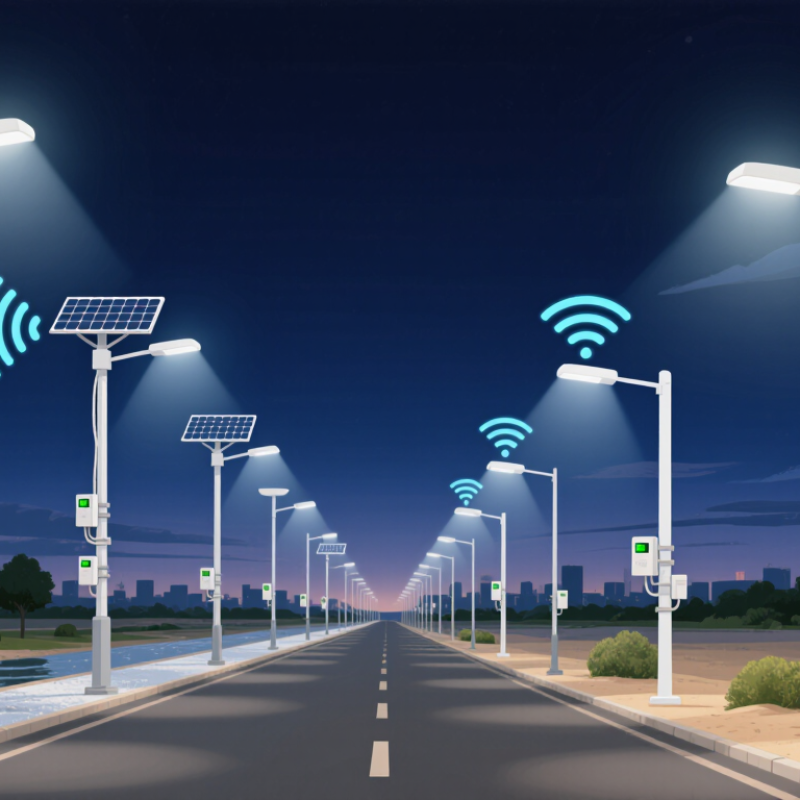
| 10. Solar off-grid smart lighting | Photovoltaic panels and batteries power the luminaire; monitoring and control may use cellular, LoRaWAN, or another supported link. | Solar charge controller, battery, luminaire driver, and a compatible optional communications controller. | Remote locations without practical grid access, subject to adequate solar resource and maintenance access. | Can operate independently of a utility connection when correctly sized for the site and load. | Required panel and battery capacity depend on solar resource, autonomy target, operating schedule, temperature, and load. | Review a site-specific energy calculation, battery service life, winter performance, shading, and component replacement plan. |