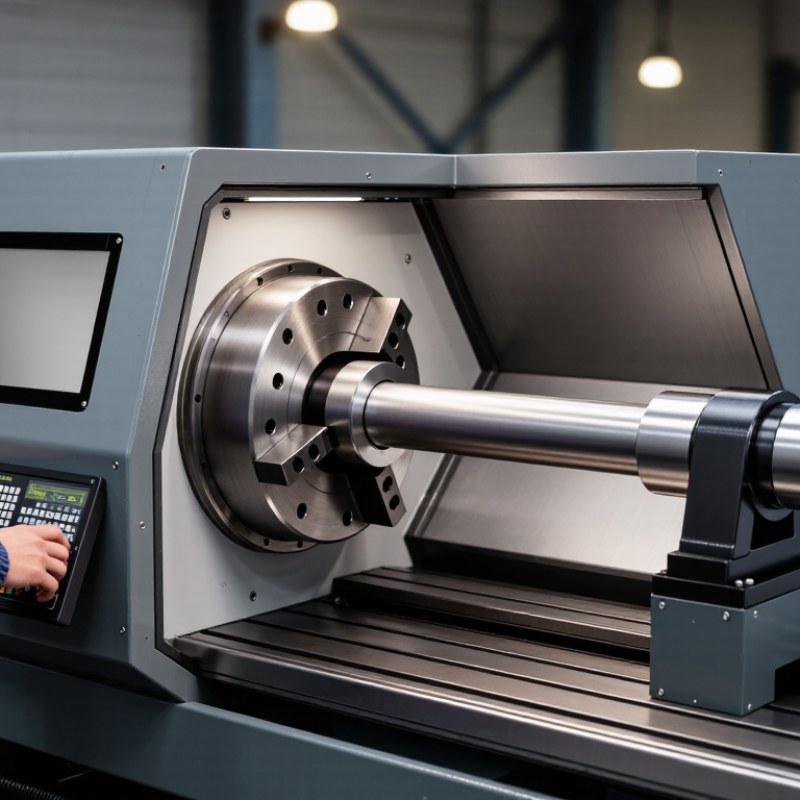
| Single-End Centering Machine | Clamps a workpiece and feeds a centering or center-drilling tool into one end to produce a centered hole or locating feature. | Preparing shaft, pin, rod, and bar-stock ends for later turning or grinding between centers. | Useful when only one end needs a center feature. The result depends on how accurately the workpiece is located and clamped. | Workpiece straightness, chuck or fixture condition, alignment between spindle and tool, tool wear, and clamping force. |
| Double-End Centering Machine | Locates a workpiece and machines center features at both ends, either simultaneously or in coordinated operations, depending on the design. | Producing shafts and similar parts that require center holes at both ends for subsequent machining or inspection. | Can help maintain consistent end-to-end setup. Coaxiality still depends on the machine’s locating method, workpiece condition, and process setup. | Reference datum selection, support and clamping, alignment of the two tool stations, end-face condition, and thermal changes. |
| Manual or Semi-Automatic Centering Machine | An operator loads and positions the part; the machine may provide powered rotation, feed, clamping, or a combination of these functions. | Job shops, repair work, short production runs, and parts that require frequent setup changes. | Flexible for varied work, but repeatability can be more sensitive to operator loading and setup than in a dedicated automated process. | Operator technique, locating stops, fixture repeatability, part-to-part variation, and consistency of tool feed. |
| CNC Centering Machine | Programmed axes control tool position and feed; CNC functions can repeat defined machining sequences and accommodate multiple part setups. | Repeat production of shafts, bars, and other components with specified center-hole positions or end features. | Supports repeatable programmed positioning, but CNC positioning alone does not guarantee the finished feature’s accuracy. | Axis calibration, spindle runout, tool offsets, program settings, fixture location, cutting forces, and maintenance condition. |
| Automatic Production-Line Centering Machine | Automates part feeding, locating, clamping, and machining as part of a production cycle; some systems process multiple parts or ends in sequence. | High-volume production where cycle-time consistency and reduced manual handling are important. | Can provide consistent cycles when correctly set up. Performance depends on stable feeding, reliable locating, and ongoing process control. | Feed-system repeatability, fixture wear, sensor and stop settings, chip removal, tool life, and preventive maintenance. |
| Common Accuracy Checks | Inspection may assess center-hole location, hole geometry, alignment between end features, or runout relative to a specified datum. | In-process checks and final inspection of parts that will be turned or ground using center holes as locating points. | Use the drawing’s tolerances and a suitable inspection method. No single accuracy value applies to every machine, workpiece, or process. | Measurement setup, datum definition, instrument condition, temperature, part cleanliness, and the chosen inspection method. |