| Quality Management | A documented quality management system aligned with ISO 9001 requirements | Provides controlled procedures for purchasing, production, inspection, corrective action, and traceability. | Request a current certificate, certification scope, issuing body, and certificate validity. |
| Wire Diameter Capability | Typical CNC spring-forming equipment is configured for specific wire ranges, commonly from approximately 0.2 mm to 12 mm depending on machine class. | The usable range determines whether the machine can produce the required spring sizes and materials. | Match the exact wire diameter, tensile strength, material grade, and spring drawings to the proposed model. |
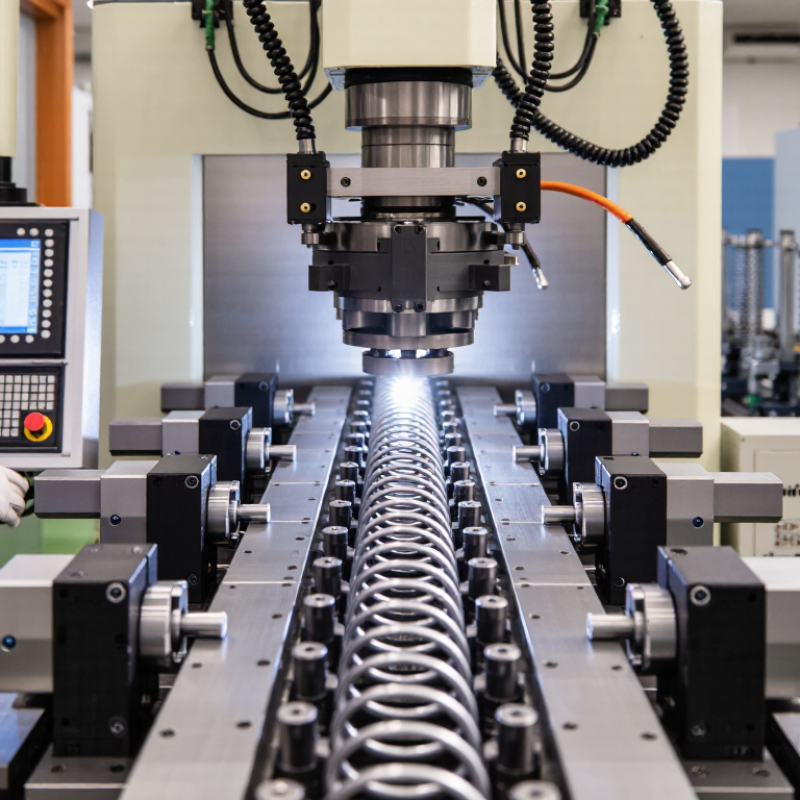
| Machine Axes and Tooling | Multi-axis CNC control, commonly using 6 to 12 programmable axes for complex spring and wire-forming operations. | More controlled axes can reduce manual adjustments and support complex geometries, but only when properly programmed. | Review the axis list, servo configuration, tooling layout, and a sample production program. |
| Dimensional Repeatability | A reliable supplier should state repeatability and test conditions; values around ±0.02 mm to ±0.05 mm may be achievable for suitable parts and processes. | Repeatability affects batch consistency, assembly fit, and scrap rates. | Request inspection records from an actual sample, including measurement equipment, tolerance, and environmental conditions. |
| Control System | Industrial CNC control with program storage, parameter backup, alarm history, recipe management, and operator access control. | Stable controls shorten changeover time and help protect production settings. | Confirm interface language, data backup method, remote-support capability, and spare-control availability. |
| Material Compatibility | The machine should be selected for the required materials, such as carbon spring steel, stainless steel, music wire, or copper alloys. | Different materials have different hardness, springback, surface-finish, and tooling requirements. | Run a trial using the customer’s actual wire material and verify dimensions after forming and heat treatment where applicable. |
| Production Efficiency | Evaluate cycle time, setup time, automatic feeding, cutting method, and the number of operations completed in one setup. | A shorter cycle is valuable only if dimensional stability and uptime are maintained. | Compare a documented sample cycle using the same spring geometry, wire size, and quality requirements. |
| Electrical and Safety Compliance | Electrical design should reflect the destination market’s requirements, including applicable machinery safety, electrical, and electromagnetic-compatibility rules. | Compliance reduces installation, workplace-safety, and import risks. | Confirm the voltage, frequency, protective devices, risk assessment, wiring documentation, and required conformity documents. |
| Inspection and Testing | Pre-shipment inspection should cover machine operation, trial parts, dimensions, safety functions, accessories, and documentation. | A defined acceptance process makes performance measurable before shipment. | Use an agreed factory acceptance test with drawings, tolerances, sampling rules, and signed inspection records. |
| After-Sales Support | Support should include installation guidance, operator training, troubleshooting procedures, software backup, and spare-parts planning. | Effective support reduces downtime and improves the customer’s ability to maintain the machine locally. | Obtain response-time commitments, service channels, training scope, warranty terms, and a recommended spare-parts list. |
| Total Cost of Ownership | Assess purchase price together with tooling, freight, installation, energy use, maintenance, consumables, software, and downtime risk. | The lowest initial quotation may not provide the lowest cost per acceptable spring. | Compare a five-year cost model based on production volume, maintenance intervals, labor, and expected machine utilization. |