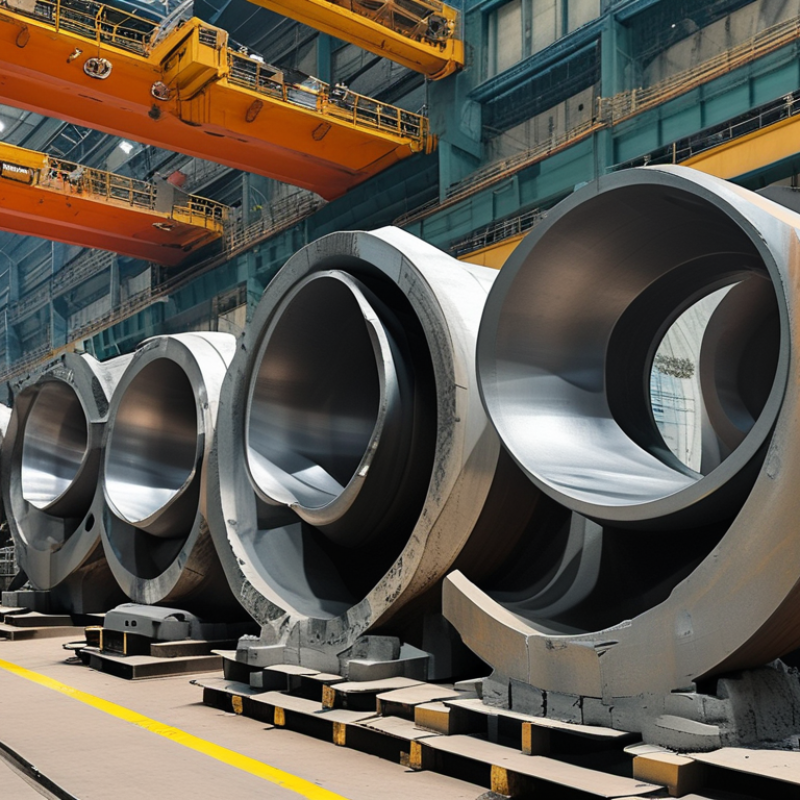
| Manufacturing Capacity | Maximum casting weight and overall casting dimensions | Capacity should exceed the required product weight and dimensions by at least 15% to 20%. | Equipment list, furnace specifications, workshop photographs, dimensional drawings, and recent production records | High |
| Steel Grades | Ability to produce carbon steel, low-alloy steel, stainless steel, and heat-resistant grades | The supplier should demonstrate experience with the exact grade, applicable standard, and required service temperature. | Material grade list, chemical composition reports, previous inspection reports, and approved material specifications | High |
| Melting Control | Furnace type, furnace capacity, temperature monitoring, and chemical analysis | Each heat should have a unique heat number and documented chemical analysis before casting. | Furnace calibration records, spectrometer reports, heat records, and molten-metal temperature logs | High |
| Dimensional Accuracy | Control of shrinkage, machining allowance, tolerances, and distortion | Casting tolerances should be agreed according to the drawing and a recognized standard such as ISO 8062. | Inspection and test plan, dimensional inspection reports, calibrated measuring-tool certificates, and 3D measurement data | High |
| Heat Treatment | Normalizing, annealing, quenching, tempering, or solution treatment capability | Heat-treatment cycles should include controlled temperature, holding time, cooling method, and furnace traceability. | Heat-treatment charts, furnace uniformity records, calibration certificates, and batch records | High |
| Mechanical Properties | Tensile strength, yield strength, elongation, impact toughness, and hardness | Results must meet the purchase specification and the applicable material standard for every approved test batch. | Independent or in-house laboratory reports, tensile-test results, impact-test results, and hardness records | High |
| Non-Destructive Testing | Ultrasonic, magnetic-particle, liquid-penetrant, and radiographic inspection | Inspection coverage and acceptance levels should be defined before production and linked to recognized codes or project specifications. | NDT procedures, operator qualifications, inspection maps, radiographic or ultrasonic reports, and repair records | High |
| Internal Quality | Porosity, shrinkage, inclusions, cracks, and casting-repair control | The manufacturer should maintain documented defect-prevention and repair procedures, with customer approval required for major weld repairs. | Nonconformance reports, weld-repair procedures, weld maps, corrective-action reports, and sample sectioning records | High |
| Quality Management | Quality management system and process consistency | An active ISO 9001-certified quality management system is a strong baseline for production control. | Valid certification, audit reports, quality manual, internal audit schedule, and corrective-action records | High |
| Environmental and Safety Control | Environmental management, worker safety, dust control, and waste handling | ISO 14001 and ISO 45001 certification can provide additional evidence of structured environmental and occupational-safety management. | Environmental permits, safety records, emissions-control records, waste-disposal documents, and relevant certifications | Medium |
| Traceability | Link between raw materials, heat numbers, molds, heat treatment, inspection, and final shipment | A complete traceability chain should be maintained from raw material receipt through final inspection and packing. | Material certificates, heat-number records, production travelers, inspection reports, nameplate photographs, and packing lists | High |
| Production Lead Time | Pattern preparation, tooling, molding, melting, heat treatment, inspection, machining, and delivery | The supplier should provide a stage-by-stage schedule, with separate dates for first casting, inspection, machining, and shipment. | Detailed production schedule, capacity plan, tooling timeline, shipping plan, and historical on-time delivery data | Medium |
| Machining Capability | Large CNC turning, milling, boring, drilling, and dimensional verification | Machining equipment should cover the finished-part envelope, tolerance requirements, surface-finish requirements, and datum references. | Machine specifications, machining samples, process sheets, CMM reports, and equipment calibration records | High |
| Inspection Independence | Separation between production personnel and final quality approval | Final acceptance should be performed by qualified inspectors using calibrated equipment and approved procedures. | Inspector qualification records, inspection organization chart, calibration certificates, and final release documents | High |
| Export Experience | Packaging, corrosion protection, shipping documentation, and international delivery handling | Export packaging should protect heavy castings against impact, moisture, corrosion, and lifting damage during multimodal transport. | Packing specifications, lifting plans, export documents, cargo photographs, and previous shipment references without confidential customer data | Medium |
| Commercial Transparency | Quotation clarity, tooling charges, inspection costs, payment terms, and warranty conditions | The quotation should separately identify casting, machining, heat treatment, NDT, tooling, packing, and transportation costs. | Itemized quotation, technical offer, payment terms, warranty policy, and change-order procedure | Medium |
| Supplier Verification | Factory audit, production sample review, and customer-reference validation | A remote or on-site audit should verify equipment, personnel, process controls, inspection facilities, and actual production capability. | Audit checklist, corrective-action plan, production-line video or visit report, sample approval records, and verifiable references | High |