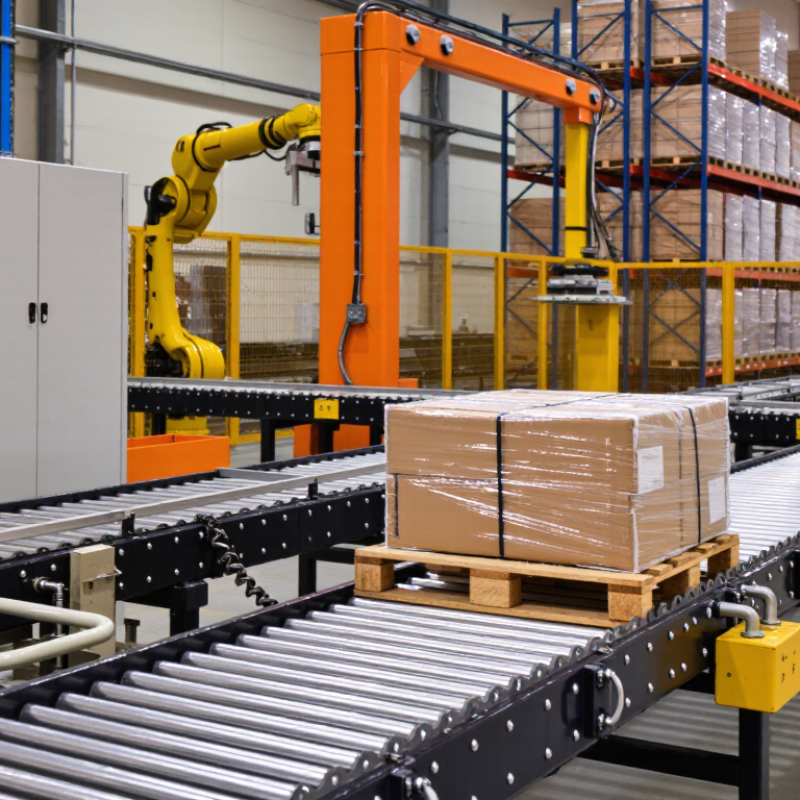
| Product Portfolio | Designs and produces chain transfer conveyors, roller transfer conveyors, lift-and-transfer units, turntables, shuttle systems, and pallet positioning modules. | Suitable configurations are available for straight transfer, 90-degree transfer, parallel-line transfer, accumulation, and warehouse interface applications. | A broader product range makes it easier to build a complete pallet-handling line from one engineering source. | Request layout drawings, application references, and a configuration list matched to the pallet dimensions. |
| Load Capacity | Heavy-duty designs commonly use structural steel frames, powered rollers, chains, bearings, and reinforced lifting mechanisms. | Many industrial pallet-transfer units are engineered for approximately 500–2,000 kg per pallet; higher capacities require project-specific calculations. | Correct load selection prevents frame deflection, drive overload, premature bearing wear, and unstable pallet movement. | Check the rated load, safety factor, pallet center of gravity, load distribution, and maximum allowable point load. |
| Pallet Compatibility | Equipment can be customized for common wooden, plastic, and steel pallets, including non-standard pallet footprints. | Typical designs accommodate pallet widths and lengths around 800–1,300 mm, subject to conveyor type and layout. | Accurate pallet compatibility reduces skewing, jamming, and transfer failures at line junctions. | Provide pallet drawings showing dimensions, runners, openings, underside clearance, weight, and surface condition. |
| Transfer Accuracy | Uses guide rails, stopper cylinders, sensors, mechanical centering devices, and controlled lifting or chain movement. | Positioning accuracy is commonly engineered within approximately ±5–10 mm, depending on the pallet, speed, and sensor arrangement. | Reliable positioning is essential for robotic picking, wrapping, labeling, storage, and automated loading. | Ask for the guaranteed positioning tolerance under the actual pallet load and operating speed. |
| Throughput | Drive selection and conveyor spacing are configured according to pallet weight, transfer distance, accumulation requirements, and cycle time. | Typical pallet transfer applications operate at roughly 10–30 pallets per hour; high-speed systems require a detailed cycle-time study. | Throughput data helps determine whether the conveyor can support production output without becoming a bottleneck. | Request a cycle-time calculation covering loading, transfer, positioning, release, and safety-reset time. |
| Drive and Control System | Common systems include geared motors, variable-frequency drives, photoelectric sensors, PLC controls, emergency stops, and HMI interfaces. | Industrial control panels are commonly designed for 380–400 V AC, three-phase, 50 Hz power, with final voltage confirmed for the destination country. | Compatible controls simplify integration with conveyors, warehouse management systems, robots, and production-line PLCs. | Confirm PLC protocol, I/O list, control-panel rating, motor protection, fault codes, and remote-support capability. |
| Safety Design | Leading suppliers normally include emergency-stop circuits, guarding, pinch-point protection, overload protection, warning labels, and safety interlocks. | Electrical safety documentation may reference IEC 60204-1 or the applicable local equivalent; machinery safety requirements depend on the destination market. | Proper safeguarding protects operators and reduces commissioning, compliance, and liability risks. | Review the risk assessment, safety-circuit diagram, guarding design, emergency-stop response, and user manual. |
| Manufacturing Quality | Established factories commonly use CNC cutting, robotic or controlled welding, machining, powder coating, assembly inspection, and load testing. | ISO 9001 certification is a useful quality-system indicator, but it does not replace product-specific inspection and performance testing. | Consistent fabrication improves alignment, service life, repeatability, and ease of installation. | Verify the certificate scope and validity, factory process controls, material records, inspection reports, and welding quality procedures. |
| Frame and Surface Finish | Carbon-steel frames with powder coating are widely used; stainless-steel or corrosion-resistant finishes can be specified for harsh environments. | Finish selection depends on humidity, washdown exposure, temperature, chemicals, and indoor or outdoor installation conditions. | The correct material and coating reduce corrosion and maintenance costs over the conveyor life cycle. | Specify material grade, coating system, coating thickness requirement, surface preparation, and environmental conditions. |
| Customization Ability | Project-based engineering commonly covers conveyor height, transfer direction, roller or chain pitch, pallet stops, guarding, sensors, and line interfaces. | Custom designs should be based on a complete technical specification rather than a catalog model alone. | Customization is important when connecting different conveyor elevations, pallet sizes, robots, racks, or automated storage systems. | Evaluate the supplier’s general arrangement drawings, 3D models, interface drawings, and design-change process. |
| Testing and Commissioning | Professional suppliers conduct no-load testing, loaded testing, sensor checks, control-system testing, and trial operation before shipment or installation. | Factory acceptance testing should use representative pallets and the agreed operating sequence wherever practical. | Pre-shipment testing reduces installation delays and identifies mechanical or control issues earlier. | Agree on FAT procedures, acceptance criteria, test records, punch-list handling, and site acceptance responsibilities. |
| Documentation | Complete project documentation may include assembly drawings, electrical schematics, spare-parts lists, operating instructions, maintenance schedules, and certificates. | Documentation should identify motors, sensors, bearings, drives, PLC components, lubrication points, and recommended replacement intervals. | Clear documentation improves operator training, preventive maintenance, troubleshooting, and future modifications. | Make document delivery and language requirements part of the purchase specification and contract. |
| Export and Installation Support | Experienced exporters can provide packing plans, shipping dimensions, installation guidance, commissioning support, and remote troubleshooting. | Export readiness depends on the destination voltage, language, customs requirements, packaging method, and local safety regulations. | Strong support reduces the risk of damage, incorrect assembly, extended downtime, and communication delays. | Confirm Incoterms, spare-parts availability, installation scope, response time, warranty terms, and technical-support channels. |
| Total Cost of Ownership | Competitive purchase prices are often combined with modular construction, standard drive components, and locally available replacement parts. | Total cost should include equipment, controls, shipping, installation, commissioning, energy use, wear parts, maintenance, and downtime risk. | The lowest initial quotation may not provide the lowest long-term operating cost. | Compare lifecycle cost, warranty coverage, motor efficiency, spare-parts pricing, maintenance access, and expected service intervals. |
| Supplier Selection Score | Preferred suppliers demonstrate verified engineering capability, stable manufacturing processes, suitable safety documentation, and relevant project experience. | Recommended weighting: Technical fit 30% · Quality 20% · Safety and compliance 15% · Delivery 15% · Service 10% · Cost 10% | A weighted evaluation prevents price from becoming the only decision factor for a safety-critical material-handling system. | Use the same checklist and evidence requirements for every shortlisted supplier before issuing a purchase order. |