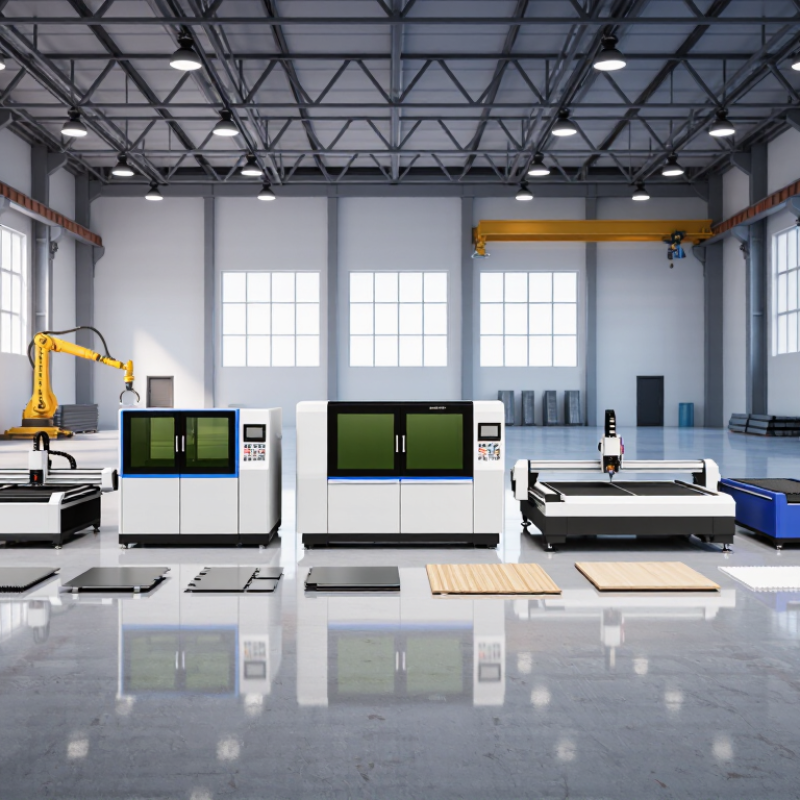
| 1 | Flat-Sheet Metal Cutting | Fiber laser, CNC motion control, assist-gas cutting | Common industrial systems range from a few kilowatts to tens of kilowatts; bed sizes vary by model. | Carbon steel, stainless steel, aluminum, and other sheet metals; fabrication and machinery parts. | Cut quality, rated power, bed size, nesting software, extraction, safety, and local service support. |
| 2 | Tube and Profile Cutting | Fiber laser with rotary chuck or multi-chuck feeding systems | Fiber sources commonly range from around 1 kW to over 10 kW, depending on material and production needs. | Round, square, and rectangular metal tubes; frames, furniture, construction, and vehicle components. | Tube diameter and length capacity, loading automation, chuck accuracy, remnant length, and software support. |
| 3 | Non-Metal CO₂ Cutting and Engraving | CO₂ gas laser with gantry motion control | Many small and mid-size systems use sources in the tens to several hundreds of watts; configurations vary widely. | Wood, acrylic, textiles, leather, paper, and some plastics; signage, crafts, packaging, and prototypes. | Working area, focus control, exhaust and cooling systems, material compatibility, and optical-component availability. |
| 4 | Fiber Laser Marking | Pulsed fiber laser; some systems use MOPA pulse control | 20–100 W is a common range for many general-purpose marking applications. | Metals and selected engineered materials; serial numbers, logos, codes, and product traceability. | Marking speed, field size, rotary options, code readability, enclosure class, and software integration. |
| 5 | UV Laser Marking and Microprocessing | Ultraviolet solid-state laser, commonly operating at 355 nm | Low-power pulsed systems are common; output depends on the required mark, material, and processing speed. | Electronics, glass, ceramics, selected plastics, and coated materials requiring fine or low-heat marking. | Spot size, pulse characteristics, thermal effect, repeatability, and compatibility with production-line vision systems. |
| 6 | Laser Welding | Fiber or diode laser with handheld, fixture-based, or robotic delivery | Systems range from lower-kilowatt handheld units to higher-power automated installations. | Metal joints in sheet fabrication, appliances, enclosures, automotive components, and precision assemblies. | Joint quality, wire-feeding options, process monitoring, operator safety, fixture design, and fume extraction. |
| 7 | Laser Cleaning | Pulsed or continuous-wave fiber laser, selected for the cleaning task | Portable and automated systems are available across a broad range of average powers and pulse formats. | Removal of rust, oxides, paint, oil, or surface residues from suitable metal components and tooling. | Substrate protection, cleaning rate, beam control, extraction, safety enclosure, and validation on sample parts. |
| 8 | Metal Additive Manufacturing | Laser powder bed fusion using one or more focused laser beams | Laser count, power, build volume, and scan strategy vary by machine and target material. | Metal powders for complex parts, prototypes, and specialized production in aerospace, medical, and industrial sectors. | Build volume, powder handling, process qualification, atmosphere control, material data, and post-processing needs. |
| 9 | Precision Micromachining | Picosecond or femtosecond ultrafast laser with precision motion stages | Configurations are application-specific; pulse duration, repetition rate, and beam quality are key parameters. | Fine drilling, scribing, texturing, and micro-cutting of metals, glass, ceramics, and electronic materials. | Positioning accuracy, pulse control, process stability, metrology, and demonstrated results on the target material. |
| 10 | Laser Cladding and Surface Hardening | High-power diode or fiber laser with powder or wire feeding, where applicable | Power and delivery configuration are selected according to coating width, material, and component geometry. | Repair, wear-resistant coatings, and surface modification of industrial parts and tooling. | Cladding consistency, dilution control, feedstock delivery, robotic reach, and metallurgical test results. |