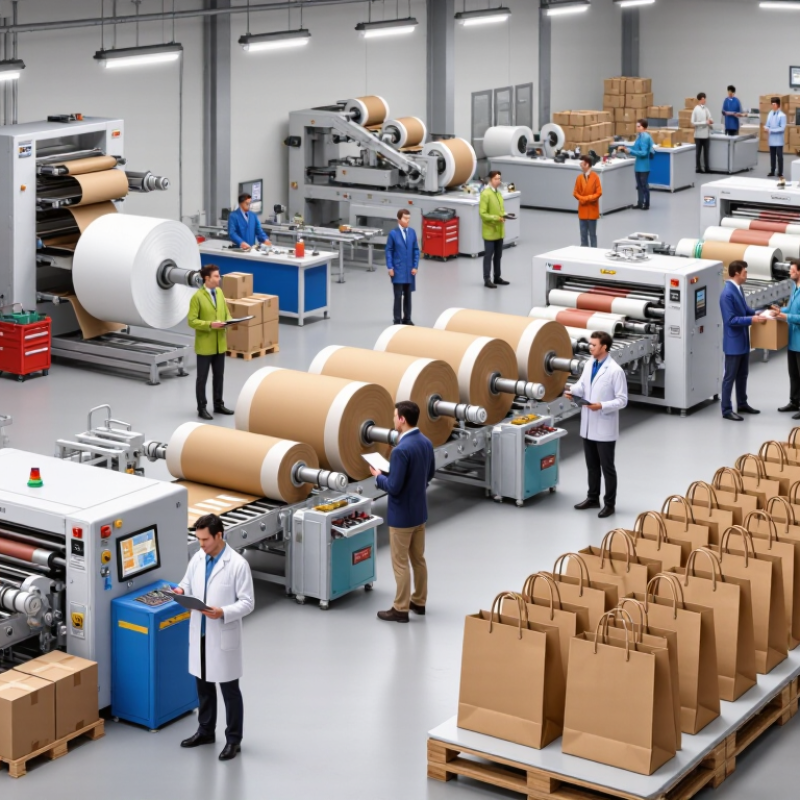
| Bag style and line configuration | V-bottom, square-bottom, flat-handle, or twisted-handle paper bag production | Confirm that the proposed line supports the required bag style, handle type, and production sequence. Handle making may be integrated or handled by a separate machine. | Written configuration list, process-flow diagram, and sample bags produced on the proposed equipment |
| Bag dimensions | Minimum and maximum bag width, side gusset, and cut-off length | Compare the quoted operating range with the buyer’s actual product sizes; check whether size limits differ by bag style or paper grade. | Machine specification sheet showing dimensional ranges and any format-specific restrictions |
| Paper material compatibility | Paper grammage, roll width, roll diameter, and supported paper grades | Compatibility depends on the machine design, paper characteristics, bag dimensions, and production speed. Verify the exact material intended for production rather than relying on a general range. | Test results using the buyer’s paper, including grammage, roll details, and finished-bag samples |
| Rated and demonstrated output | Machine speed, measured in bags per minute, for the required bag format | Distinguish the maximum rated speed from the sustained speed achieved with the buyer’s paper, bag size, printing, and handle configuration. | Factory acceptance test (FAT) results recording the bag specification, material, run duration, output, and reject count |
| Printing capability | Inline or offline printing, number of colors, print width, and registration control | Check whether printing is included in the line quotation and whether the print unit can handle the intended artwork, ink system, and paper surface. | Printing-unit specification, approved print samples, and details of included tooling and setup |
| Changeover and adjustment | Format-change procedure, tooling requirements, and changeover time | Compare the number of manual adjustments and special parts needed when switching between the buyer’s bag sizes or handle options. | Demonstration of a format change and a written list of change parts, tools, and operator steps |
| Quality control and waste | Glue application, fold accuracy, handle attachment, detection systems, and start-up waste | Agree on acceptance criteria for finished bags and clarify how defects, stoppages, and material waste will be measured during testing. | Sample inspection report, agreed quality checklist, and documented production-test results |
| Electrical and utility requirements | Supply voltage, frequency, installed power, compressed air, and extraction needs | Confirm compatibility with the installation site and local electrical standards before ordering. Requirements vary by machine configuration and destination country. | Electrical drawings, utility schedule, and a site-preparation checklist |
| Automation and operator interface | Control system, recipe storage, alarms, safety interlocks, and language options | Check which functions are standard, how production settings are saved, and whether manuals and operator training are available in the required language. | Control-system description, sample manual, safety documentation, and training plan |
| Installation and after-sales support | Commissioning, training, spare parts, remote support, and service response arrangements | Compare the scope and cost of installation support, warranty coverage, recommended spare parts, and service availability in the buyer’s region. | Written warranty terms, service plan, spare-parts list, and commissioning schedule |
| Comparison note: Use the same bag specifications, paper, testing conditions, and acceptance criteria when assessing quotations. Performance figures and equipment limits are configuration-specific; confirm all values in the supplier’s written technical proposal and acceptance test. |