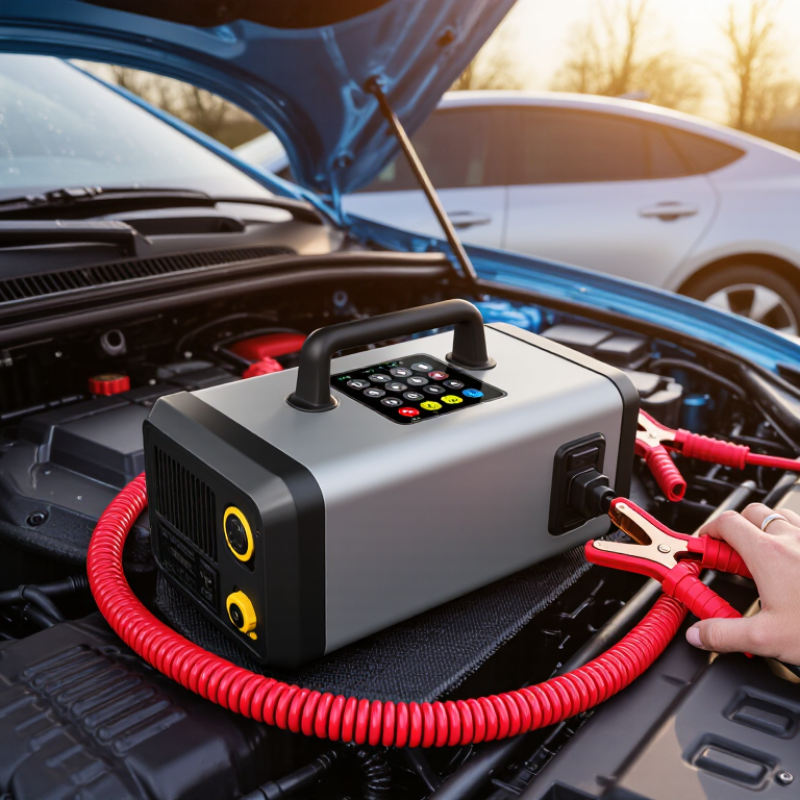
| 1 | Vehicle Compatibility | Choose a unit rated for the engine type and displacement of the vehicle. A 12-volt starter is typical for passenger cars, while larger engines may require a higher peak-current rating. | A starter that is undersized may not deliver enough current to crank the engine, especially in cold weather or with an aging battery. | Confirm the manual lists compatibility with the vehicle's fuel type, engine size, and electrical system. |
| 2 | Peak and Starting Current | For many compact and midsize cars, approximately 400–800 starting amps can be a practical range. Larger engines generally need more capacity. | Starting current indicates the output available during cranking, but advertised peak current may last only briefly and should not be the sole selection factor. | Look for both peak current and starting-current ratings, and compare them with the vehicle manufacturer's requirements. |
| 3 | Battery Capacity | A built-in battery of about 8,000–20,000 mAh is common for portable automotive units. Higher capacity usually supports more starting attempts between charges. | Capacity affects standby time, the number of emergency uses, and how often the device must be recharged. | Check whether the stated capacity is measured at the internal cell voltage and review the manufacturer's estimated jump-start count. |
| 4 | Physical Size and Weight | For regular car use, a compact unit around 15–25 cm long and approximately 0.8–1.8 kg is generally easier to store and carry. | A smaller, lighter design is more convenient for a glove box or roadside use, although very high-output models may be larger. | Measure the available storage space and compare the product's dimensions and weight, including cables and accessories. |
| 5 | Recharge Method and Input | USB-C input is convenient; an input of approximately 15–30 W can provide faster recharging than basic low-power USB charging. | Faster and more widely compatible charging reduces the time needed to restore the unit after an emergency. | Verify whether the required charging cable and wall adapter are included and whether the device supports the stated input power. |
| 6 | USB Output Ports | At least one USB-A output is useful for common cables, while a USB-C output with power delivery can support newer phones and tablets. | Multiple output types allow the starter to function as a portable power bank during travel or roadside emergencies. | Compare the output voltage, current, and total wattage rather than counting ports alone. |
| 7 | 12-Volt Auxiliary Port | A regulated 12-volt outlet can support compatible accessories such as tire inflators, coolers, or vehicle electronics. | The port expands the device's emergency usefulness, but connected accessories may drain the internal battery quickly. | Confirm the port's maximum current or wattage and ensure the accessory plug matches the socket size. |
| 8 | Safety Protection | Look for reverse-polarity, short-circuit, over-current, over-temperature, overcharge, and spark-resistant protection. | These safeguards help reduce the risk of cable damage, battery damage, sparks, and incorrect connection during a jump start. | Read the operating instructions to confirm which protections are built into the clamps and control unit. |
| 9 | Operating Conditions | A broad working range, such as approximately -20°C to 60°C, is useful for seasonal and roadside storage, provided it is supported by the specifications. | Battery performance can decrease in cold temperatures, while excessive heat can shorten lithium-battery life and affect safety. | Review the stated operating and storage temperature ranges and avoid leaving the unit in a hot vehicle for long periods. |
| 10 | Indicators, Cables, and Maintenance | A clear battery-level display, adequately long insulated clamps, bright work light, and periodic recharging are desirable features. | Clear indicators and accessible cables make the unit easier to use in darkness, while regular charging keeps it ready for emergencies. | Choose a model with readable status indicators, durable cable insulation, secure clamp storage, and a recommended maintenance-charging schedule. |