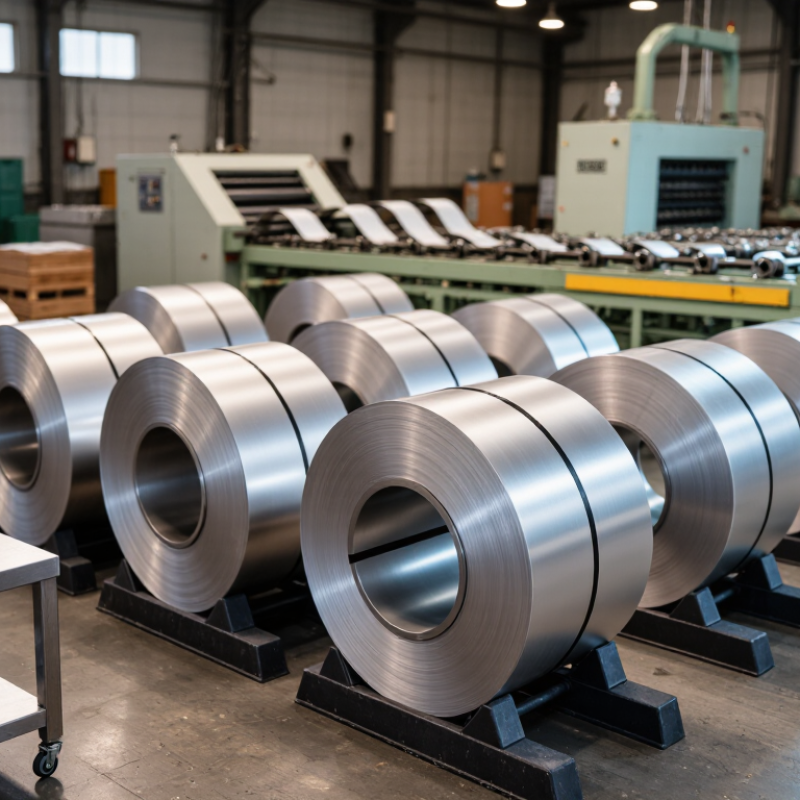
| Material | Grade and standard | 430 ferritic stainless steel strip, commonly specified under ASTM A240/A240M or EN 10088-2 requirements. | Using the same standard and grade prevents suppliers from quoting different material categories under the same product name. | Request the applicable standard, material test certificate, heat number, and chemical analysis. |
| Material | Typical chemical composition | Chromium: approximately 16.0–18.0%; carbon: maximum 0.12%; nickel is generally not intentionally added as a major alloying element. | 430 is usually less expensive than nickel-containing austenitic grades, but it has lower corrosion resistance and formability than 304 in many applications. | Confirm the chemical limits required by the purchase specification rather than relying only on the designation “430.” |
| Material | Physical characteristics | Density: approximately 7.70 g/cm³; magnetic at room temperature; thermal expansion is typically lower than that of 304 stainless steel. | Density is useful for converting strip dimensions into estimated shipment weight and freight cost. | Use the agreed density and actual coil weight for landed-cost calculations. |
| Dimensions | Thickness range | Common commercial range: approximately 0.05–3.00 mm, subject to rolling capability, tolerance, and order quantity. | Ultra-thin strip generally carries higher processing and inspection costs than standard thicknesses. | Specify nominal thickness, tolerance, measuring method, and sampling frequency. |
| Dimensions | Width and slit tolerance | Typical slit widths may range from approximately 10–600 mm. Tolerance depends on width, thickness, edge condition, and equipment. | Narrow or tight-tolerance slitting can increase setup time, scrap, and unit cost. | Define width tolerance, burr height, camber, edge condition, and allowable coil telescoping. |
| Surface | Finish selection | Common finishes include 2B, BA, brushed or satin finishes, and No. 1 hot-rolled finish for suitable thicknesses. | Bright annealed and decorative finishes usually cost more than standard 2B because of additional process control and protection requirements. | Provide a surface sample or reference specification and define acceptable scratches, pits, stains, and roll marks. |
| Cost | Material price basis | Indicative transaction levels for 430 strip can vary widely, often approximately USD 1.80–4.50 per kg before international freight, depending on thickness, finish, quantity, region, and market conditions. | A low unit price may exclude slitting, surface protection, export packing, testing, or special tolerances. | Compare quotations on an identical basis: grade, dimensions, finish, quantity, inspection, packing, currency, and Incoterm. |
| Cost | Quantity and coil weight | Small trial orders generally have a higher price per kilogram. Larger production orders may reduce setup and slitting cost per kilogram. | Ordering more material can reduce unit cost but increases inventory, storage, and foreign-exchange exposure. | Ask for separate pricing at trial, medium-volume, and annual-contract quantities. |
| Cost | Quote validity | Metal prices, energy costs, currency exchange rates, and freight rates can change during a short quotation period. | A quote without a validity period creates uncertainty when purchase orders are delayed. | Require the validity period, surcharge mechanism, currency, payment terms, and price-adjustment conditions. |
| Packaging | Coil orientation | Coils may be supplied eye-to-side or eye-to-sky, depending on handling equipment and transport requirements. | The wrong orientation may require additional handling or make warehouse lifting unsafe. | Show the required orientation in the purchase order and packing drawing. |
| Packaging | Protection materials | Typical protection includes waterproof wrapping, edge protection, steel or fiber-board outer protection, and a pallet or skid where required. | More robust packaging increases packing cost and gross weight but reduces the risk of moisture, impact, and edge damage. | Specify moisture protection, edge guards, wrapping layers, lifting points, and whether materials must be suitable for export transport. |
| Packaging | Wood packaging compliance | Solid-wood pallets, skids, and crates used in international trade may need ISPM 15 treatment and marking. Plastic or steel supports generally avoid this specific wood-treatment requirement. | Non-compliant wood packaging can cause customs delays, treatment at destination, re-export, or disposal costs. | Confirm the destination-country requirement and request treatment documentation when solid wood is used. |
| Packaging | Shipping marks and documents | Recommended marks include purchase-order number, coil number, grade, size, net weight, gross weight, dimensions, country of origin, and handling symbols. | Clear identification reduces receiving errors and supports customs clearance and traceability. | Approve the packing list, commercial invoice, certificate of origin, and labels before dispatch. |
| Shipping | Transport mode | Ocean freight is normally economical for palletized or containerized production orders. Air freight is faster but normally much more expensive and is better suited to samples or urgent small quantities. | Mode selection should consider total landed cost, production downtime, inventory carrying cost, and delivery urgency. | Compare door-to-door transit time, port handling, customs clearance, and final-mile delivery—not only the ocean or air rate. |
| Shipping | Indicative ocean freight scale | Container freight is commonly quoted by container, route, season, and equipment availability. A 20-foot dry container has a nominal internal capacity of about 33 m³, but payload limits and local regulations apply. | High-density steel can reach the container payload limit before the internal volume is full. | Confirm the carrier’s maximum payload, local road weight limits, container tare weight, and actual packed gross weight. |
| Incoterms | EXW | The buyer generally arranges collection from the seller’s premises and bears most transport, export, and import responsibilities. | May appear inexpensive but can be less convenient for buyers without local logistics control. | Request a complete pickup cost and verify who performs export customs formalities. |
| Incoterms | FCA | The seller delivers the goods to the named carrier or agreed location and handles export clearance where applicable. | Often provides clearer control over the main carriage while separating origin responsibilities. | State the exact FCA location, such as the seller’s facility or a named terminal. |
| Incoterms | FOB | For sea or inland waterway transport, the seller delivers the goods on board the vessel at the named port of shipment. | Useful for buyers controlling ocean freight, but it is not designed for every multimodal or containerized arrangement. | Confirm the named port, export clearance, terminal charges, and transfer of risk. |
| Incoterms | CFR and CIF | The seller arranges carriage to the named destination port. Under CIF, the seller also arranges the minimum contractual insurance cover required by the rule. | Freight-inclusive pricing can simplify comparison, but destination charges, import clearance, duties, and inland delivery may remain excluded. | Request a destination-cost breakdown and verify the insurance coverage, exclusions, and claim process. |
| Incoterms | DAP and DDP | DAP generally delivers to the named destination while the buyer handles import clearance and duties. DDP places the broadest delivery responsibility, including import clearance and duties, on the seller where legally practicable. | These terms can make landed cost easier to estimate, but DDP may be unsuitable where the seller cannot legally act as importer of record. | Identify the exact delivery address, importer of record, tax treatment, customs broker, and excluded destination fees. |
| Compliance | Import duties and taxes | Duty rates depend on the destination country, tariff classification, customs value, origin, trade agreements, and applicable trade-remedy measures. | Duty and tax can materially change the final cost even when the supplier’s ex-works price is competitive. | Confirm the likely HS classification with a licensed customs professional before placing the order. |
| Quality | Inspection and testing | Typical controls include dimensional inspection, surface inspection, mechanical testing where required, chemical analysis, and review of the material test certificate. | Pre-shipment inspection may cost more but can reduce the risk of receiving nonconforming coils. | Define acceptance criteria, sampling plan, inspection party, claim period, and remedy for nonconforming material. |
| Lead Time | Production and transit planning | Standard production may require several weeks, while ocean transit and customs clearance add route-dependent time. Actual lead time varies by order size, finish, port, season, and capacity. | Ordering only against the advertised transit time can create stock-out risk. | Request a schedule covering order confirmation, production completion, inspection, cargo readiness, vessel departure, arrival, customs, and delivery. |
| Landed Cost | Recommended calculation | Estimated landed cost = material price + processing and slitting + packaging + inland origin charges + export documentation + international freight + insurance + destination charges + duties and taxes + inland delivery. | This calculation provides a more meaningful comparison than price per kilogram alone. | Use the same currency, quantity, exchange-rate date, delivery location, and Incoterm for every supplier comparison. |
| Note: Price ranges, freight levels, lead times, and duty exposure are indicative planning values rather than binding offers. Final costs depend on the confirmed specification, order quantity, origin, destination, market conditions, customs classification, packaging design, and selected Incoterm. |