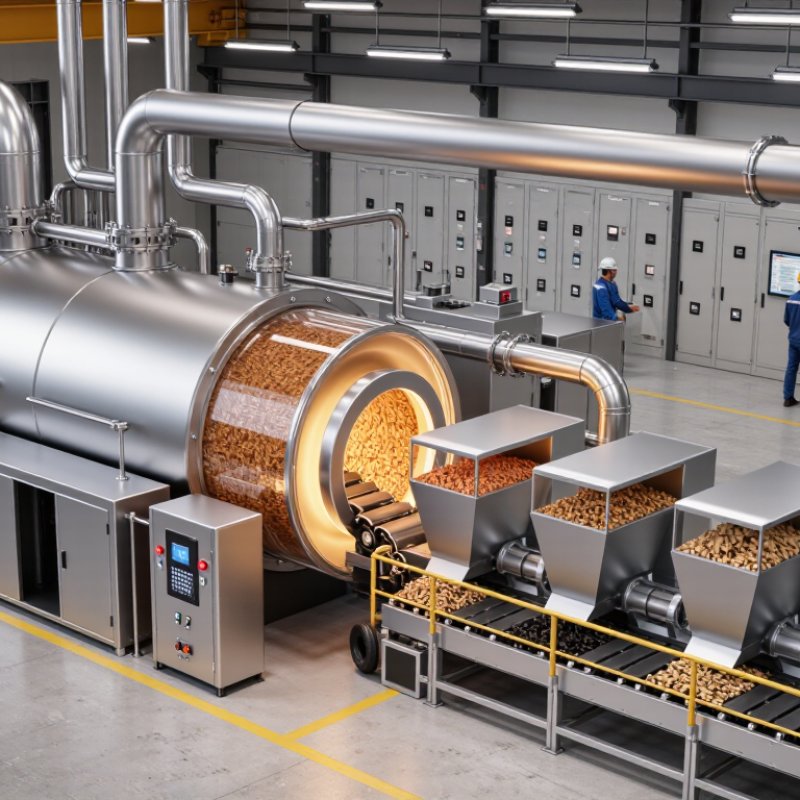
| Reactor Configuration | Common continuous designs include rotary kilns, screw reactors, moving-bed reactors, and fluidized-bed reactors. | Select a design that matches particle size, bulk density, stickiness, abrasion, and desired residence-time control. The reactor should provide uniform solids movement without oxygen ingress. | Review the mass-flow path, sealing arrangement, heat-transfer area, clean-out access, and demonstrated operation with the intended feedstock. |
| Operating Temperature | Slow and intermediate pyrolysis commonly operate around 350–600 °C; fast pyrolysis generally uses approximately 450–550 °C with rapid vapor removal. | Use independently controlled electric heating zones, accurate thermocouples, and automatic temperature adjustment along the reactor length. | Request temperature maps from multiple operating zones and confirm that measured solids temperature, not only wall temperature, is controlled. |
| Solids Residence Time | A practical continuous range is often about 10–60 minutes for solid material, depending on reactor type, particle size, temperature, and target product. | The feed rate, reactor speed, fill level, and discharge device should allow residence time to be adjusted without destabilizing temperature or pressure. | Use a tracer test or measured solids mass balance to determine actual residence-time distribution rather than relying only on theoretical calculations. |
| Vapor Residence Time | Fast vapor removal is typically required when maximizing condensable liquids; vapor residence time is often measured in seconds rather than minutes. | The vapor path should be short, insulated, and designed to limit secondary cracking, uncontrolled condensation, and tar deposition. | Check vapor-line temperature profiles, pressure drop, condensate collection efficiency, and inspection records for deposits. |
| Feedstock Moisture | Many systems perform more consistently when feed moisture is reduced to approximately 10–15% wet basis, although acceptable limits vary by design. | Include a reliable drying stage, moisture measurement, and automatic feed-rate adjustment. Excess water increases energy demand and can reduce liquid-product quality. | Test representative samples using a calibrated moisture analyzer and record moisture variation over several production shifts. |
| Particle Size and Preparation | Uniform particles commonly improve heat transfer and feeding stability; many systems use particles in the approximate 5–30 mm range. | The plant should include screening, metal removal, and a feeder suitable for the actual particle-size distribution and bulk density. | Measure particle-size distribution, bulk density, bridging tendency, and feeder torque using production feedstock. |
| Oxygen Exclusion | Pyrolysis requires an oxygen-limited environment; excessive oxygen can cause combustion, temperature excursions, and product loss. | Look for airlocks, nitrogen or recycled-gas purging where required, sealed discharge equipment, pressure monitoring, and automatic emergency isolation. | Review oxygen-analyzer readings, pressure-control performance, leak-testing procedures, and emergency shutdown logic. |
| Electric Heating Design | Electric heating demand depends on feed moisture, feed rate, heat losses, operating temperature, and heat recovery; it must be calculated from a complete energy balance. | Prefer staged heating zones, insulated hot surfaces, variable-power control, electrical protection, and a documented specific electricity-consumption target in kWh per tonne of feed. | Request a guaranteed energy balance covering drying, pyrolysis, vapor condensation, gas handling, and auxiliary equipment. |
| Throughput Stability | Continuous lines may range from laboratory and pilot scale below 0.1 t/h to commercial modules above 1 t/h; actual capacity is highly feedstock-specific. | Evaluate stable throughput, not only maximum nameplate capacity. The system should maintain temperature, pressure, and product quality during turndown and start-up. | Require a continuous performance test covering at least one full operating cycle, with recorded feed rate, uptime, energy use, and product yields. |
| Char Quality Control | Important indicators include moisture, ash, volatile matter, fixed carbon, pH, electrical conductivity, surface area, particle size, and contaminant content. | Provide consistent discharge cooling, screening, sampling, and sealed storage to prevent moisture uptake and cross-contamination. | Use representative composite samples and test them through a qualified laboratory against the intended end-use specification. |
| Pyrolysis Oil Quality | Relevant properties include water content, density, viscosity, acidity, ash, solids, stability, and heating value. Values vary substantially with feedstock and process conditions. | Use staged condensation, filtration, temperature control, and separate collection of heavy fractions where required. | Define acceptance limits before procurement and verify them through repeated laboratory analysis during the performance test. |
| Non-Condensable Gas | Product gas commonly contains combustible components such as carbon monoxide, hydrogen, methane, and light hydrocarbons, together with carbon dioxide and nitrogen. | Include gas cleaning, pressure regulation, flare or safe venting, and a controlled recycle or burner system for process heat. | Analyze gas composition, lower heating value, flow rate, and contaminant levels under different feed rates. |
| Yield and Mass Balance | Typical product distribution can vary widely: char, condensable vapors, and gas depend on feedstock composition, temperature, heating rate, and residence time. | Choose a plant based on guaranteed mass-balance ranges rather than a single ideal yield percentage. | Require measured input and output weighing, moisture correction, gas-flow measurement, and a documented mass-balance closure. |
| Control and Data Logging | Core variables include feed rate, zone temperatures, reactor pressure, oxygen concentration, motor load, power consumption, gas flow, and product temperatures. | Use automated alarms, trend records, recipe control, interlocks, and secure data export for quality traceability. | Inspect the control philosophy, alarm list, calibration schedule, historical trends, and manual override procedures. |
| Maintenance and Availability | Wear commonly occurs at feeders, seals, screws, bearings, refractory or insulation, condensers, filters, and gas-cleaning components. | Prioritize modular access, replaceable wear parts, clean-out ports, spare-parts availability, and a realistic planned-maintenance schedule. | Request preventive-maintenance intervals, expected service life of critical components, and historical availability data from comparable installations. |
| Emission and Safety Control | Potential hazards include combustible gas, carbon monoxide, hot surfaces, dust, pressure excursions, and oxygen-deficient atmospheres. | Include gas detection, ventilation, pressure relief, flame-failure protection, dust control, emergency shutdown, and documented operating procedures. | Complete a process hazard assessment and verify compliance with applicable local electrical, pressure, fire, environmental, and occupational-safety requirements. |