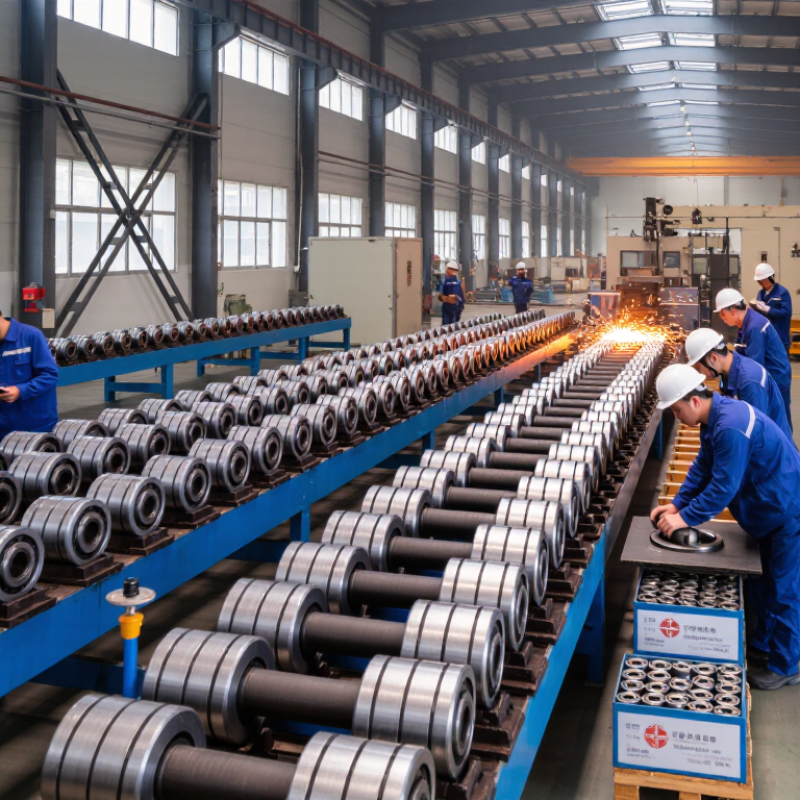
| Manufacturing Facility | Production area, equipment list, process layout, and monthly production capacity | A documented production flow with dedicated forming, welding, machining, assembly, and testing areas | Factory audit, live video inspection, equipment records, and production-capacity documents | 15% | High |
| Roller Size Range | Available shell diameters, shaft sizes, face widths, and custom dimensions | Common conveyor roller diameters typically include approximately 50–159 mm, with custom sizes available when required | Review dimensional drawings, product samples, and measurement reports using calibrated tools | 10% | High |
| Material Selection | Shell, shaft, bearing, seal, coating, and polymer material specifications | Material grades and surface treatments should be stated clearly and matched to load, moisture, abrasion, and temperature conditions | Material certificates, incoming inspection records, and sample testing | 10% | High |
| Dimensional Accuracy | Outside diameter, face width, shaft length, concentricity, runout, and shaft tolerance | Critical dimensions should be controlled against approved drawings; runout requirements must be defined before production | Inspection plan, calibrated measuring instruments, first-article inspection, and batch reports | 10% | High |
| Bearing and Sealing Performance | Bearing type, load rating, seal structure, grease specification, and contamination protection | Bearing selection should be based on radial load, speed, operating temperature, dust, water, and maintenance conditions | Technical datasheets, bearing certificates, seal inspection, and operating-condition review | 10% | High |
| Load and Running Tests | Static load, rotational resistance, noise, vibration, endurance, and temperature-rise data | Test limits should be linked to the roller design, conveyor speed, transported material, and stated service conditions | Witness testing, test reports, sample approval, and comparison with approved specifications | 15% | High |
| Welding and Assembly Quality | Welding procedure, shaft alignment, end-disc fit, bearing installation, and assembly controls | Welds should be uniform and free from visible cracks, undercut, excessive spatter, or misalignment | Process audit, visual inspection, dimensional checks, and destructive or non-destructive tests where appropriate | 8% | High |
| Corrosion Protection | Surface preparation, painting, galvanizing, powder coating, or other protective treatment | The coating system should match the application environment, including indoor, outdoor, humid, corrosive, or washdown conditions | Coating specification, thickness measurement, adhesion testing, and salt-spray data when applicable | 7% | Medium |
| Quality Management | Quality procedures, inspection stages, traceability, non-conformance handling, and corrective actions | Controls should cover incoming materials, in-process production, final inspection, packing, and shipment release | Quality-system audit, inspection forms, corrective-action records, and batch traceability review | 8% | High |
| Customization Capability | Ability to produce grooved, tapered, rubber-coated, sprocket, impact, or other application-specific rollers | The supplier should provide drawings, prototypes, design review, and repeatable production for approved custom designs | Review engineering resources, prototype samples, drawings, and previous non-brand-specific project records | 5% | Medium |
| Packaging and Export Readiness | Packaging method, moisture protection, pallet design, labeling, loading plan, and export documentation | Packaging should prevent shaft deformation, surface damage, corrosion, and component mixing during international transport | Packaging inspection, packing-list review, loading photographs, and trial-shipment evaluation | 2% | Medium |
| Recommended Supplier Assessment Structure | 100% | Complete |