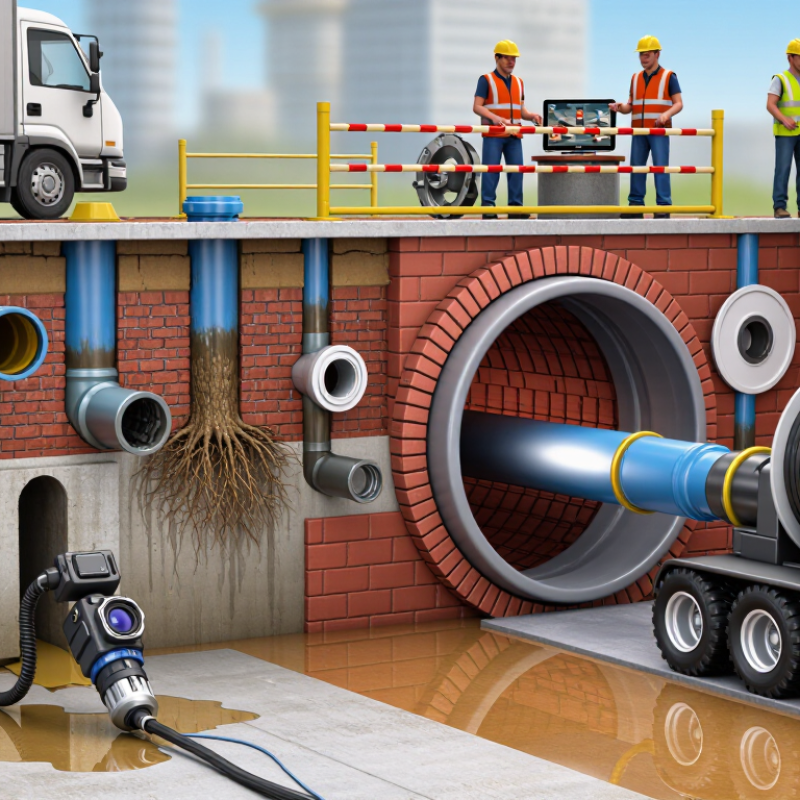
| Push Camera | Approximately 50–150 mm | Commonly 30–60 m, depending on the system | A flexible camera head is pushed through the pipe by a semi-rigid rod; most models provide forward viewing and LED lighting. | Residential drains, small commercial lines, branch pipes, and short inspection runs. | Portable, relatively simple to operate, and suitable for narrow pipes and quick diagnosis. | Limited ability to pass sharp bends, heavy deposits, or long sections; it cannot actively drive itself forward. |
| Self-Propelled Crawler Camera | Approximately 150–1200 mm or more, depending on wheel size and configuration | Often 100–300 m of tethered cable | Motorized wheels or tracks move the camera through the pipe; the camera usually provides pan, tilt, rotation, and adjustable lighting. | Municipal sewers, stormwater lines, industrial pipelines, and long or large-diameter inspections. | Stable movement, high-quality video, accurate defect documentation, and better performance in large pipes. | Higher purchase and operating costs; transportation and setup may require more equipment and trained personnel. |
| Pan-and-Tilt Zoom Camera | Generally 150–2000 mm, depending on the camera head and mounting system | Usually installed on a crawler with a long tether | The lens can rotate and tilt to inspect the full pipe circumference; optical or digital zoom helps examine defects in detail. | Large sewer lines, manholes, joints, connections, cracks, deformation, and internal structural assessment. | Provides a broad inspection view and detailed close-up images without repositioning the crawler frequently. | More complex and expensive than a fixed-view camera; image quality depends on lighting, lens cleanliness, and pipe conditions. |
| Lateral Launch Camera | Main line commonly about 150–1200 mm; lateral lines often about 75–200 mm | Main-line tether plus a deployable lateral cable, often extending tens of metres | A secondary camera or launching mechanism enters connected branch lines through a service connection or opening. | Inspecting property laterals, service connections, branch drains, and the junction between a main line and a lateral. | Inspects multiple connected pipes from one access point and helps identify the location of defects in lateral lines. | Requires suitable access and adequate pipe geometry; deployment is more complicated than standard push inspection. |
| Sonde-Equipped Inspection Camera | Commonly used in pipes from approximately 50–200 mm | Typically matches the push cable or crawler tether length | Includes a small radio transmitter, or sonde, that can be detected above ground with a compatible locator. | Finding buried pipe routes, locating blockage positions, identifying service connections, and marking excavation points. | Adds above-ground location data to the video inspection and helps reduce unnecessary excavation. | The locating range can be affected by pipe depth, soil conditions, metal structures, and other sources of signal interference. |
| Manhole and Vertical Inspection Camera | Manholes, shafts, tanks, and other vertical or large-access structures | Commonly mounted on a telescopic pole or lowered on a cable; reach varies by configuration | Wide-angle viewing, powerful lighting, and adjustable camera orientation for vertical or open-structure inspections. | Manhole walls, benches, channels, wet wells, tanks, culverts, and other areas that are difficult or unsafe to enter. | Improves operator safety and provides visual access without requiring personnel to enter a confined space. | Not designed for navigating long, enclosed horizontal pipelines unless combined with a suitable deployment system. |