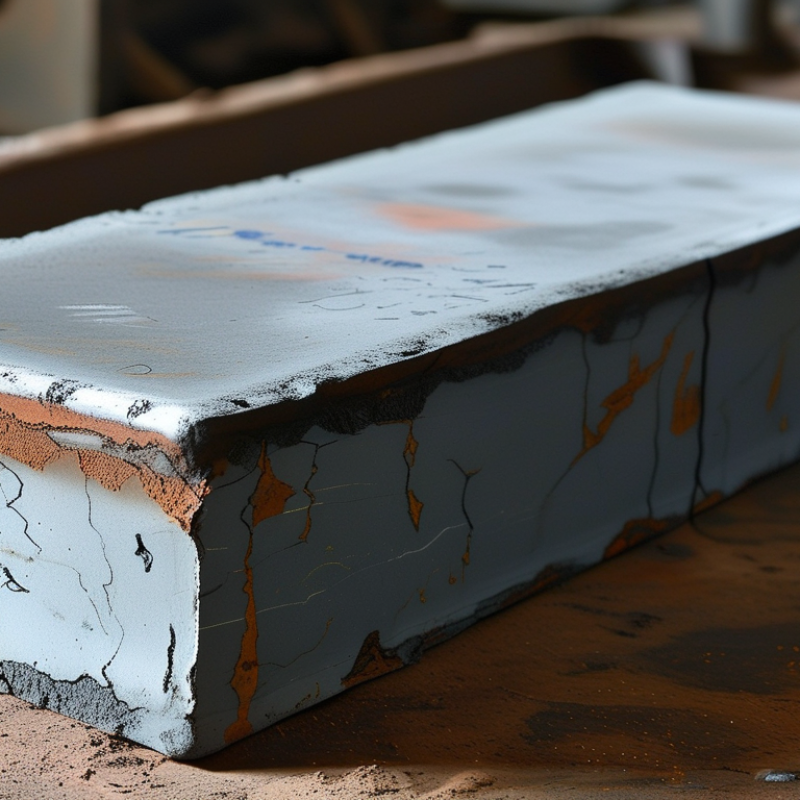
| Raw Material | Calcined petroleum coke | Fixed carbon commonly ≥98.5%; ash generally ≤0.5%; moisture after calcination is normally controlled at a low level. Particle-size distribution is adjusted for the block recipe. | Provides the main carbon skeleton. Low ash and stable granulometry improve electrical conductivity, density, and resistance to chemical attack. | Check proximate analysis, sulfur, vanadium, nickel, ash, moisture, true density, and particle-size distribution. |
| Raw Material | Coal-tar pitch binder | Binder softening point is commonly about 100–115°C, although the selected grade depends on mixing, forming, and baking conditions. Quinoline-insoluble content is often specified within a controlled range. | Controls green strength, binder distribution, pore formation, baking shrinkage, and final mechanical properties. | Measure softening point, coking value, quinoline insolubles, toluene insolubles, moisture, viscosity, and ash. |
| Raw Material | Anthracite or other low-volatile carbon additions | May be used in selected formulations. Typical anthracite feedstocks contain approximately 85–90% fixed carbon, with ash depending strongly on the source and beneficiation process. | Can improve resistance to oxidation and alter shrinkage, but excessive ash or mineral matter can increase electrical resistivity and reduce purity. | Verify fixed carbon, volatile matter, ash, sulfur, moisture, and mineral composition before approving the material. |
| Raw Material | Recycled anode butts | Often recycled after cleaning and crushing. The usable proportion depends on residual electrolyte, bath contamination, metal content, and particle-size control. | Reduces raw-material consumption, but contamination can increase sodium, calcium, fluoride, or other unwanted impurities. | Test sodium, calcium, fluoride, aluminum, iron, ash, moisture, and contamination from attached bath material. |
| Manufacturing | Crushing, screening, and particle grading | A multi-size aggregate system is normally used, combining coarse, medium, and fine fractions. The exact grading is recipe-specific and should be maintained within tight control limits. | Optimized grading improves packing density, reduces excess binder demand, and limits open porosity. | Use sieve analysis, material-balance checks, and routine monitoring of fines and coarse fractions. |
| Manufacturing | Heating and dry mixing | Dry aggregate is commonly heated to approximately 140–180°C before binder addition, depending on pitch properties and plant equipment. | Maintains suitable pitch viscosity and promotes uniform coating of coke particles. | Record aggregate temperature, pitch temperature, mixing time, torque, and batch discharge temperature. |
| Manufacturing | Paste mixing | Mixing time is typically controlled in the range of several minutes to approximately 20 minutes, depending on batch size, mixer design, and formulation. | Insufficient mixing causes binder-rich and binder-poor areas; excessive mixing may alter temperature and workability. | Check paste homogeneity, temperature uniformity, workability, and binder content by batch. |
| Manufacturing | Block forming | Vibrocompaction or equivalent forming methods are used. Forming pressure, vibration, filling sequence, and green density must be controlled for each block geometry. | Uniform compaction reduces internal voids, cracking, density variation, and localized high resistivity. | Measure green density, dimensional tolerances, mass variation, surface defects, and internal homogeneity. |
| Manufacturing | Baking | Industrial baking commonly reaches approximately 1,100–1,200°C, with a controlled heating and cooling cycle that may last several days. | Converts pitch into carbon, develops final strength, and determines pore structure, electrical resistivity, and reactivity. | Review furnace temperature profiles, soaking time, heating rate, cooling rate, and traceability by furnace position. |
| Manufacturing | Post-baking machining and cleaning | Machining should maintain specified dimensions, contact-face flatness, hole geometry, and surface cleanliness. | Accurate geometry supports reliable rodding, stable electrical contact, and predictable positioning in the electrolytic cell. | Use dimensional inspection, flatness checks, hole-position checks, visual inspection, and foreign-material control. |
| Finished Anode | Apparent density | A commonly encountered range for baked anodes is approximately 1.50–1.65 g/cm³, depending on formulation and production route. | Higher uniform density generally improves mechanical strength and reduces air and CO₂ penetration. | Determine apparent density using a validated laboratory method; test multiple locations or representative samples. |
| Finished Anode | Electrical resistivity | Many prebaked anode specifications target a value at or below approximately 55 μΩ·m at the specified test temperature. | Lower resistivity reduces voltage drop and electrical energy consumption during electrolysis. | Measure according to the purchaser's approved electrical-resistivity method, with controlled sample dimensions and temperature. |
| Finished Anode | Compressive strength | Typical specification levels are commonly above 30 MPa, with the actual limit determined by block design and handling requirements. | Indicates resistance to crushing during rodding, transport, installation, and cell operation. | Perform compressive-strength testing on representative baked samples and report failure mode. |
| Finished Anode | Flexural strength | Values of approximately 8–12 MPa are commonly encountered for sound baked anodes, subject to recipe and test method. | Helps assess resistance to bending, thermal stress, handling damage, and cracking. | Use a consistent three-point or four-point bending procedure and monitor variation between samples. |
| Finished Anode | Open porosity and permeability | Open porosity is often controlled within roughly 20–30%, while permeability should remain low and uniform throughout the block. | Excessive porosity increases bath penetration, air oxidation, CO₂ consumption, and carbon loss. | Check porosity, apparent density, gas permeability, and internal defects using validated laboratory methods. |
| Finished Anode | CO₂ and air reactivity | Acceptance limits vary by smelter and test temperature. Lower mass loss and lower dusting are preferred; values must be compared only under the same test conditions. | Low reactivity reduces anode consumption, dust generation, process instability, and greenhouse-gas-related carbon loss. | Use standardized CO₂-reactivity and air-reactivity tests, recording temperature, exposure time, mass loss, and dusting. |
| Finished Anode | Impurity control | Sulfur, vanadium, nickel, sodium, calcium, iron, silicon, fluoride, and other contaminants are controlled according to the smelter's process limits. | Impurities can affect anode consumption, bath chemistry, metal purity, emissions, electrical performance, and refractory condition. | Use representative sampling and laboratory analysis by validated elemental or chemical methods. |
| Quality Standards | Sampling and traceability | Each production lot should be traceable to raw-material batches, mixing records, forming conditions, furnace position, machining records, and test results. | Enables root-cause analysis and prevents nonconforming blocks from entering cell operation. | Apply a documented sampling plan, lot definition, retention-sample policy, and nonconformance procedure. |
| Quality Standards | Applicable test frameworks | Commonly referenced frameworks include ISO or ASTM methods for coke analysis, ash, sulfur, density, electrical resistivity, flexural strength, compressive strength, CO₂ reactivity, and air reactivity. | Standardized methods make supplier comparisons meaningful and reduce disagreement caused by different test conditions. | Specify the exact method, specimen preparation, test temperature, calculation formula, laboratory calibration, and reporting format. |
| Decision Rule | Choosing the right anode carbon block | Prioritize consistent raw materials, stable particle grading, uniform density, low resistivity, adequate mechanical strength, low reactivity, controlled impurities, and complete traceability. | The best selection is not based on one property alone; it must balance energy efficiency, carbon consumption, mechanical reliability, and operating conditions. | Compare suppliers using the same approved test methods, identical sampling rules, historical process data, and an agreed acceptance specification. |