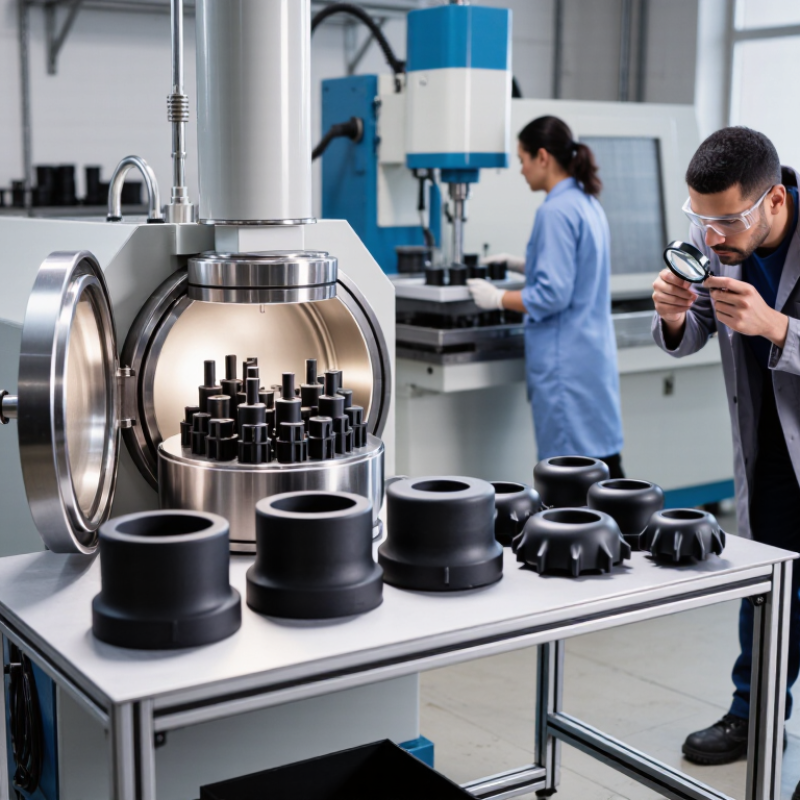
| Deflashing effectiveness | Run representative parts with the actual rubber compound, geometry, and flash condition. | Agree on acceptable residual flash locations and limits before testing; inspect parts under consistent lighting and magnification. | Parts meeting criteria, residual flash findings, and inspection method. |
| Part damage and quality | Check for cuts, cracks, surface marks, deformation, or unwanted material loss after processing. | Compare processed parts with approved quality samples and applicable drawing tolerances; assess critical features before and after the trial. | Defect count, dimensional results, and pass/fail decision. |
| Cycle time and throughput | Time complete production-representative cycles, including loading, processing, unloading, and routine handling. | Calculate good parts per hour from repeatable runs, not from processing time alone; confirm the result meets the required production rate. | Cycle time, batch size, handling time, and accepted parts per hour. |
| Repeatability | Repeat the trial using the same settings and comparable batches; include parts from more than one production lot where possible. | Confirm that quality and cycle time remain within the agreed limits across repeated runs. | Results for each run, settings used, and any variation observed. |
| Process setup and changeover | Have an operator change recipes or settings and switch between representative part types. | Verify that settings are documented, repeatable, and accessible to authorized operators; check the time and tools required for changeover. | Setup steps, changeover time, training needs, and recipe controls. |
| Utilities and consumables | Measure or document electrical demand, compressed-air use, process media, and other consumables under the proposed operating conditions. | Compare actual requirements with available site utilities and estimate operating cost per good part using local prices and expected production volume. | Utility specifications, consumption per cycle or hour, and consumable replacement intervals. |
| Safety and workplace conditions | Review guarding, interlocks, emergency stops, operator access, noise, dust or emissions, and any process-specific hazards. | Confirm the machine documentation identifies applicable hazards and required controls; assess the installation against local regulations and site procedures. | Risk assessment, safety documentation, measured noise where required, and unresolved actions. |
| Maintenance and cleaning | Inspect routine access points and ask the supplier to demonstrate cleaning, wear-part checks, and basic fault diagnosis. | Verify that maintenance tasks, intervals, required tools, and replacement parts are clearly documented and practical for the site. | Maintenance schedule, estimated task time, wear parts, and recommended spares. |
| Installation and acceptance | Review footprint, access for loading and service, utility connections, foundation needs, and installation responsibilities. | Require a written installation and acceptance plan with agreed test parts, process conditions, quality limits, and sign-off criteria. | Layout, connection requirements, schedule, acceptance protocol, and responsibilities. |
| Supplier training and service | Confirm operator and maintenance training scope, service contact channels, coverage area, and support availability. | Obtain written response-time targets, warranty terms, escalation steps, and the process for obtaining technical assistance and spare parts. | Training deliverables, support hours, response commitments, warranty, and parts lead times. |
| Final decision | Compare machine results and supplier commitments against the same written requirements. | Select only after the production trial meets agreed part-quality and capacity criteria and support terms are documented. | Trial approved: Yes / No | Open actions: ____________________ |