7 Tips for Choosing a Tile Laser Cutting Machine?
Choosing a Tile Laser Cutting Machine is not simply a matter of comparing wattage and price. The right system must match tile hardness, thickness, finish, workload, and required edge quality. Porcelain may look smooth on the surface, yet its dense body can expose weak cooling, unstable motion, or poor focusing. In a busy workshop, a small alignment error can become a visible chip across an expensive slab.
Industry data supports the need for careful selection. MarketsandMarkets has reported continued growth in the global laser cutting machine market, driven by automation, precision manufacturing, and shorter production cycles. Grand View Research also identifies expanding demand for digitally controlled cutting equipment across construction and manufacturing applications. Meanwhile, ceramic tile market reports from Mordor Intelligence indicate sustained demand for porcelain and large-format tiles. These trends matter. More complex materials require more dependable equipment.
This guide presents seven practical tips for evaluating a Tile Laser Cutting Machine. It considers laser power, cutting speed, worktable size, cooling, software, maintenance, and supplier support. A higher-power source is not automatically better. Sometimes, it creates unnecessary operating costs. The cheapest machine can also become expensive after repeated nozzle changes, calibration problems, or delayed repairs. That is easy to overlook.
Real workshops reveal the difference. Measure a sample tile. Inspect its underside. Check the cut after cooling. Ask the supplier for test results, not only attractive videos. Standards, reports, and specifications provide direction, but they cannot replace a physical trial. One limitation remains: published market figures vary by research method. Buyers should verify claims before investing.
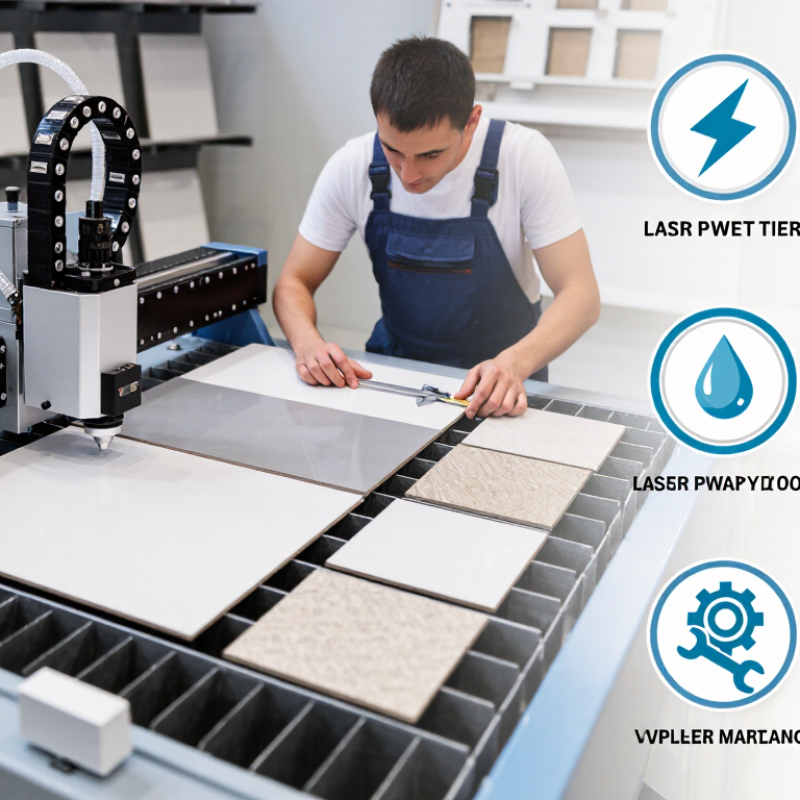
Define the Tile Types and Cutting Requirements
Before choosing a tile laser cutting machine, identify the tile materials you will process. Ceramic and porcelain tiles behave differently because porcelain is denser and usually harder to penetrate. Glass, marble, granite, and mosaic sheets may require different laser settings or cutting methods. Check each tile’s thickness, surface glaze, mesh backing, and moisture content. Measure twice.
Your cutting requirements should match your daily work, not an ideal project. Record the longest tile length, narrowest strip, required angle, and acceptable edge tolerance. A bathroom installer may need clean holes and small corner cuts, while a workshop may need repeated straight cuts. Consider whether the machine can control heat, dust, and smoke around coated surfaces. Dark glazes can absorb energy unevenly and may show burn marks.
Ask for a sample cut using your actual tile. Inspect the edge under bright light, then check the back for cracks or delamination. Test several thicknesses when possible. Laser cutting can produce precise results, but it is not automatically the best choice for every tile. I have seen accurate settings fail when the glaze changed slightly between batches. That detail is easy to overlook. Also compare cutting speed with production volume, since a precise machine may still be inefficient for large orders. Keep a record of power, speed, focus, and cooling settings for repeatable work.
Evaluate Machine Size, Worktable, and Material Capacity
A laser cutter should fit your real tile workflow, not an imagined one. Measure the largest tile diagonally, then add clearance for loading and clamping. A 600 × 600 mm worktable may suit standard residential formats, but it can restrict 600 × 1,200 mm slabs. Measure twice.
Grand View Research reports continued growth in the ceramic tiles market, driven partly by larger-format products. That trend makes usable table area increasingly important. Check the machine’s internal travel, not only its external dimensions. A compact frame may save floor space, yet require extra repositioning. That slows production and can reduce edge accuracy.
Material capacity also needs careful testing. Record the maximum thickness for porcelain, glazed ceramic, and sintered surfaces separately. Manufacturer figures may describe ideal laboratory conditions. Dust, surface coatings, and uneven support can change results. The U.S. Geological Survey’s Mineral Commodity Summaries highlights silica and feldspar as major ceramic-material inputs, but material composition varies widely between tile batches. Ask for cutting samples from your own supplier. Check kerf width, heat marks, corner chipping, and repeatability. A larger worktable is not automatically better; its rigidity and extraction design matter too. I would also compare the stated load capacity with your heaviest tile, leaving at least a practical safety margin. That margin is easy to overlook.
Assess Maintenance Needs, Support, and Overall Cost
A tile laser cutting machine should be judged by serviceability, not only cutting speed. Ask whether technicians can reach the lens, rails, filters, and cooling system without dismantling half the machine. The U.S. Department of Energy’s Operations and Maintenance Best Practices Guide reports that preventive maintenance can reduce costs by 12–18% compared with reactive repairs. Build that discipline into your purchase decision. Check cleaning intervals, lubrication points, diagnostic alerts, and the availability of replacement optics.
Support quality matters more than attractive promises. Request documented response times, remote troubleshooting procedures, installation training, and operator manuals written in clear English. Confirm whether critical parts are stocked locally or shipped internationally. McKinsey’s Predictive Maintenance 4.0 report cites potential maintenance-cost reductions of 10–40% and downtime reductions of 30–50% when reliable monitoring is used. Those figures are not guaranteed. Your results depend on dust, workload, alignment, and operator habits.
Calculate the total cost over three to five years. Include electricity, extraction, cooling, consumables, calibration, software, training, and production losses during repairs. Compare warranty coverage carefully, especially for the laser source, motion system, and control electronics. A low purchase price can become expensive after one failed cooling pump. Visit a working installation if possible. Watch a technician perform routine cleaning. It may reveal an inconvenient truth: the machine is powerful, but difficult to maintain.
7 Tips for Choosing a Tile Laser Cutting Machine: Five-Year Cost Planning Model
This planning model estimates a five-year total cost of ownership of $44,200: $18,000 purchase cost, $2,700 electricity, $7,500 consumables, $6,000 routine maintenance, and a $10,000 reserve for technical support and downtime. Actual figures vary with machine power, operating hours, local energy prices, service terms, and tile-processing volume.
