How to Choose the Right Water Treatment Valve

Choosing the right water treatment valve is a practical decision with consequences far beyond the pipe. A valve must control flow, isolate equipment, and withstand the water’s chemistry and operating pressure. It also affects maintenance time, energy use, and service continuity. Small parts matter.

The scale of infrastructure investment makes careful selection especially important. The U.S. Environmental Protection Agency’s 2023 Drinking Water Infrastructure Needs Survey and Assessment estimated $625 billion in drinking water infrastructure needs over 20 years. That figure covers many system components, not valves alone, but it underscores the cost of keeping networks reliable. The WHO/UNICEF Joint Monitoring Programme reported that 2.2 billion people lacked safely managed drinking water in 2022. Reliable treatment and distribution depend on many connected choices, including valve performance.

For engineers and facility teams, the best water treatment valve depends on its actual duty, not just its nominal size. Start with the fluid, temperature, pressure range, flow rate, and required shutoff. Then consider body and trim materials, corrosion exposure, actuation, installation space, and access for inspection. A valve suited to clean water may not suit a chemical dosing line. That distinction is easy to miss on a busy specification sheet. Compare manufacturer data with project conditions, and confirm relevant performance claims before purchase. No single valve type fits every application. A careful choice can reduce avoidable failures, though even a well-chosen valve still needs proper installation and maintenance.

How to Choose the Right Water Treatment Valve

Define the Water Treatment System’s Operating Requirements

Before comparing valve types, define the system’s real operating envelope. Record minimum, normal, and peak flow, plus inlet and outlet pressure. Include temperature, suspended solids, disinfectants, and cleaning chemicals. A valve handling clear water may behave differently when grit collects around its seat. Note how often it cycles and what it must do during power loss. Fail-safe position matters.

Demand figures help explain why averages are not enough. USGS’s Estimated Use of Water in the United States in 2015 reports public-supply withdrawals of about 39 billion gallons per day. That national figure cannot size an individual valve, but it underscores the range of operating conditions across systems. The U.S. EPA’s 2023 Drinking Water Infrastructure Needs Survey and Assessment estimated $625 billion in needs over 20 years. Budget pressure makes avoidable replacements costly. Still, a low purchase price is not a dependable operating specification.

Ask operators about short, awkward events: pump starts, filter backwash, and sudden flow changes. They often remember details missing from design sheets. Check pressure surges against the valve’s rated limits, and confirm that the actuator can respond at the required speed. I would verify these figures against logged site data; assumptions from a quiet week can mislead. Test the proposed valve under representative conditions before final selection.

How to Choose the Right Water Treatment Valve

Define the Water Treatment System’s Operating Requirements

Indicative operating pressure ranges vary by system design and are not valve pressure ratings. Before selecting a valve, confirm the actual minimum and maximum pressure, flow rate, temperature, water chemistry, pressure drop, and required shutoff or control function for each service.

Compare Valve Types and Their Control Functions

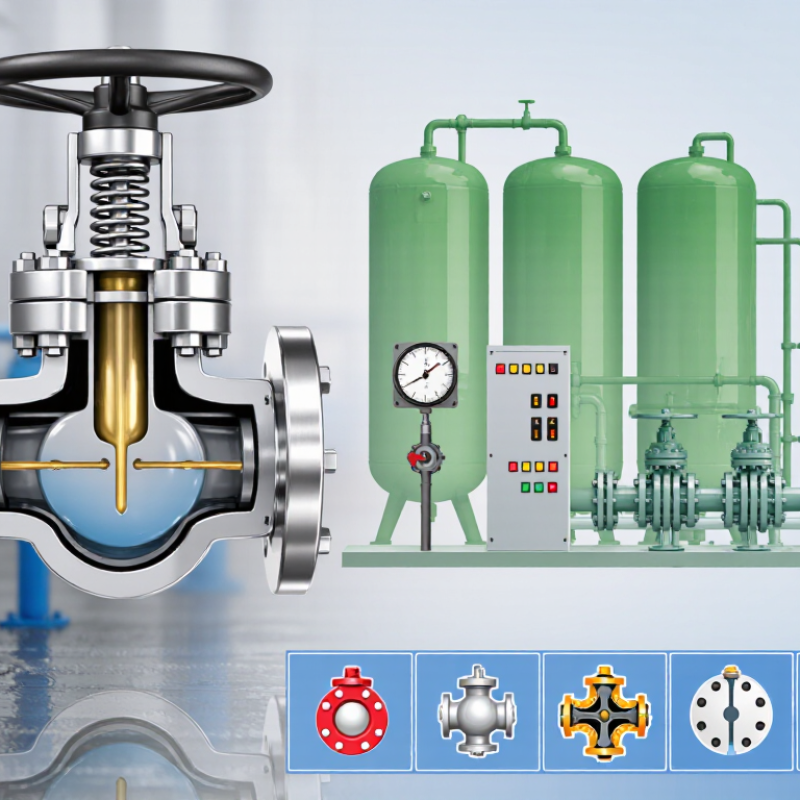
Water treatment systems use valves for different jobs: stopping flow, preventing backflow, or adjusting pressure and rate. A gate valve is commonly suited to isolation, where it stays fully open or closed. It is not the best choice for frequent throttling, since partial opening can wear its seating surfaces.

A globe valve offers more controlled throttling, useful when operators need to adjust flow through a filter line. Butterfly valves are compact and quick to operate, making them practical on larger pipes, though fine adjustment depends on the model and system conditions. Ball valves provide fast shutoff, but they may be less suitable for precise flow control. Small details matter.

Check valves close when flow reverses, helping protect pumps and other equipment. Diaphragm valves can work well with some corrosive or solids-bearing streams because the fluid is separated from moving parts. Still, compatibility depends on the diaphragm material and water chemistry. A valve chart won’t tell the whole story.

Compare each valve’s control function with operating pressure, pipe size, flow range, and maintenance access. For automated control, consider whether an actuator and position feedback are needed. A valve that looks right on paper may respond poorly when flow varies sharply. That is easy to overlook. Check manufacturer specifications and consult a qualified engineer for critical process lines.

How to Choose the Right Water Treatment Valve — Compare Valve Types and Their Control Functions

Valve Type Primary Control Function Typical Water-Treatment Uses Control Characteristics Key Selection Considerations
Gate valve On/off isolation Main distribution lines, plant headers, and pipelines where a straight-through flow path is useful. Designed to be fully open or fully closed. It is generally not suitable for routine throttling because partial opening can cause vibration, erosion, and seat damage. Consider face-to-face space, operating time, pressure rating, and whether the valve will remain in one position for long periods.
Globe valve Throttling and flow regulation Flow-control branches, dosing lines, and services that need frequent adjustment. Provides comparatively precise manual or actuated flow adjustment, but typically creates more pressure loss than a full-bore gate or ball valve. Check allowable pressure drop, flow range, trim materials, and whether an actuator or positioner is needed for automatic control.
Butterfly valve Isolation and, with suitable design, throttling or modulation Large-diameter water mains, treatment-plant headers, and space-constrained piping. Quarter-turn operation supports compact manual or actuated control. Modulating performance depends on valve design, sizing, and operating range. Confirm pressure and temperature limits, liner and disc compatibility, shutoff requirements, and the control accuracy needed.
Ball valve Fast on/off isolation Equipment isolation, sampling points, utility lines, and smaller process connections. Quarter-turn operation provides quick shutoff and low flow resistance when fully open. Standard ball valves are generally intended for on/off service; characterized or V-port designs may be used for control. Verify seat and body compatibility with the fluid, required shutoff performance, pressure rating, and whether throttling is explicitly supported by the valve design.
Diaphragm valve Isolation and moderate flow control Chemical dosing, corrosive liquid service, and applications where the process fluid should be separated from the operating mechanism. A flexible diaphragm closes against a weir or seat. The design can limit fluid contact with internal moving parts, but the diaphragm is a wear component. Match diaphragm and body materials to the chemical, temperature, pressure, and cleaning conditions. Check replacement intervals and required flow capacity.
Pinch valve Isolation and flow control for suitable slurry or solids-bearing fluids Sludge, abrasive suspensions, and some process streams containing suspended solids. A sleeve is compressed to stop or restrict flow, leaving the fluid in contact mainly with the sleeve. The sleeve can wear and requires inspection or replacement. Assess particle size, abrasiveness, sleeve compatibility, pressure, and the maintenance access needed for sleeve replacement.
Check valve Automatic non-return flow control Pump discharge lines and process lines where reverse flow could damage equipment or disrupt operation. Opens and closes in response to flow conditions; it does not provide normal manual or modulating flow control. Selection must account for potential water hammer and minimum operating flow. Choose a suitable check-valve design and orientation for the flow direction, installation layout, closing behavior, and system surge conditions.

Match Valve Materials to Water Chemistry and Conditions

Water chemistry should guide valve material selection, not just pipe size or purchase price. Check pH, chloride levels, disinfectants, temperature, and suspended solids. A valve handling cool, neutral water may fail quickly in warm, acidic water. Chlorides can pit some stainless steels, especially when temperatures rise. PVC or CPVC can suit many treated-water lines, but confirm pressure and temperature limits. Metal bodies may be preferable where impact resistance or higher temperatures matter. Small details matter.

Match seals and internal parts to the same water conditions. EPDM is commonly used in water service, but verify its compatibility with the actual disinfectant and operating temperature. Abrasive particles can wear soft seats, while scale may stop a valve from closing fully. I have seen material choices look sound on a specification sheet, then prove less suitable after water chemistry changes. That rule is not perfect. Ask for current water analysis and check the manufacturer’s chemical-resistance data; do not rely on a generic “potable water” label alone. For uncertain or changing conditions, test a representative seal or component before installation, and inspect it after an initial operating period.

Evaluate Pressure, Flow, and Connection Specifications

A valve that fits the pipe can still be wrong for the treatment line. Check its pressure rating against the system’s maximum operating pressure, including pump start-up and possible water hammer. Leave the safety margin specified by the system designer; do not rely on a catalog maximum alone. Pressure drop across the valve matters too. Excessive restriction can reduce delivery or disrupt backwash timing. Numbers matter.

Match flow capacity to actual demand, not just pipe diameter. For a control valve, review its flow coefficient and expected operating range at the available pressure difference. An oversized valve may respond poorly at low demand, while an undersized one can create excessive pressure loss. Confirm flow needs during peak use and regeneration. Field readings help; they can reveal assumptions that looked sound on paper.

Connection details deserve equal attention. Verify nominal size, thread type, flange drilling, end style, and installation direction before ordering. A one-inch connection does not guarantee matching threads or face dimensions. Check seal material and wetted construction against the water chemistry and treatment media. It is easy to overlook a mismatch until installation. If specifications conflict, pause and ask the system designer to confirm the operating point and connection interface.

Check Maintenance Needs and System Compatibility

Choosing a water treatment valve means checking how it will be maintained, not just its flow rating. Confirm the fluid, operating pressure, temperature, and expected flow range against the valve’s limits. Then check body and seal materials against treatment chemicals and suspended solids. A mismatch can cause corrosion, leakage, or sluggish operation. Small details matter.

Maintenance access matters too. Can staff isolate the line, remove the actuator, and inspect the seat without dismantling nearby pipework? The U.S. EPA’s 2023 Drinking Water Infrastructure Needs Survey and Assessment estimates $625 billion in drinking water infrastructure needs over 20 years. That broad estimate is not a valve cost, but it underscores the value of durable, serviceable equipment. Compare inspection intervals, replacement-part availability, and cleaning requirements before selection. For automated systems, verify actuator voltage, control signals, fail position, and available clearance. A catalog match is not proof of compatibility; that shortcut can miss installation constraints. I would also question whether the proposed maintenance interval fits the site’s actual water quality. Record the assumptions, and revisit them after commissioning.

Top