| Moisture Barrier | Water Vapor Transmission Rate (WVTR) | Approximately 1–8 g/m²/day for 200–300 μm flexible PVC film, depending on plasticizer, thickness, and test conditions | ASTM F1249 or ASTM E96; report temperature and relative humidity | Lower WVTR helps limit evaporation, concentration changes, and moisture loss during storage. |
| Oxygen Barrier | Oxygen Transmission Rate (OTR) | Approximately 300–2,000 cm³/m²/day for uncoated flexible PVC at 23°C and 50% RH | ASTM D3985 or ISO 15105-2 | For routine urine collection, moderate oxygen barrier is generally adequate; lower OTR may be preferred for longer storage or odor-control designs. |
| Film Thickness | Nominal thickness and thickness uniformity | Common construction range: 150–400 μm; target thickness tolerance often within ±5–10% | ISO 4593 or ASTM D6988 | Greater thickness usually improves puncture resistance and handling strength but can reduce flexibility and transparency. |
| Tensile Strength | Machine-direction and cross-direction tensile strength | Approximately 15–25 MPa for plasticized flexible PVC film | ASTM D882 or ISO 527-3 | Check both directions because extrusion orientation can create unequal strength and affect bag durability. |
| Elongation | Elongation at break | Approximately 200–400% for soft, plasticized PVC film | ASTM D882 or ISO 527-3 | Higher elongation supports flexing and impact absorption, but excessive softness may make handling and sealing less consistent. |
| Puncture Resistance | Peak puncture force | Common development target: at least 10–20 N for 200–300 μm film, subject to probe geometry and test setup | ASTM F1306 or ISO 7765-1 | Use a defined target based on transport, bedside handling, tubing components, and expected contact with sharp edges. |
| Heat-Seal Strength | Seal strength after conditioning | Typical development target: ≥15 N/15 mm for peelable or permanent medical pouch-style seals; final target depends on seal design | ASTM F88/F88M or ISO 11607-1/-2 | Evaluate seal strength across the operating window, not only at the optimum temperature and pressure. |
| Seal Process Window | Sealing temperature and dwell-time tolerance | Typical heat-seal development window: approximately 120–180°C, depending on formulation, tooling, pressure, and line speed | ASTM F2029 for heat-seal initiation studies; confirm with production equipment | A wider process window reduces weak seals, burn-through, channel leaks, and production variation. |
| Leak Integrity | Leak rate or pass/fail under pressure and vacuum | A practical design requirement is zero visible leakage during validated pressure, vacuum, and flexing tests | ASTM F2096, ASTM D3078, or an internally validated pressure-decay method | Test complete bags, including ports, tubing connections, seals, and corners; film-only testing is insufficient. |
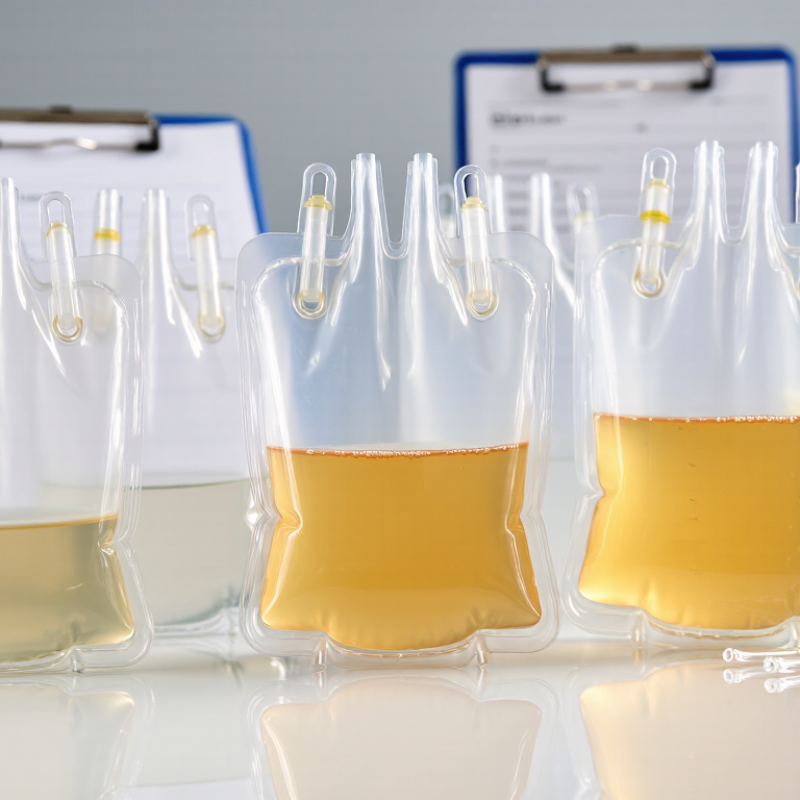
| Transparency | Total light transmittance | Common clear-film target: ≥85% total transmittance | ASTM D1003 or ISO 13468-1 | High transmittance supports visual monitoring of fill level, color, sediment, and contamination. |
| Haze | Percentage of diffused transmitted light | Preferred clear-film target: ≤10%; lower haze provides a sharper view of contents | ASTM D1003 | Haze can increase after sterilization, aging, printing, or contact with incompatible additives, so test the finished product. |
| Low-Temperature Flexibility | Brittleness or cracking temperature | A suitable formulation should remain flexible at the validated transport and storage minimum; many plasticized PVC grades are designed for temperatures below 0°C | ASTM D1790 or ISO 8570 | Important for cold-chain transport, unheated storage, and handling immediately after delivery. |
| Biocompatibility and Extractables | Material safety and chemical compatibility | Must meet the applicable medical-device biological evaluation and chemical characterization requirements for the intended contact duration | ISO 10993 series; ISO 10993-18 and ISO 10993-17 where applicable | Confirm the complete formulation, including plasticizers, stabilizers, colorants, adhesives, inks, and processing residues. |