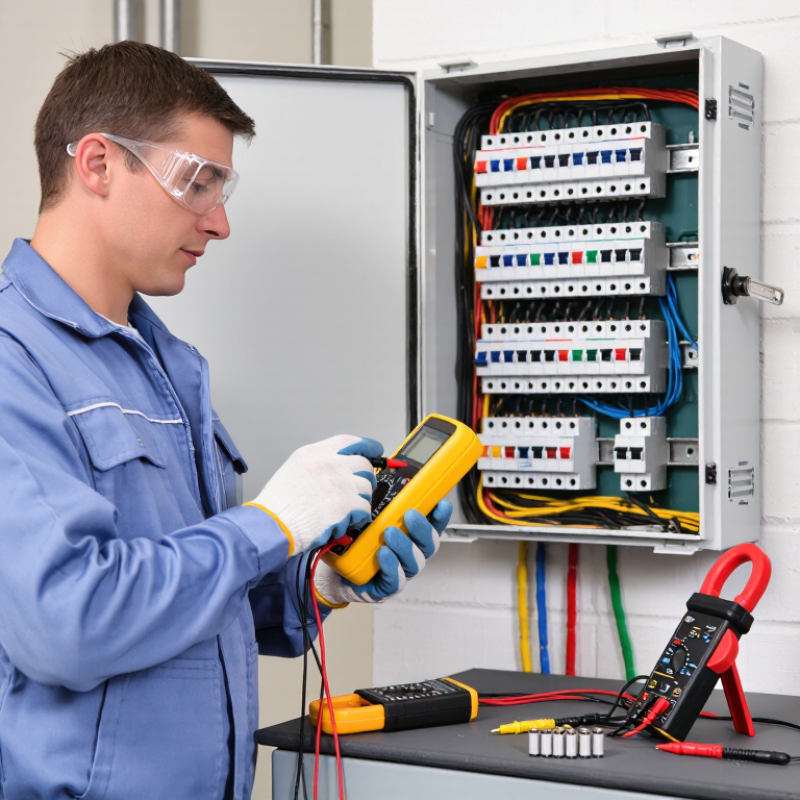
| Homes | Voltage tester or digital multimeter | Whether voltage is present and, when used correctly, the voltage across a suitable point in a circuit. | A qualified person checks a wall outlet or lighting circuit before troubleshooting. | A non-contact voltage detector is a screening aid, not proof that a circuit is de-energized. Verify instruments before and after use. |
| Homes | Continuity tester or multimeter continuity function | Whether a conductor or component forms a continuous electrical path when the circuit is isolated. | Checking a disconnected cord or fuse for an open circuit. | Continuity tests must be performed on de-energized equipment. Isolate the circuit and confirm it is not live first. |
| Homes | Socket or outlet tester | Some common wiring conditions, such as certain open-conductor or reversed-connection faults. | A homeowner performs a basic outlet screening check. | Simple plug-in testers cannot identify every wiring fault or confirm that an installation is safe. Follow up suspected issues with a qualified electrician. |
| Workplaces | Clamp meter | Current flowing through an individual conductor without disconnecting it, within the meter’s rated range. | A technician checks the operating current of a motor or fixed appliance. | Use the correct measurement category and current range. Do not clamp around a complete cable containing both outgoing and return conductors when measuring load current. |
| Workplaces | Insulation resistance tester | Resistance of electrical insulation between conductors or between a conductor and earth, using a specified test voltage. | Maintenance staff assess a disconnected cable or motor winding after isolation. | Testing can apply a high DC voltage and may damage connected electronics. It should be carried out by trained personnel using the appropriate test procedure. |
| Workplaces | RCD or GFCI tester | Whether a residual-current protective device responds to a test current under the conditions supported by the tester. | A qualified technician checks a protective device during inspection or maintenance. | Testing may interrupt power to connected equipment. Use the device’s test button as directed and follow local electrical rules. |
| Industry | Three-phase voltage and phase-sequence tester | Presence of voltage and the phase rotation sequence in three-phase systems. | An electrician verifies phase sequence before connecting or commissioning a three-phase motor. | Industrial systems can present lethal voltages and arc-flash hazards. Only qualified workers with suitable protective equipment should perform live tests. |
| Industry | Loop impedance or installation tester | Earth-fault loop impedance and related installation characteristics used to assess protective-device operation. | A qualified inspector tests a distribution circuit during commissioning or periodic verification. | Results depend on the test method and installation conditions. Interpret them against applicable electrical standards and local requirements. |
| Industry | Multifunction installation tester | Several installation checks, which may include continuity, insulation resistance, polarity, and protective-device tests. | A commissioning team records test results for a new or modified electrical installation. | Use the correct test sequence and settings. Isolate sensitive equipment where required and keep documented results for comparison. |