| Business Registration | Confirm that the legal entity is registered for manufacturing or processing metal building products. | Current business license, registered address, unified social credit information, and bank-account name matching the contract entity. | All legal names, addresses, and payment details are consistent across documents. | Different names on the quotation, license, contract, and invoice. |
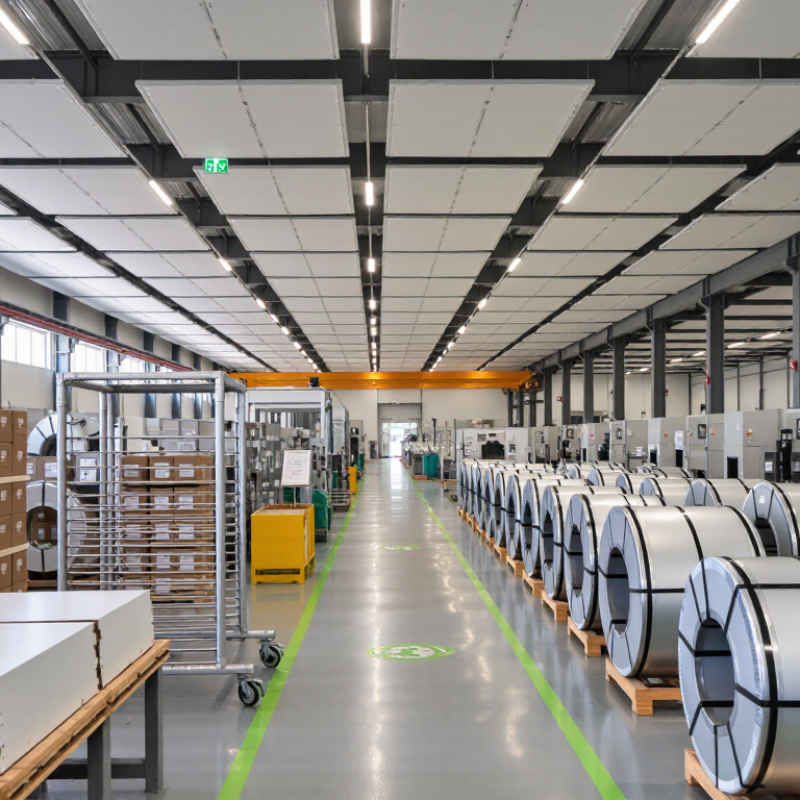
| Manufacturing Location | Establish whether production is performed in the stated facility or outsourced. | Live video inspection, dated factory photographs, utility or production records, and an independent audit report. | The facility contains identifiable areas for raw materials, forming, coating, assembly, inspection, and finished-goods storage. | Only a trading office is shown, or factory access is repeatedly refused. |
| Product Scope | Check experience with aluminum ceiling panels, lay-in panels, clip-in systems, baffle ceilings, or customized perforated panels. | Technical drawings, production samples, project references with client permission, and product inspection records. | The supplier can explain alloy, temper, thickness, dimensions, edge details, perforation pattern, coating, and installation method. | Product specifications change after quotation or cannot be confirmed in writing. |
| Factory Capacity | Assess monthly output, available shifts, key equipment, and production load during the required delivery period. | Equipment list, production-flow chart, capacity statement, recent delivery schedule, and third-party factory audit. | Capacity is stated by product type and finish, with realistic lead time and reserved production slots for the order. | Only a broad annual figure is provided without equipment, shift, or product-level details. |
| Aluminum Material Control | Verify alloy, temper, thickness tolerance, coil or sheet traceability, and incoming material inspection. | Mill test certificate, purchase records, incoming inspection report, thickness measurements, and batch traceability records. | Material grade and thickness are defined on the approved drawing and can be traced to the production batch. | The supplier uses “standard aluminum” without specifying alloy, temper, or thickness. |
| Surface Finish | Confirm coating or finish type, color reference, gloss, adhesion, corrosion resistance, and outdoor or indoor suitability. | Coating technical data sheet, color sample, production sample, coating thickness record, and relevant test report. | The approved sample and mass-production finish are controlled by written color, gloss, and coating requirements. | Color approval is based only on screen images or unmarked photographs. |
| Quality Management System | Check whether quality procedures cover purchasing, production, inspection, nonconformity, and corrective action. | Valid ISO 9001 certificate, certification scope, certificate number, issuing body, and audit status. | The certificate scope covers relevant manufacturing activities and can be verified with the issuing certification body. | An expired certificate, unclear scope, or certificate belonging to another legal entity. |
| Environmental Management | Review controls for coating chemicals, waste, emissions, energy use, and environmental compliance. | ISO 14001 certificate where applicable, waste-handling records, environmental permits, and coating-process documentation. | Environmental documents match the production site and the processes used for the ordered finish. | Environmental claims are made without site-specific records or certification scope. |
| Occupational Health and Safety | Assess worker-safety controls for presses, cutting equipment, coating lines, lifting, and chemical handling. | ISO 45001 certificate where applicable, safety procedures, training records, and factory-audit findings. | Safety certification and procedures apply to the actual manufacturing facility and current operating processes. | No documented safety training or visible safeguards around machinery. |
| Product and Fire Performance | Identify the fire-performance requirements of the destination market and the complete ceiling assembly. | Test report from a competent laboratory, declared test method, product construction, and installation conditions. | The report identifies the tested panel, coating, core if any, suspension system, and applicable local code or standard. | A fire rating is quoted without a test method, specimen description, or laboratory details. |
| Applicable Standards | Determine which standards apply in the importing country rather than accepting generic compliance statements. | A compliance matrix linking each requirement to a drawing, test report, certificate, or inspection record. | Standards such as EN 13964 are used only when relevant to the specified suspended-ceiling application and market. | The supplier lists multiple standards without explaining their relevance to the product. |
| Inspection and Testing | Verify dimensional accuracy, flatness, coating appearance, color consistency, packaging, and quantity. | Inspection and test plan, sampling method, calibrated measuring tools, pre-shipment inspection report, and retained samples. | Acceptance criteria are agreed before production and recorded against the purchase-order specifications. | Inspection is limited to counting cartons or taking unverified photographs. |
| Sample and Pilot Order | Evaluate whether samples accurately represent mass production and packaging performance. | Signed sample approval, dimension report, finish comparison, installation trial, and pilot-order inspection. | The approved sample is uniquely identified and referenced in the final purchase order. | The supplier refuses a sample or cannot reproduce the approved finish and dimensions. |
| Lead Time and Delivery | Check raw-material availability, production lead time, port schedule, and contingency planning. | Detailed production schedule, packaging plan, shipping terms, and written delay-escalation procedure. | The timeline separates sample approval, production, inspection, packing, and transport. | Delivery promises are unusually short and contain no production or shipping assumptions. |
| After-Sales Support | Confirm responsibility for shortages, transit damage, installation questions, and nonconforming products. | Warranty terms, spare-parts policy, complaint procedure, response-time commitment, and corrective-action format. | Claims procedure, replacement responsibility, and response times are written into the contract. | Warranty wording is vague or excludes defects without defining acceptable tolerances. |