How to Find Top Panel Light Manufacturers in China?
Finding a dependable Panel Light manufacturer in China requires more than comparing catalogue prices. Lighting performance, factory discipline, and after-sales support determine the real purchasing result. The International Energy Agency reports that lighting consumes roughly 15% of global electricity. This makes efficiency a commercial issue, not merely a technical detail. A low-cost panel may waste energy through poor drivers, weak heat management, or premature lumen depreciation.
Market reports also require careful interpretation. Grand View Research identifies continued growth in the global LED lighting market, while different research firms publish noticeably different market values and forecasts. That gap matters. Buyers should verify claims through samples, test reports, and factory evidence rather than trusting impressive percentages. Numbers can look precise and still be incomplete.
A serious search should examine the manufacturer’s production line, driver sourcing, optical design, and quality records. Request LM-80 and TM-21 documentation where applicable. Check IEC 60598-1 compliance, flicker performance, UGR data, power factor, and measured efficacy. Ask to inspect a finished Panel Light before placing a large order. Look for consistent soldering, sealed wiring, clean diffuser edges, and readable labels. A factory audit can reveal more than a polished website. It may also expose weaknesses in documentation.
Experience has taught many buyers that communication speed is not the same as engineering capability. Some suppliers promise five-year warranties without explaining replacement procedures. Others provide attractive samples but inconsistent mass production. That is a warning sign. The strongest manufacturers usually offer traceable testing, stable component suppliers, clear tolerances, and practical technical support. No supplier is perfect. The right choice is the one whose limitations are visible, measurable, and honestly discussed.
Define Your Panel Light Requirements and Quality Standards
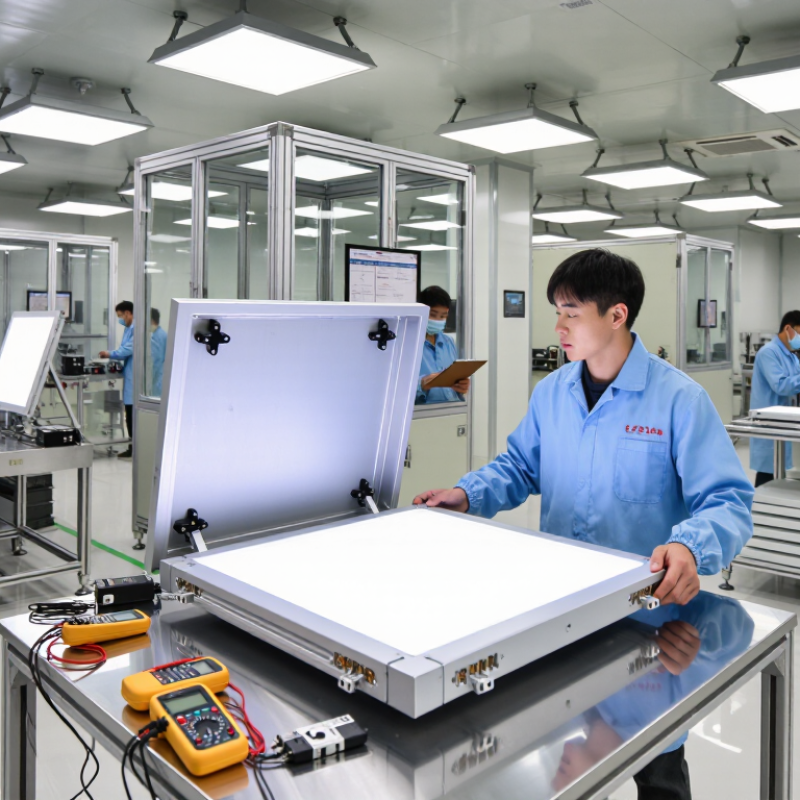
Finding a reliable panel light manufacturer in China starts with a precise requirement sheet. Define the installation area, ceiling type, panel dimensions, wattage, color temperature, beam angle, and dimming method. Include the expected operating hours and local power conditions. These details help manufacturers quote comparable products instead of making broad promises.
My first specification was too vague. I requested “bright, efficient panels” and received samples with different glare levels and housing finishes. That mistake taught me to set measurable standards. Specify luminous efficacy, color rendering, flicker performance, power factor, lifespan testing, and allowable color variation. Ask for photometric files, electrical test reports, and sample measurements from an independent laboratory. Do not rely on a supplier’s catalog alone.
Check the construction closely. A stable aluminum frame, clean diffuser, secure driver connection, and consistent screw placement reveal manufacturing discipline. Request samples from the proposed production line, not only showroom samples. Compare them after several hours of operation. Watch for heat buildup, uneven illumination, buzzing, or visible flicker through a phone camera. Small issues matter.
Use a written acceptance standard. It should define brightness tolerance, color consistency, packaging protection, inspection procedures, and remedies for failed batches. Also verify the manufacturer’s production experience, quality-control records, and ability to provide replacement parts. I would not skip a pre-shipment inspection, even when the sample looks excellent. Factories can change components quietly. That possibility deserves direct questions and documented answers.
Research China’s Main Panel Light Manufacturing Regions
To find top panel light manufacturers in China, begin with regional research. China Customs data show that China exported more than US$60 billion in lighting products in 2023. The China Lighting Industry Association also identifies Guangdong, Zhejiang, Jiangsu, and Fujian as important lighting production bases. These figures describe the wider lighting sector, not panel lights alone. That distinction matters.
Guangdong remains the practical starting point. Zhongshan has dense lighting clusters, while Foshan supports metal processing, diffusers, and commercial fixtures. Shenzhen is stronger in electronics, drivers, and smart-control components. The Pearl River Delta can shorten sampling time because assembly and component suppliers often sit nearby. Zhejiang and Jiangsu deserve comparison. Their factories commonly serve commercial, industrial, and export projects, with stronger access to eastern ports. Fujian may suit buyers seeking flexible production for mid-volume orders.
Regional reputation is not enough. Ask each factory for recent test reports, photometric files, driver specifications, and production photographs. Check whether the reported lumen output matches an independent sample. A 2024 report from the International Energy Agency notes that LEDs dominate global lighting sales, but efficiency claims still vary widely between products. Request LM-80 or equivalent evidence for claimed lifetime figures. Also compare warranty terms, color consistency, heat management, and packaging damage records. My own caution is simple: the cheapest quotation can hide a weaker driver or thinner housing. This map helps, but it is imperfect. Supplier verification remains essential.
Evaluate Manufacturer Experience, Certifications, and Product Range
When searching for top panel light manufacturers in China, do not treat a long company history as proof. Ask how many years they have produced panel lights, not merely traded electrical products. Request factory photos, production records, and recent project references. A useful supplier should explain its testing process clearly.
Certifications deserve careful checking. Ask for current CE, RoHS, or UL-related documents when your target market requires them. Verify that the certificate matches the exact model, driver, and factory address. A copied PDF proves very little. Check photometric files, safety reports, warranty terms, and batch traceability. Small details matter.
Product range also reveals technical capability. Compare sizes, wattages, color temperatures, CRI levels, UGR ratings, dimming options, and emergency versions. Ask whether the manufacturer can provide samples with the same driver used in mass production. Test uniformity, flicker, heat, and installation fit. A broad catalog may hide weak specialization. Years alone can mislead. One overlooked issue is communication. If answers remain vague during sampling, production problems may become expensive later. Leave room for doubt, and inspect before approving.
How to Find Top Panel Light Manufacturers in China?
Suggested evaluation weight for manufacturer experience, certifications, and product range
Use this framework when comparing suppliers: review documented project experience, verify relevant product and management certifications, and check whether the product range covers different sizes, wattages, color temperatures, controls, and installation options. The percentages represent a practical evaluation model rather than data from any individual company.
Compare Samples, Pricing, Production Capacity, and Lead Times
How to Find Top Panel Light Manufacturers in China?
Begin with physical samples, not polished catalog images. Request the exact panel size, wattage, color temperature, driver, and diffuser used in production. Inspect the frame joints, diffuser uniformity, cable strain relief, and heat management. Turn each sample on for several hours. A bright first impression can hide uneven illumination or driver noise.
Compare pricing with a detailed specification sheet. Ask whether the quote includes packaging, testing, tooling, replacement parts, and export documents. The lowest price may reflect a thinner frame or lower-grade driver. Request a cost breakdown, then compare equivalent products. I once saw a quote look attractive until testing and reinforced cartons were added. That changed the decision.
Production capacity needs evidence. Ask for monthly output, active orders, assembly lines, and quality-control checkpoints. A factory claiming high capacity should explain how it handles peak seasons. Request recent production photos or arrange a video audit. Lead times should be separated into sample approval, material preparation, production, inspection, and shipping. For a regular order, obtain a written schedule with buffer days. Delays still happen. A supplier that reports risks early is often more reliable than one promising impossible speed. Check whether quality records, electrical test reports, and corrective-action procedures are available. Do not rely on one successful sample. A sample is only a starting point.
