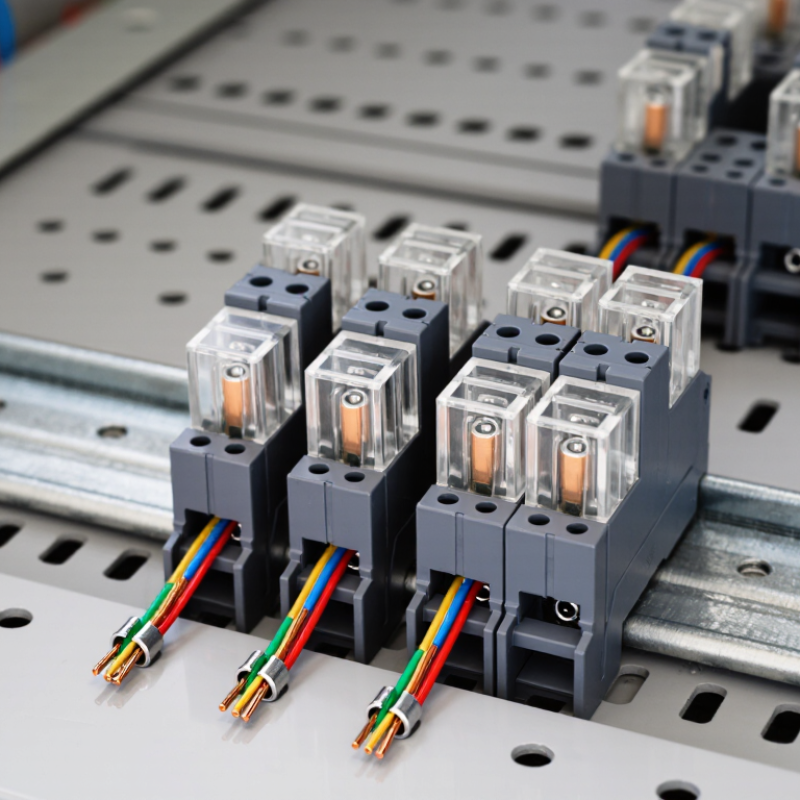
| Screw-clamp fuse terminal block | A fuse is held in a carrier or holder within the block. Screw-clamp terminals connect the field conductors to the protected circuit. | Cartridge fuse sizes specified for the particular block; formats vary by model. | Control cabinets, industrial machinery, and general-purpose control wiring. | Familiar wiring method; conductor size, tightening torque, and fuse compatibility must follow the product specifications. |
| Spring-clamp fuse terminal block | A spring mechanism grips the conductor, while a separate holder or carrier provides access to the fuse. | Specified miniature or cartridge fuse formats, depending on the design. | Vibration-prone equipment, compact control panels, and installations where quick wiring is useful. | Can simplify conductor installation; the permitted conductor type and cross-section depend on the terminal design. |
| Hinged or pull-out fuse carrier | The carrier opens or withdraws to expose the fuse, allowing replacement without removing the entire terminal block. | Fuse format and dimensions matched to the carrier. | Control circuits, instrumentation panels, and circuits where convenient fuse replacement is needed. | Provides access for maintenance; opening the carrier does not necessarily make the circuit safe to touch. |
| Indicator-style fuse terminal block | An indicator provides a visual or electrical signal when the fuse has operated, according to the block’s design. | Specified cartridge or miniature fuse formats. | Distributed control systems, alarm circuits, and panels with many individually protected branches. | Indicator operation and polarity requirements vary; check the wiring diagram and device specifications. |
| Disconnect-style fuse terminal block | A switchable or removable section separates the circuit and incorporates a fuse, enabling isolation for testing or maintenance. | Fuse format matched to the disconnect mechanism. | Measurement circuits, process-control panels, and circuits that require a defined isolation point. | Confirm the device’s isolation function and operating procedure; a fuse alone is not a substitute for an approved isolator. |
| Multi-circuit fuse terminal assembly | Several fused terminals are arranged together, with common supply distribution or individual feed connections as designed. | One specified fuse per protected circuit; formats may be shared across the assembly. | Machine control panels, HVAC controls, and grouped low-power branch circuits. | Supports organized circuit protection; verify current distribution, terminal ratings, and required spacing. |