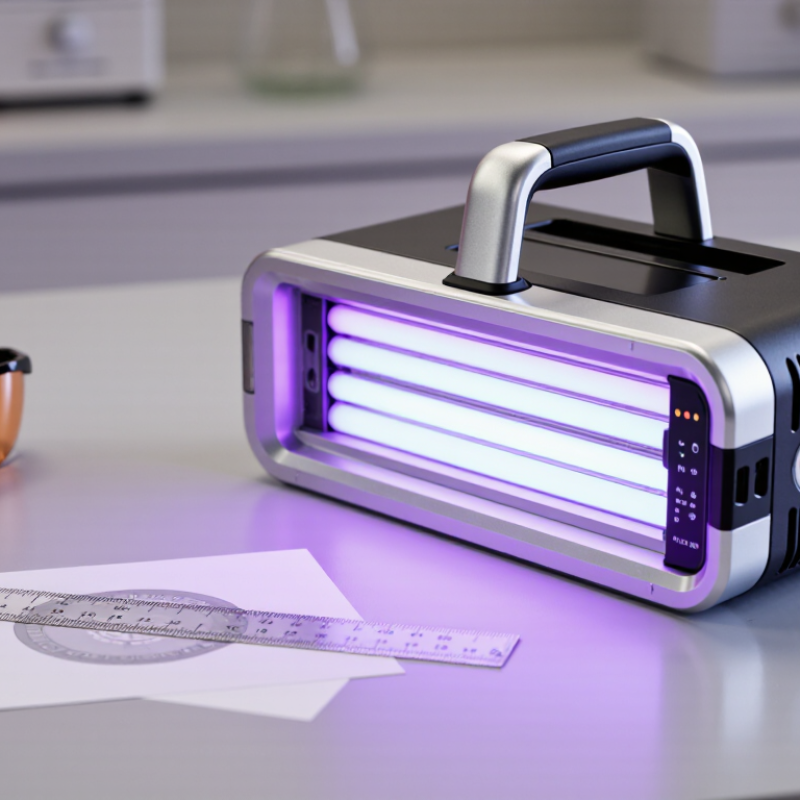
| 1 | Confirm the UV wavelength | Look for a stated wavelength or range in nanometres, rather than relying on a general “UV” description. UVA is commonly defined as 315–400 nm, UVB as 280–315 nm, and UVC as 100–280 nm. | Different UV bands present different exposure hazards. Do not assume a lamp is safe for eyes or skin based on its appearance or intended use. |
| 2 | Check for shielding and direction control | Review product diagrams and instructions for a shielded light source, a directed beam, or a design that limits UV reaching the operator. | Prefer designs that reduce stray and reflected UV. Keep the beam pointed away from people, and avoid direct or reflected exposure to eyes and uncovered skin. |
| 3 | Look for exposure-prevention controls | Check for features such as a timed shutoff, a trigger that must be held to operate, a tilt or motion shutoff, or a contact-activated switch, where appropriate to the product design. | These controls can help reduce unintended operation, but they do not make direct exposure safe. Confirm how each control works in the manual. |
| 4 | Verify eye-protection guidance | Look for clear instructions identifying suitable protective eyewear for the lamp’s wavelength and exposure conditions. Any eyewear specification should state the relevant wavelength range and protection details. | Ordinary sunglasses are not a substitute for eyewear specifically rated for the relevant UV wavelengths. Never look directly at an operating UV source. |
| 5 | Assess skin-exposure safeguards | Check whether the instructions warn against skin exposure and explain safe handling, operating distance, and any required protective clothing or barriers. | UV exposure can injure skin, and some effects may not be immediately apparent. Do not use a UV lamp on people or animals unless a qualified healthcare professional has specifically directed its use. |
| 6 | Ask for safety test information | Look for accessible safety documentation, including relevant photobiological hazard assessment information. IEC 62471 is a standard used to assess photobiological safety of lamps and lamp systems. | A claim such as “tested” is not enough on its own. Check which model was assessed, what the assessment covers, and whether the instructions explain any exposure limits or precautions. |
| 7 | Read the full operating and storage instructions | Confirm the manual describes intended uses, prohibited uses, handling, cleaning, battery or charging precautions, and how to store the lamp securely when not in use. | Choose a product with specific, understandable warnings. Keep it out of reach of children and never rely on visible light—or the absence of visible light—to judge whether UV is being emitted. |