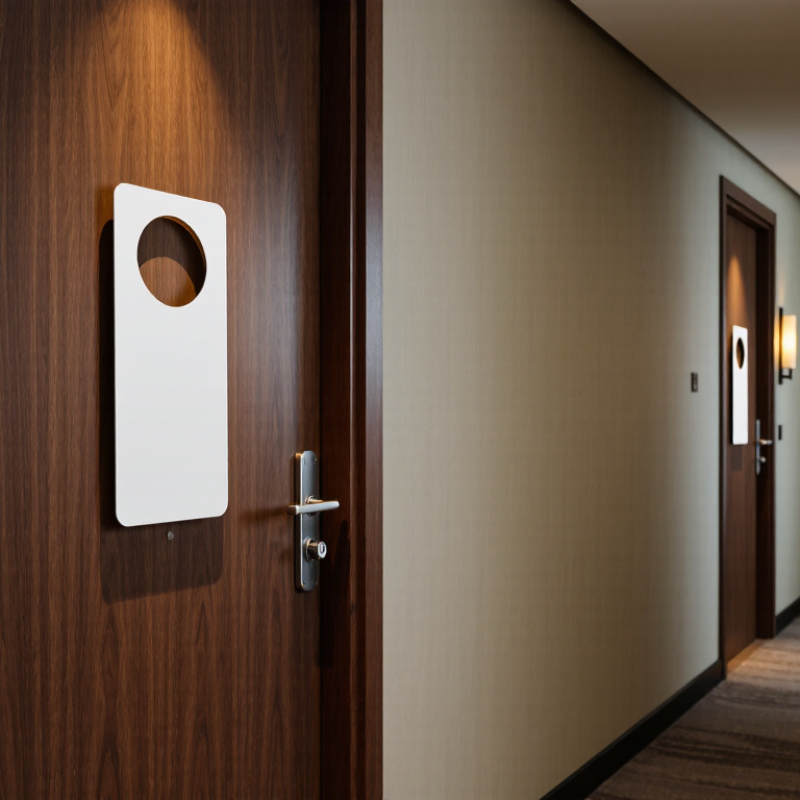
| “Please Make Up Room” displayed | The guest is requesting housekeeping service, subject to staffing and service hours. | How DND Signs Work: Door Hangers, Magnetic Cards, and Digital Alerts A hotel DND sign is a guest’s request for privacy, but the message can travel in different ways. A door hanger is the simplest: guests place it outside, and staff check it while moving along the corridor. It needs no power or training. Yet it can fall, face the wrong way, or be missed during a busy shift. Small details matter. Magnetic cards work similarly, but attach directly to a metal door. They are easy to reposition and less likely to slip off a handle. They still rely on staff seeing them during room checks. Digital alerts send the request to a staff device or housekeeping system, where teams can record the time and status. These systems may help coordinate work, but only if devices stay connected and staff update them. Technology can fail, too. The staffing context makes clear communication especially useful. The American Hotel & Lodging Association’s 2024 survey of U.S. hotels found that 76% reported staffing shortages; housekeeping was the most commonly cited staffing need, at 49%. Those figures do not prove that digital alerts improve service. They do show why a clear, visible DND status can help teams prioritize limited time. A practical setup should give guests an obvious choice and staff a reliable way to notice it. There is a trade-off: digital records offer visibility, while a simple hanger may be easier for every guest to understand. 24-Hour DND Policies: Housekeeping Logs and Guest Welfare Checks What Are Hotel DND Signs and How Do They Work? A “Do Not Disturb” sign tells staff that a guest prefers privacy. It does not always mean housekeeping can skip the room indefinitely. Under a 24-hour DND policy, staff record when the sign was first noticed and any later checks. A log might note the room number, time, attempted contact, and staff member’s initials. Clear records help the next shift understand what happened, rather than treating the door as a fresh mystery. Guest welfare checks should follow the hotel’s written procedure, not an improvised schedule. Staff may call the room or knock and announce themselves before escalating concerns to a supervisor. The details matter: a quiet hallway, a full tray, or a sign left up for many hours can prompt attention, but none alone proves a guest needs help. The American Hotel & Lodging Association’s 2024 industry survey reported that 76% of hotels faced staffing shortages. That makes consistent handovers especially important, though speed should not replace sound judgment. Policies can still feel awkward at the door. Tips: Log each observation with a time, use neutral wording, and brief incoming staff. If the policy sets a welfare-check threshold, follow it consistently and document any exception. Never promise guests uninterrupted privacy beyond the stated policy. AHLA Safety Guidance: Staff Response to Extended Do-Not-Disturb Requests A Do Not Disturb sign protects a guest’s privacy, but an extended request also calls for a consistent staff response. AHLA’s January 2024 hotel survey found that 67% of responding properties reported staffing shortages, and 12% described them as severe. In busy operations, a clear procedure helps prevent a missed welfare concern. AHLA guidance should not be read as one universal room-entry deadline: properties need to follow their own safety procedures and local requirements. Staff can record when the sign was first observed, notify a supervisor, and make discreet contact through the approved channel. A quiet hallway is not proof that everything is fine. Tips: Set a written escalation threshold for prolonged DND requests. Have a supervisor review the room status, check for prior guest contact, and coordinate with housekeeping or security. If a welfare concern remains, use the property’s authorized check-in procedure; do not enter alone or improvise. Document times and actions factually. Keep the guest’s privacy in view. A knock, a brief pause, then a calm announcement can feel far less intrusive than sudden entry. Teams may need to revisit these steps after a near miss; procedures can look clear on paper and still fail during a shift change. NFPA 101 and Local Codes: Emergency Access Beyond the DND Sign A hotel DND sign is a request for privacy, not a promise that nobody will enter. NFPA 101 addresses life safety in buildings, while local fire and building codes may add requirements for emergency access. The exact rules depend on the property, its layout, and the authority having jurisdiction. During a fire, medical emergency, or other urgent threat, staff or responders may need to check a room despite the sign. Safety comes first.
Hotels should explain this boundary clearly during check-in and in guest information. Staff procedures should also distinguish routine service from an emergency response. For example, a housekeeper should not treat a silent room as permission to enter, while trained personnel may follow emergency protocols when there are signs of immediate danger. Details matter. A sign cannot replace clear procedures, staff training, or coordination with local officials. Even well-written policies can be misunderstood under pressure.
Tips: Keep the DND sign visible on the outside handle, and review the hotel’s emergency instructions. If you need help, call the front desk rather than relying on the sign alone. Hotel managers should confirm applicable local requirements with qualified safety officials and explain when emergency access may occur. That conversation is easy to postpone, and it should not be. FAQS It asks staff to pause routine visits and respect your privacy. A small card sets a clear boundary. Staff should avoid entering for ordinary service and follow the property’s procedures. If you need towels, call the front desk or remove the sign. No. Extended requests or safety concerns may lead to an approved check-in. That can feel intrusive, even when staff intend to help. They may note when they saw it, alert a supervisor, and make discreet contact through an approved channel. A quiet hallway proves little. Trained staff or responders may need to check a room during an urgent threat. A sign does not override emergency procedures. Call the front desk with a clear request. A quick call is often better than leaving the sign’s status uncertain. Follow written procedures, coordinate with a supervisor, and record actions factually. Shift changes can still cause mistakes, so teams should review near misses. Ask how prolonged DND requests and emergency access are handled. Local requirements and property procedures can differ. Conclusion Hotel Dnd Signs let guests request privacy and help set clear boundaries for housekeeping and other staff. They may be displayed as door hangers or magnetic cards, or sent through a hotel’s digital system. Whatever the format, the sign communicates a preference rather than an absolute promise that staff will never approach the room. Hotels may record extended requests and follow their own procedures for checking on guest welfare.
When a DND request remains in place for a long time, staff response should balance guest privacy with safety. Hotel guidance may outline when and how to check in, while building safety rules and emergency procedures can require access when there is an urgent concern. Guests can help avoid misunderstandings by contacting the front desk if they need uninterrupted privacy for an extended period or want to arrange a convenient time for room service. |