| Pretreatment and reverse osmosis (RO) | Pretreatment reduces suspended solids, oxidants, hardness, and other contaminants. RO then removes most dissolved salts and prepares low-conductivity feed for the EDI stage. | RO permeate conductivity, pressure, flow, recovery, and feed-water quality. EDI feed limits are system-specific; common design checks include low hardness, low silica, and no harmful residual oxidant. | Trend RO performance and differential pressure; inspect pretreatment equipment and replace consumables based on condition and validated service intervals. Confirm feed-water specifications against the EDI module documentation. |
| EDI feed conditioning | RO permeate enters the EDI module. Flow distribution and, where installed, carbon dioxide management help keep the feed within the module's operating envelope. | Feed conductivity, temperature, flow, pressure, hardness, silica, and carbon dioxide or alkalinity where relevant. | Investigate changes in feed quality before adjusting the EDI module. Check instruments against calibration schedules and review alarms for recurring deviations. |
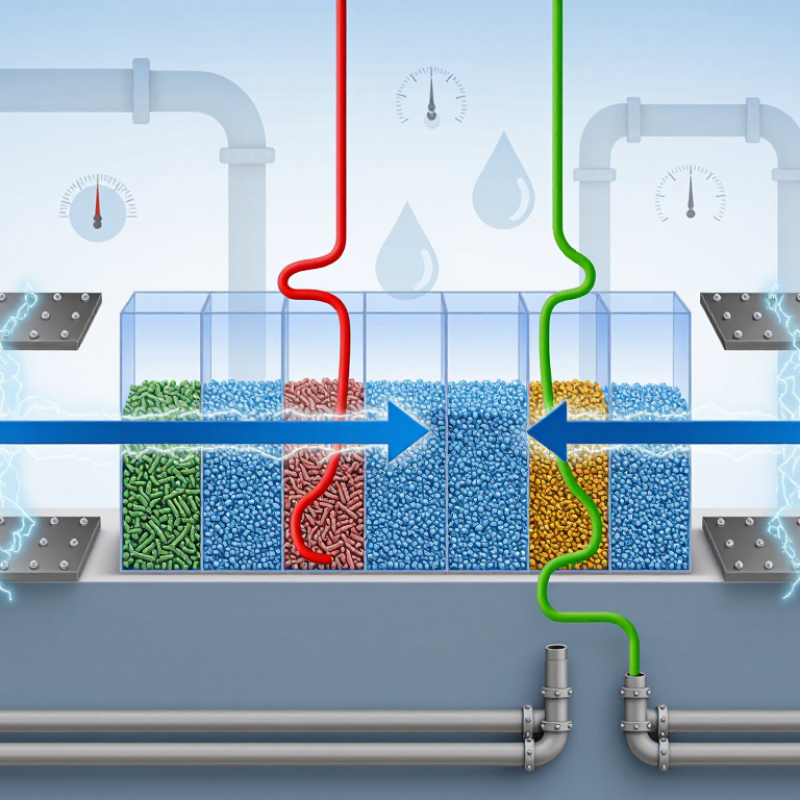
| Ion removal inside the EDI module | An applied direct-current field moves cations and anions through selective ion-exchange membranes into concentrate channels. Ion-exchange resin in the dilute compartments supports ion transport and removal. | Product-water resistivity or conductivity, voltage, current, dilute and concentrate flow, pressure drop, and module temperature. | Compare trends with the module's approved operating limits. A rising product conductivity or unusual electrical reading can indicate feed-quality, hydraulic, instrumentation, or module issues; diagnose before changing settings. |
| Continuous electrical regeneration | The electric field helps split water into hydrogen and hydroxide ions. These ions continually regenerate the resin, so routine acid-and-caustic regeneration is generally not part of normal EDI operation. | Stable current and voltage, correct flow, product quality, and safe handling or venting of gases as specified by the system design. | Do not apply chemical cleaning or regeneration unless the module supplier's approved procedure requires it. Follow electrical isolation and safety procedures for inspection or service. |
| Product-water monitoring and storage | EDI product water is monitored and routed to the point of use or a suitable storage and distribution loop. Downstream treatment may be needed for particular applications. | Conductivity or resistivity, temperature-compensated readings where appropriate, flow, and application-specific quality tests. | Verify sensor calibration and sample-point suitability. Assess storage and distribution hygiene separately; EDI alone does not guarantee microbial control throughout a water system. |
| Routine maintenance planning | Preventive maintenance protects feed quality, stable hydraulics, accurate monitoring, and reliable electrical operation. | Operating logs, alarms, calibration records, leaks, abnormal noise, flow balance, and changes in product quality or pressure drop. | Use a site risk-based schedule: review operating trends routinely, inspect equipment at planned intervals, and service filters, instruments, pumps, and valves according to measured condition and documented requirements. Intervals depend on water quality and system design. |
| Controls and software updates | The control system monitors process values, runs alarms and interlocks, and may record operating data for troubleshooting and quality review. | Alarm history, data gaps, sensor status, control logic, access permissions, and communication faults. | Treat firmware, software, and cybersecurity changes as controlled changes: back up configurations, assess impact, test where practical, document approval, and verify alarms and interlocks after implementation. Install only compatible, validated updates. |
| Performance troubleshooting | EDI performance depends on suitable feed quality, correct flow and pressure, stable electrical operation, and reliable measurement. | Compare current readings with the site's baseline and the module's specified limits; check whether the change is gradual, sudden, or linked to an upstream event. | Check instruments and feed-water conditions first, then hydraulic and electrical factors. Record findings and involve qualified service personnel if performance remains outside approved limits; avoid unsupported set-point changes. |