How to Choose Plastic Candy Stand Up Pouches?
Choosing packaging for sweets involves more than finding a pouch that looks attractive. Candy can be light, sticky, sharp-edged, or sensitive to moisture, and each detail affects how the pack performs. Plastic Candy Stand Up Pouches offer a flexible format with a flat base, a resealable opening, and room for clear product information. Still, one design does not suit every candy.
Start by matching the pouch size and material structure to the product. A handful of gummies needs different space and barrier protection than hard candies or individually wrapped chocolates. Ask suppliers about thickness, seal strength, and food-contact documentation for your intended market. Request samples, then fill and seal them as your packing team would. Check whether the pouch stands steadily, opens cleanly, and closes without trapping candy near the zipper. Small tests matter.
Appearance deserves attention, but it should not lead the decision. A clear window can show color and texture; a matte finish may feel more understated. Yet a window can reduce the protected area, depending on the pouch design. Compare print quality, zipper placement, storage needs, and order quantities before committing. A pouch that looks excellent on screen may wrinkle or tip when filled. That is easy to overlook. This guide explains the practical features to compare, the questions to ask a packaging supplier, and the trade-offs worth reviewing before choosing a pouch for your candy.
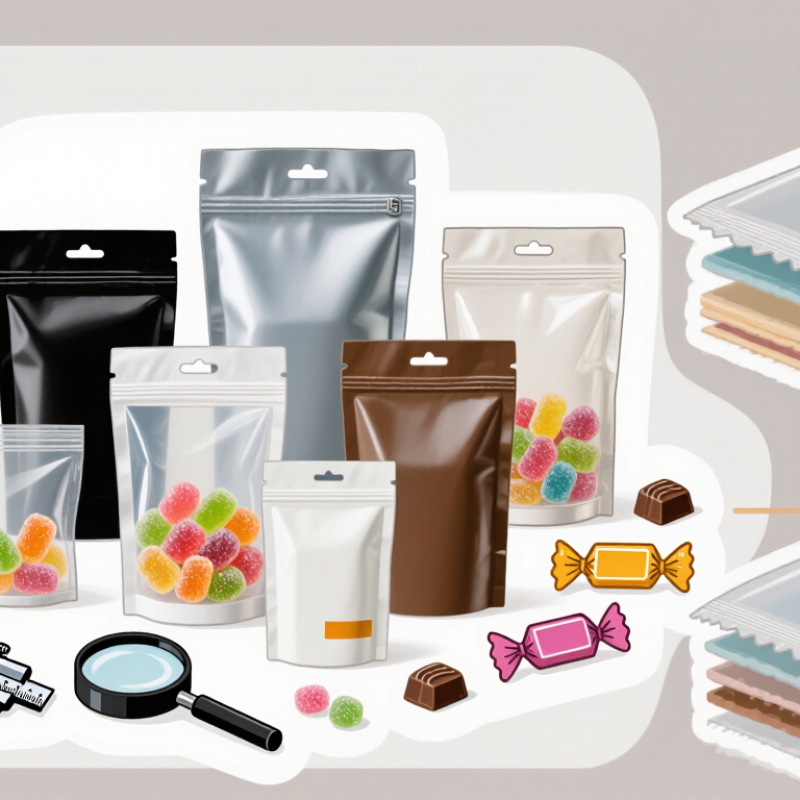
Identify the Candy Type and Its Packaging Requirements
Match the pouch to the candy’s texture and sensitivity. Hard candies can become tacky when exposed to humidity, so prioritize a moisture barrier and a reliable heat seal. Gummies may clump or lose their intended texture in warm conditions; check the recommended storage range before choosing a film. Chocolate-coated sweets need protection from oxygen, light, and heat, while loose sour or sugar-dusted candies can leave residue around the seal. Texture matters. Sharp shapes also deserve attention: they may puncture thin film during transport.
Next, estimate the fill weight and the space each piece needs. A stand-up pouch should hold candy without excessive compression, and its bottom gusset should remain stable on a shelf. A zipper helps shoppers close the pouch after opening, but it does not replace the factory seal. A clear window can show color and shape, though a large window may reduce the area available for protective layers. Small details count.
Before ordering, ask the packaging supplier for food-contact documentation and film specifications suited to your product. Test filled pouches for seal strength, leaks, and handling damage, then store samples under realistic conditions. I sometimes focus too much on barrier performance and overlook how easily a pouch opens; a simple consumer trial can catch that. No single film suits every candy, and actual shelf-life testing is more dependable than assumptions.
Compare Pouch Materials and Barrier Properties
Plastic candy pouches often combine layers because one material rarely provides every useful property. PET can add stiffness and print clarity, while PE commonly provides a heat-sealable inner surface. Metallized films can improve light and moisture protection; foil laminates offer a stronger barrier but may complicate recycling. The Flexible Packaging Association’s 2023 industry report valued U.S. flexible-packaging sales at $42.9 billion, reflecting the format’s broad use—not proof that every structure suits candy.
For sugar-based candy, moisture protection deserves close attention: humid air can soften hard candy or make pieces stick together. Compare water-vapor transmission rate (WVTR) and oxygen transmission rate (OTR), not just material names. ASTM F1249 measures WVTR, while ASTM D3985 measures OTR. Ask suppliers for results with test temperature, humidity, and film thickness; numbers without conditions can mislead. I’d question one assumption: more layers are not automatically better. Product shelf life, seal integrity, light exposure, and disposal options all matter.
Tips: Request samples and test them with your actual candy. Check seals after filling, then assess texture and clumping during storage. Small trials help. A little uncertainty remains until real-world testing.
Choose the Pouch Size, Shape, and Capacity
Size the pouch around the candy’s settled volume, not its net weight alone. Small details matter. A kilogram of airy marshmallows needs more space than a kilogram of dense chocolate pieces. FPA’s 2023 State of the U.S. Flexible Packaging Industry report recorded $42.9 billion in U.S. flexible-packaging sales for 2022. That represented about 21% of the U.S. packaging market. Smithers’ 2023 report, The Future of Flexible Packaging to 2028, forecasts a global flexible-packaging market worth $200.5 billion by 2028. These figures describe the sector, not a pouch-size formula; product testing still decides fit.
Check the pouch’s width, height, and bottom gusset together. A broad base can help a filled pouch stand, while a narrow opening may make small candies awkward to pour. Match the shape to the pieces: round gummies settle differently from long wrapped sweets. Leave headspace for sealing, but avoid excess space that lets candy tumble and break. This is easy to underestimate. Fill sample pouches with the real candy, then weigh them and check how they sit on a shelf. Capacity labels can mislead because pieces vary in shape and bulk density. I would not choose a pouch from a volume estimate alone. Test real samples.
Select Closures and Features for Storage and Display
How to Choose Plastic Candy Stand Up Pouches?
Select Closures and Features for Storage and Display
Candy pouches should protect texture and make repeat access simple. For chewy sweets or individually wrapped pieces, a press-to-close zipper helps keep the pouch usable after opening. Hard candies may need less frequent access, but a reliable heat seal still protects them before purchase. Add a tear notch for easy opening. Small detail. Big difference.
Consider the shelf as well as storage. A clear window lets shoppers see colors and shapes, while a hang hole suits peg displays. The Flexible Packaging Association’s 2023 State of the Industry report estimated U.S. flexible-packaging sales at $44.3 billion for 2023. That figure reflects the format’s broad use, not proof that every pouch suits every candy. Match film barrier properties to the product’s sensitivity to moisture, oxygen, and aroma. A glossy pouch can look appealing, but glare may hide the candy; test it under actual store lighting.
Tips: Fill sample pouches and test the zipper after several openings. Check whether crumbs collect in the seal. Compare window size, pouch stability, and label space on a real shelf. Small trials can catch awkward details before a large order.
Check Food-Contact Safety, Printing, and Supplier Quality
When choosing plastic candy stand up pouches, treat food-contact safety as a purchasing requirement, not a checkbox. Ask for evidence. Request material specifications and relevant test reports for the pouch structure, including any inner sealant layer. Confirm that the documents cover the intended candy, storage conditions, and sales market. A pouch holding sour, oily, or strongly colored sweets may need different material performance than one holding dry hard candy. If the supplier cannot explain the test scope clearly, pause before approving production.
Printing deserves equal scrutiny. Ask which inks and coatings are used, and whether they are suitable for the packaging’s intended use. Color can mislead. Review a physical sample under ordinary shop lighting, not only on a bright screen. Check small text, fine edges, and color consistency near folds and seals. Rub the printed surface gently and inspect it for scuffing. A beautiful mock-up is not proof that a full production run will look the same.
Supplier quality shows up in repeatability. Request samples from a recent production lot, plus details about inspection procedures and defect handling. Compare pouch dimensions, zipper alignment, seal strength, and standing stability across several pieces. Ask how changes in film or printing are communicated. Price matters, but a low quote is less useful if the supplier cannot trace materials or investigate a failed seal. No checklist removes every risk; build in a review step after the first order.
