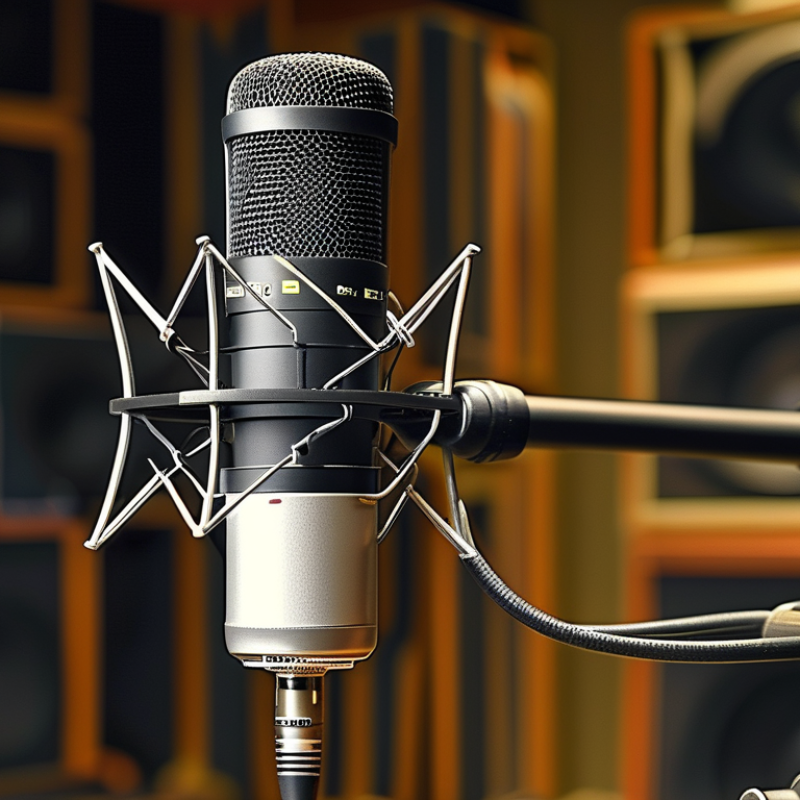
| Solo vocals in a treated room | Large-diaphragm condenser | Cardioid | Frequency response: approximately 20 Hz–20 kHz
Self-noise: preferably below 16 dBA
Maximum SPL: at least 120 dB SPL | Provides detailed high-frequency reproduction and strong sensitivity for capturing vocal nuance. | Use a pop filter, maintain a consistent distance of about 15–30 cm, and position the rear of the microphone toward major noise sources. |
| Voice-over, podcast, or spoken-word recording | Large-diaphragm condenser with controlled presence | Cardioid | Smooth midrange response
Self-noise: preferably below 20 dBA
Sensitivity: commonly around 10–35 mV/Pa | Captures speech articulation and vocal detail while allowing sufficient headroom for expressive delivery. | A quiet room is essential because condenser microphones are highly sensitive. Use an audio interface with clean gain and phantom power. |
| Acoustic guitar and other detailed acoustic instruments | Small-diaphragm condenser or neutral large-diaphragm condenser | Cardioid or hypercardioid | Extended response: roughly 40 Hz–20 kHz or wider
Maximum SPL: at least 125 dB SPL
Fast transient response | Accurately reproduces pick attack, string detail, and short transients without excessive coloration. | Experiment with microphone distance and angle. A higher maximum SPL rating is useful when recording close to the instrument. |
| Stereo recording of piano, ensemble, or room ambience | Matched pair of condenser microphones | Cardioid, omni, or selectable multi-pattern | Consistent frequency response between microphones
Low self-noise: ideally below 18 dBA
Good off-axis consistency | Two closely matched microphones provide a stable stereo image and more predictable left-to-right balance. | Choose a stereo technique such as XY, ORTF, or spaced pair. Room acoustics have a major effect on the final recording. |
| Drums, percussion, and loud amplified instruments | Small-diaphragm or robust large-diaphragm condenser | Cardioid, hypercardioid, or supercardioid | Maximum SPL: preferably 130 dB SPL or higher
Fast transient response
Pad switch: −10 dB or −20 dB preferred | Handles strong peaks while retaining attack and high-frequency detail. | Engage the pad when necessary, keep a safe distance from the source, and check that the preamp does not overload. |
| Recording in an untreated or moderately noisy room | Condenser with controlled off-axis response, or a dynamic alternative | Cardioid or supercardioid | Low sensitivity to room reflections is preferred
Self-noise is less important than room noise control
Strong rear rejection | A directional microphone can reduce some unwanted sound, although it cannot completely remove room reflections or background noise. | Improve the room first with absorption, soft furnishings, and a quiet recording position. Avoid choosing a highly sensitive omni pattern. |
| Natural room, choir, or orchestral capture | Omnidirectional condenser or selectable-pattern condenser | Omnidirectional or wide cardioid | Flat low-frequency response
Low self-noise: ideally below 15–18 dBA
Wide, consistent off-axis response | Omnidirectional designs can produce an open, natural sound and capture room ambience without proximity-effect bass buildup. | Use only in an acoustically suitable space. Omnidirectional microphones provide little rejection of environmental noise. |
| Flexible studio work with multiple sources | Selectable multi-pattern condenser | Cardioid, omni, figure-eight, and intermediate patterns | Multiple polar patterns
Maximum SPL: approximately 120–140 dB SPL
Pad and high-pass filter preferred | Pattern selection allows one microphone to adapt to vocals, instruments, stereo techniques, and room capture. | Confirm that the microphone offers the required controls and that its power supply or interface supports the selected operating mode. |
| Close-miking bass-heavy sources | Condenser with a high-pass filter and sufficient headroom | Cardioid | High-pass filter: commonly 75–100 Hz
Maximum SPL: at least 125 dB SPL
Pad switch recommended | Filtering and headroom help control excessive low-frequency energy and sudden peaks from close placement. | Use the high-pass filter carefully; do not remove useful fundamental frequencies from the instrument or voice. |
| Portable or computer-based recording | USB condenser microphone or compact XLR condenser | Cardioid for focused recording | USB: 16-bit/44.1 kHz is adequate for basic production; 24-bit/48 kHz provides more editing headroom
XLR models require 48 V phantom power | USB models simplify setup, while XLR models provide a more upgradeable signal chain and broader interface compatibility. | Check connector type, monitoring options, driver compatibility, gain control, and whether the microphone needs external phantom power. |